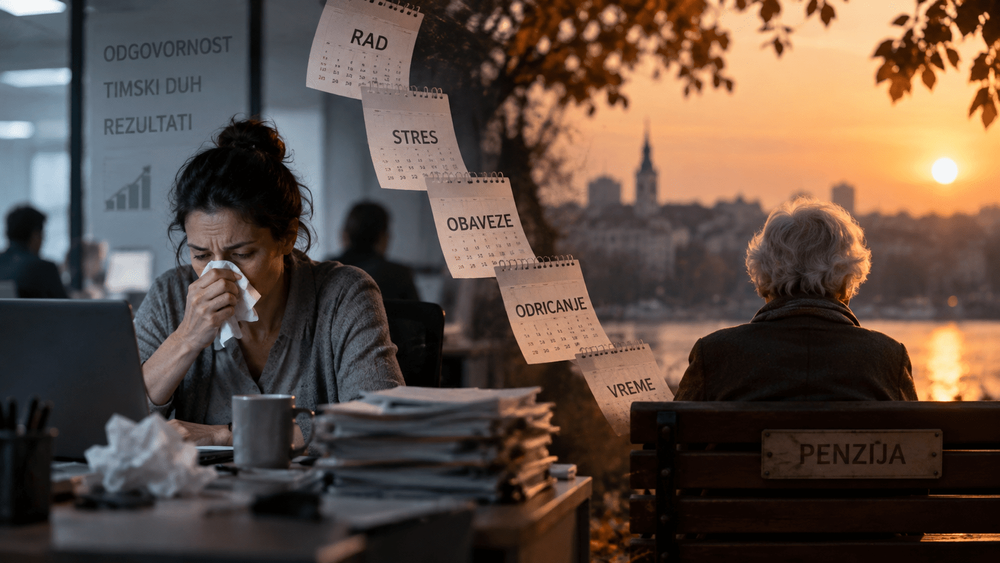
For years, we are told to work while we are young so that one day we can finally live.
But what if, when that day finally comes, we no longer have our health, our energy or the people with whom we wanted to spend it?
There is one strange thing we almost take pride in.
“I’ve never taken sick leave.”
“I had a fever, but I still went to work.”
“I could barely walk because of the pain, but I didn’t want to leave my colleagues behind.”
“I worked even when I was sick.”
In many workplaces, these sentences are not treated as warning signs. They are almost badges of honour. Proof of responsibility. Proof that we are “fighters”, that we are difficult to defeat and that an employer can count on us.
But what is really hidden behind that pride?
Perhaps the fact that we have learned to treat our own health as something expendable for the sake of work.
Then, one day, when retirement finally arrives, we suddenly want to recover everything we spent over the years.
We look for a way to become young again.
We search for the right supplement, therapy, treatment, operation, rehabilitation, an “elixir of youth”.
We look for another twenty years of energy.
And our body reminds us of what we spent decades trying to ignore.
Sick leave is not weakness
Perhaps we need to change one dangerous social message: taking sick leave is not an absence of responsibility.
Sometimes it is exactly the opposite.
Staying at home when we are ill can be an act of responsibility towards our own health, our family, our colleagues and the people to whom we could transmit an infection.
Going to work while sick is not automatically proof of dedication.
Sometimes it is simply proof that we have created a society in which people fear they will be worth less if they become ill.
And that brings us to an uncomfortable question:
Why are we proud of having been sick at work?
Why is “I never took sick leave” spoken as though it were a medal?
No employment relationship can return the sleep we have lost, the health we have neglected for years or the time that has passed.
And that does not mean every employer is a bad person.
It simply means that work is not a family relationship.
The employer runs an organisation.
We have one life.
Work can continue without us. Our body cannot
This may be one of the most important lessons we need to learn.
When we become ill, work will usually find a way to continue.
Someone will take over our shift.
Someone will answer the email.
Someone will finish the project.
The company will reorganise the work.
But our body has no substitute worker.
If we push it beyond its limits for years, the consequences remain with us.
That is why a culture in which absence due to illness is treated as weakness, while coming to work with a fever is treated as heroism, is particularly troubling.
Such a culture does not produce healthier workers.
It produces people who postpone confronting their own health.
And postponing a problem is not the same as solving it.
Medicine has no concept of “I’ll just make it to retirement”
The human body does not function according to years of service.
There is no internal agreement that says:
“Hold on for another five years, and after retirement we will fix everything.”
Long-term stress, lack of sleep, physical overload, insufficient movement, poor diet, shift work and occupational exposure to different hazards can leave lasting effects on health.
Some consequences develop gradually and remain unnoticed for years.
Then retirement comes.
And for the first time, a person has time.
But no longer has the same body.
For the first time, there is no obligation to get up at six in the morning.
But the knees hurt.
For the first time, there is time to travel.
But health makes it difficult.
For the first time, there is more time for family.
But not enough energy.
For the first time, there is freedom.
But much of it is spent going from one doctor to another.
That is the cruel irony of a model in which we have been taught to postpone life until later.
“I was saving myself for retirement”, but what if we were not?
When we talk about health, we often ask the individual:
Do you exercise enough?
Do you eat well?
Do you attend preventive medical check-ups?
Do you sleep enough?
All of these are legitimate questions.
But there is another question we ask far less often:
What conditions has society given you to make any of that possible?
If someone works a physically demanding job for ten hours a day, takes care of children, spends a long time commuting and lives with insecure income, it is difficult to reduce their health to a question of personal discipline.
Health is a personal responsibility.
But it is not only a personal responsibility.
Health is also shaped by working conditions, income, education, housing, access to healthcare and social security.
“Taking care of your health” therefore means something very different when you control your own time than when almost your entire day is organised around work, caring for others and survival.
Retirement is not a reward for how much we endured
We often imagine retirement as a reward.
As though society were saying:
“You have worked enough. Now you are allowed to live.”
But why should a person have to earn the right to live?
Why should free time, family, culture, travel, recreation, friendships and personal development begin only when we are no longer economically productive?
Retirement should represent the right to a dignified old age, not a reward for how well we endured poor conditions.
And that is precisely why this is not merely a question of lifestyle.
It is also a question of human rights.
The right to health.
The right to rest.
The right to safe and healthy working conditions.
The right to social security.
The right to family and private life.
The right to dignity.
These are not privileges a person receives when they stop working.
They are rights that should be enjoyed throughout life.
We do not protect our health while working, then we try to buy it back
Perhaps this is the heart of the problem.
During our working lives, we often treat health as something we can spend.
“Just today.”
“Just this week.”
“Just until I finish the project.”
“Just until the season is over.”
“Just until I reach retirement.”
And when retirement finally arrives, we realise that health cannot simply be restored by making a decision.
That is when the search for the elixir of youth begins.
For the pill that will restore our energy.
For the treatment that will restore our mobility.
For the therapy that will undo the consequences of decades.
But medicine is not a time machine.
It can treat, slow down and improve many things.
It cannot give us our years back.
Not all workers reach retirement with the same body
There is another injustice we do not discuss enough.
Not everyone spent forty years doing the same kind of work.
Someone worked at a computer.
Someone worked in a factory.
Someone on a construction site.
Someone in healthcare.
Someone worked nights.
Someone lifted heavy loads for decades.
Someone worked with chemicals, noise, dust or extreme temperatures.
Someone carried other people’s responsibility, emotional exhaustion and stress every day.
And in the end, everyone receives the same label: retiree.
But their bodies do not enter retirement in the same condition.
That is why retirement justice cannot be only a question of money.
It must also be a question of healthy years of life.
How many years after retirement can a person genuinely live independently, move, travel, socialise, care for themselves and do the things they love?
Perhaps the quality of the years after retirement matters just as much as the number of years we live.
We do not need a life that begins at 65
Perhaps it is time to abandon the idea that life has three stages:
education, work, life.
Why should the final stage begin only with retirement?
A person needs a life at 25, 35, 45 and 55.
They need rest, family, friends, health, culture, recreation, love, sleep, meaning and time for themselves.
We cannot spend forty years telling people that “one day” they will have time and then be surprised when old age brings chronic illness and too little energy to use that time.
A society that wants healthier old age must begin building it while people are still working.
Not with supplements.
Not with miracle treatments.
But with better working conditions, prevention, accessible healthcare, the right to rest, protection of mental health, early intervention and a culture in which sick leave is not a source of shame.
Perhaps responsibility looks exactly the opposite
Perhaps we should no longer be proud when we say:
“I have never taken sick leave.”
Perhaps a healthier sentence would be:
“When I was sick, I stayed home and recovered.”
Because a worker who takes sick leave has not betrayed the job.
They have protected themselves.
And a company that can function while one person is sick has shown that it is organised.
A company that cannot function without a person who has a fever may not have a problem with that worker’s responsibility.
It may have a problem with its own organisation.
That is why we should stop glorifying exhaustion.
Ignoring your own body is not courage.
Becoming ill because of work is not responsibility.
Reaching retirement at any cost is not success.
Real success would be reaching it with as much life preserved within us as possible.
Because an employer may be able to find someone to replace us at work.
But there is no replacement for our body.
There is no replacement for our health.
There is no replacement for the years we have lost.
And there is no pension that can return a life we spent decades postponing.
So the question is no longer only:
“How much will our pension be?”
We should also ask:
“In what condition will we reach retirement?”
And perhaps even more importantly:
Is society’s goal simply to provide a person with a pension, or to make sure they do not have to wait for retirement to have the right to a life?
Comments