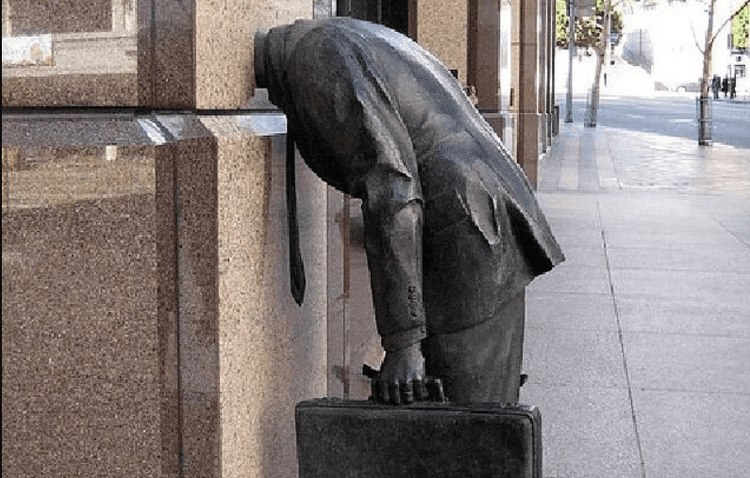
Canadian author Alain Deneault, in his book Mediocracy (La médiocratie), develops the thesis of the rule of mediocrity in the contemporary world and, through different social spheres, explains how mediocrities, rather than average people, have effectively taken control of all areas of life. The book is not a critique of ordinariness, but a critique of a system in which the most desirable person is the mediocrity. The idea itself is not new at all and can be found as far back as the ancient world. The famous robber Procrustes from Greek mythology offered travellers a place to spend the night, but the bed in his inn was of a length that Procrustes considered perfect. Every guest had to fit that bed, so the tragic Procrustes would cut off the legs of those for whom the bed was too short and stretch the bodies of those for whom it was too long. The critique of uniformity and conformism, therefore, is not a new idea. What is new is the idea that mediocrities are responsible for the decline of contemporary societies.
In his book, Deneault also introduces something he calls the politics of the extreme centre, something ordinary people might call the politics of “don’t rock the boat”. Politics and political positions are declared harmful, radical and dangerous, while depoliticization becomes a kind of “penicillin” for every illness that appears in society. Our late actor Milan Lane Gutović once described, very briefly, in a television interview why mediocrities as such are desirable to every ruler. In his analysis, delivered with a dose of sarcasm and irony, Gutović says that a stupid person is of no use because he will cause damage to the person holding power, but that an intelligent person is equally harmful because he will understand what the “ruler” is doing. So the search begins for someone resembling a barber’s chair, someone suited to every backside. What is sought is the one who nods, the one who confirms and, ultimately, the one who can easily be removed because he poses no threat to the current holder of public office.
Our society has become the embodiment of the rule of the extreme centre, of fighters against politicization and, of course, of an exclusive struggle for personal interest. All these phenomena are closely connected, and it is practically impossible for one to appear without simultaneously seeing the roots of another. The aim of this text is to show how the mediocrity wages war against political positions, how he establishes the rule of the extreme centre and how, in the end, he places his personal interest as the supreme moral norm to which he adapts the whole of society.
PROFILE OF THE DEPOLITICIZER
The mediocrity in our text is older than 35 but younger than 55. He therefore makes up a relative majority of the working-age population. He has a secondary education, while higher education was obtained somewhere, somehow, in some way. For most people, it does not even matter how, but there is some diploma, some title. It was a requirement for a managerial position, so our mediocrity hurried to obtain it. Naturally, he is an active member of the ruling party. It does not matter which one, as long as it is in power. It can be right-wing, left-wing, large, small, minority-based or majority-based, but what matters is that it governs. That is where our mediocrity draws his strength from.
Although he is a mediocrity, our character certainly does not consider himself part of the people he represents. He or she is, of course, above that “simple crowd” they represent. We are not talking here about how things actually are, but about how our mediocrity sees them. It is obvious to the reader that our character is very much part of the people he represents, and quite often among its worst elements.
He is moderate and holds no radical views. In fact, he has no political views at all, because the position of the extreme centre is precisely that: the absence of values and positions. Everything is extreme to our mediocrity, even political opinions themselves. Everything has been politicized; he or she would like to depoliticize it, while at the same time, of course, clinging ferociously to corrupt schemes and business arrangements.
A common feature of our mediocrity is that, on a declarative level, he holds very strong moral positions, often rooted in religion, while at the same time behaving immorally toward everyone who is not mediocre. Stupidity is mocked, intelligence is demonized and marginalized, and conformism is celebrated.
Among our male or female mediocrities, petty-bourgeois habits and all the phenomena that accompany such behaviour are not uncommon. Very often, he or she has some hobby intended to demonstrate that they are “above those simple people”, so our female mediocrity may sometimes be some sort of average painter who manages masterfully to combine artistic freedom with party obedience. Abstract art becomes the perfect tool: “those awful simple people” do not understand it, while she still gives the impression of creativity. At the same time, the party guarantees privileges, and that must never be forgotten.
Anyone who notices this and says it differently is slandering and lying, and holds radical positions, while our female mediocrity remains there in that extreme middle, trapped by herself and too vain to admit it.
The absence of political positions and values does not prevent our mediocrity from holding very strong positions when personal interests are concerned. In fact, once everything has been depoliticized, what remains is naked personal interest. That is why the mediocrity must not have political convictions, because, in his view, they could endanger his interests.
We believe that our mediocrity is proud of everything he has achieved, while remaining completely unaware of his own replaceability. The mediocrity as such is an absolute category. One cannot be more or less mediocre, nor is there any possibility of improvement. That is precisely why every system needs him: he is very easily replaceable.
The preceding lines describe, in a mildly comic way, how mediocrities shape our society and why they are so attached to their personal interests. There is a saying I heard a few years ago which, ironically, claims that everything passes and only interest is eternal. The irony of that saying describes the reality our society is now living through. The politics of the extreme centre has consolidated the rule of mediocrities; they have further consolidated the position of the centre, declared everything radical and dangerous and, completely unaware of the scale of their own ignorance, proclaimed politicization to be a contemporary disease of our society. Every criticism is politicization. Everything must be depoliticized, everything must be politically sterile, while personal interest has been proclaimed the supreme deity, whether that interest is office, money or fame. The more mediocrities depoliticize everything, the more tightly they cling to the extreme centre and, paradoxically, the more they lose their own position. As the saying goes: what we chase runs away from us; what we run from catches up with us.
Depoliticization as such is itself a political nonsense, because depoliticization is itself a political position. It must be noted that freeing institutions from party influence is certainly desirable in a democratic society, but depoliticization is fundamentally impossible. We are never free from politics and political positions at any moment of our lives because the very act of being born is shaped by political decisions. A baby is born in a maternity hospital shaped by healthcare policies; a mother who chooses to give birth at home again does so, in part, because of certain political positions of her own. Our education, our jobs and our family relationships are permeated by political decisions. Only death, as such, is depoliticized because, in the vast majority of cases, we do not decide when we die; only that act is free from relations of power and politics. Unfortunately, there are exceptions, where people take their own lives, in part because of political positions. Politics, political decisions and relations of power within political relations are inherent to human beings themselves.
For all these reasons, the human being is by nature a political being, and to depoliticize a person is to deprive them of something fundamentally human. One therefore cannot be human, cannot act humanely, while demanding depoliticization. It is either humanity or depoliticization. The third option, which attempts to combine the first two, is animalistic and inhuman.
Comments