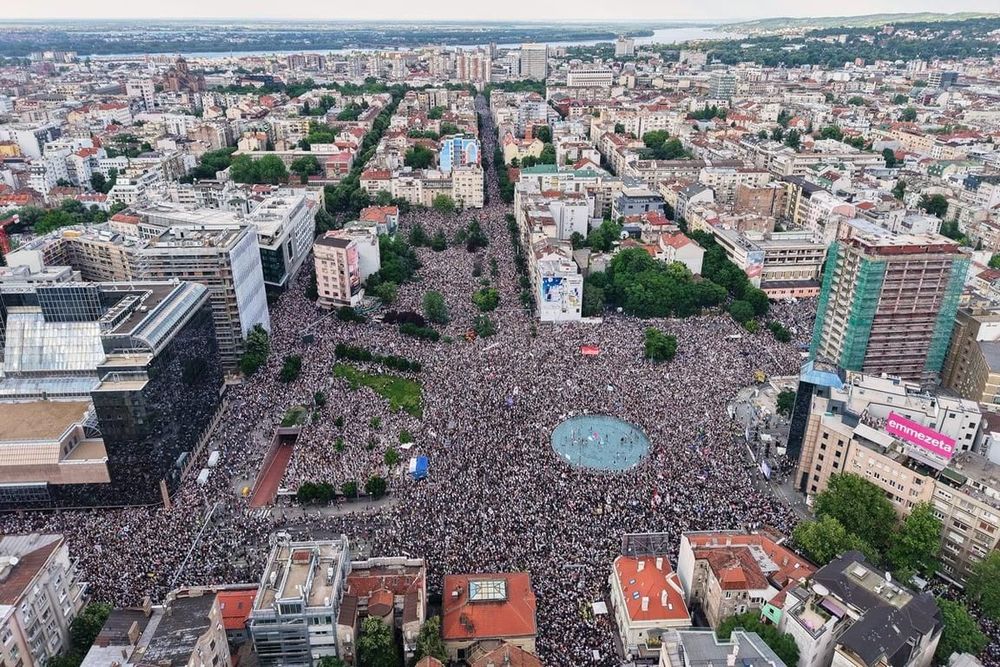
In light of the upcoming parliamentary elections and the evident polarisation of Serbian society, the question of a possible escalation of relations within society and a potential civil war is once again being raised, meaning an armed conflict between supporters of the SNS, or Aleksandar Vučić, and supporters of the Student List, namely the student movement formed after the collapse of the canopy at the Novi Sad railway station less than two years ago.
While supporters gathered around Aleksandar Vučić are called “ćaci”, supporters of the students are called “blokaderi”. Recently, tensions have become more frequent, and an increasing number of social analysts speak of “unbelievable divisions” within Serbian society, as well as “tensions threatening to spill over into civil war”.
The aim of this text is to show that although Serbia has a high degree of political and social polarisation, it will almost certainly not develop into a civil war.
DEEP DIVISION DOES NOT MEAN CIVIL CONFLICT
Supporters of this thesis on both opposing sides speak of unprecedented polarisation within Serbian society and frequent physical clashes between the two opposing sides, which genuinely do occur. This is certainly not good in itself, but at the same time it is no proof that society is heading towards civil conflict. Quite the opposite, a society can remain highly polarised for many years without such polarisation ever leading to an actual civil war.
Good examples are Israeli and American society. Although Israeli society contains a high degree of division, including social groups that barely have any contact with one another, civil war simply does not occur. American society has been extremely polarised for nearly a decade, yet civil war has not occurred there either. Although society is deeply divided over support for the current president Trump and his policies, although there are numerous protests and although both populations engage in fierce verbal confrontation, civil war does not occur.
Although the situation in Serbia is different, the possibility that current political polarisation will develop into civil war is also very small. The mere existence of deep divisions, strong political antagonism and occasional physical clashes is not enough to conclude that society is heading towards armed conflict. Such a scenario requires much more than political hatred and social division.
BOTH SIDES ARE VICTIMS, BOTH SIDES ARE AGGRESSORS
First of all, one point that connects both “ćaci” and “blokaderi” must be highlighted: the status of victim that both groups assign to themselves, which is also one of the main factors preventing the creation of conditions for civil war. A section of citizens supporting the students constantly says that they are victims of the current system, namely the personal regime of Aleksandar Vučić and the “ćaci” who assist him in exercising personal power. On the other hand, citizens who support Vučić simultaneously claim that they are victims of the “blokaderi”, who spent the previous two years blocking the whole of Serbia and attempting to “harm the state”. Both sides want the status of victim, but at the same time provoke the other side into conflict and occasionally engage in physical clashes. Both sides simultaneously regard the other as treacherous, while their own side is tasked with saving Serbia.
Consequently, both sides draw their strength from right-wing narratives, meaning nationalism serves as the ideological base of both groups. This can be seen quite easily through the ideological positions of both groups. The anniversary of “Operation Storm” and the beginning of the NATO bombing are commemorated, while the genocide in Srebrenica is met with silence. The Student List, like the SNS, opposes introducing sanctions against Russia, while both are uninterested in events in Gaza. Neither the SNS nor the Student List has clearly condemned Israel’s actions in the Gaza Strip or described them as genocide. The SNS and the Student List have very similar attitudes towards Republika Srpska and Bosnia and Herzegovina, and students recently went on a “visit to brothers on the other side” of the Drina.
Although the Student List seeks to present itself as a non-ideological movement focused “on the system in Serbia”, precisely this lack of definition contains its ideological orientation. An individual or group that does not identify ideologically but wants to be popular within a community automatically accepts the dominant narrative of that community. In Serbia, that narrative is right-wing, namely Serbian nationalism.
Thus, both sides are nationalist and both want the role of victim so that they can “save Serbia from traitors”. However, this brings them into conflict with their own narratives. When both sides represent the same ideological narrative, it becomes impossible for either side to use violence as a means of achieving a political objective. Paradoxically, in seeking the role of victim, both sides become victims, but victims of their own actions, because violence becomes legitimate only if the other side is at least ideologically different, which is certainly not the case here. Tensions rise and society becomes polarised, but armed conflict is impossible.
The absurdity of this situation could be seen in the summer of 2025 during numerous physical confrontations between supporters of the student protests and the SNS. During many encounters between them, “blokaderi” called “ćaci” “Šiptari”, while from the other side came shouts of “Ustaše!”. Thus, both sides consider the other side treacherous in relation to the nationalist narrative and use phrases employed in right-wing circles as insults against the Albanian and Croatian populations.
The absurdity is that members of the Serbian people stand on both sides, a population that is itself highly hostile towards both “Šiptari” and “Ustaše”. Thus, any legitimacy for the use of violence is lost, because both sides delegitimise themselves as potential targets for confrontation. Paradoxically, in their desire to become victims, both sides become a kind of “passive aggressor”, aggressors unable fully to fulfil their role.
This further produces frustration, which increases the gap within society but also strengthens the right-wing narrative. Both sides consequently become more aggressive and “more nationalist” and more convinced that the other side is betraying Serbia, continuing the vicious circle of victimisation and aggression.
The latest example is the physical confrontation between the mayor of Belgrade and supporters of the “Kreni-promeni” movement. The public remains fairly confused as to whether Šapić was provoked and, in self-defence, accidentally struck a woman, or whether he was the one who chose to attack. The author stresses that such a situation can in practice continue indefinitely, because the pattern is simply such that genuine violence involving larger numbers of members of both groups cannot occur.
IF THERE ARE NO TWO SOCIAL GROUPS, THERE IS NO CIVIL WAR
The next argument supporting the claim that civil war is almost impossible is the fact that, in addition to the very similar, if not identical, ideological narrative represented by supporters of both sides, the two sides are not politically, economically or socially distinct classes either. It is evident that both sides include members of different nations and religions, meaning this criterion cannot become a trigger for conflict. Politically, although both sides rely on right-wing narratives, both sides are simultaneously supported by “the right and the left”, liberals and conservatives alike, while what “ćaci” or “blokaderi” actually mean ideologically remains unclear.
Furthermore, from an economic perspective, a conflict based on economic stratification is also impossible. At the very beginning, the student movement did call for a general strike, but it never fundamentally gained support among the working population. We therefore cannot say that the majority of support comes from the “disenfranchised working class”. Students are supported both by workers and owners of capital, by neoliberals as well as the far left. Another paradox is that a large proportion of “disenfranchised workers” in Serbia support the SNS and Aleksandar Vučić’s policies, meaning a large share of SNS support comes precisely from the “working class”.
Generationally, however, there are some differences, because a large proportion of young people favour the students, while the middle-aged population and pensioners favour the students. Yet even here it is questionable to what extent any larger conflict could arise, because there is no ideological conflict of that kind. We can have a family in which everyone is right-wing, but the young support the students while the older members support the SNS, or everyone may be left-wing and the same division of support may still exist. Thus, the generational difference exists, but it becomes irrelevant if there is no ideological difference.
Finally, in the broader social sense, it is still impossible to determine which parts of society support the SNS and which support the students. If we were to speak of a rural-urban conflict, the situation is unclear there as well, especially following large student actions in Serbian villages. If we instead speak of more progressive or more conservative sections of society, we again cannot draw a clear dividing line. Many relatively progressive individuals can be found within the ranks of the SNS, while many conservatives support the students, and vice versa.
The situation is similar regarding the liberal-authoritarian divide. Here too, a clear dividing line simply cannot be drawn. If there is no clear social, economic, political or ideological boundary between two groups, then it is difficult to speak of two clearly formed social sides capable of becoming two opposing camps in a civil war.
GOOD AND EVIL ARE NOT POLITICAL CATEGORIES
The author of this text remains confused by the division between “ćaci” and “blokaderi”. It is clear that morality is involved and that supporters of the students see the “ćaci” as morally corrupt, backward and fundamentally bad, while supporters of the SNS see the “blokaderi” as mercenaries trying to drag Serbia backwards and, again, as fundamentally bad. However, the author observes that the very division into good and bad is essentially absurd and impossible, cannot resolve anything and certainly cannot lead to civil war.
Moral categories such as “good” and “evil” are clear and possible in wartime, when one side must be characterised as evil in order to raise morale and thereby influence the outcome of the war. Using the division of “good versus evil” in peacetime, without any political definitions of what is good and what is evil, can only further confuse the population of a country and destroy the political process as such. We are therefore not talking here about the destruction of democratic political processes, but about the destruction of political processes as such.
By introducing good and evil, normal and abnormal, human and inhuman into political space, we destroy the political process itself, which cannot integrate these terms at the level of political values. Good and evil, human and normal, right and wrong are not political categories and cannot become political categories. This kind of “institutionalisation” of non-political categories within politics can dismantle the political process itself without showing what the alternative is.
Foreign centres of power can benefit from the destruction of political processes because the legitimacy of power on domestic ground is being dismantled, as can military and security circles that in any case do not concern themselves with political processes. The point here is therefore that although civil war is not possible because there is no adequate division of society, political processes themselves can be destroyed, opening the door to non-political forms of action that may operate from abroad or from within the state itself, especially from security and military circles.
A BOUNDARY THAT IS EASY TO CROSS
The next argument supporting this thesis is the relatively easy transition from one group to the other, meaning the ease with which one of the “ćaci” can become a “blokader” and vice versa. Because the rules are not clearly defined and are explicitly linked to support for or opposition to the policies of Aleksandar Vučić and the SNS, crossing from one side to the other is relatively easy and carries no major consequences.
Both groups are prepared to “accept” those who change their minds because they have “recognised the truth”, although the very ease of moving from one side to another says a great deal about how different the two groups actually are. The author observes that readers of this text probably know many people in their own surroundings who have been “changing sides” during the previous two years, meaning that after assessing the situation in society, they position themselves on whichever side currently appears more beneficial to them.
This fact alone is enough to call the polarisation itself into question. If the boundary between two supposedly irreconcilable groups can be crossed relatively easily, the question arises of how deep this division really is, how much it represents a genuine social conflict and how much it is merely temporary political alignment.
THERE IS NO SECOND ARMED SIDE
Finally, we arrive at the key element, namely control over physical force, which remains firmly under state control and shows no signs of being divided. A genuine civil war requires armed conflict, and members of the armed and security forces themselves, including the police, military, security services and so on, would need to split into two groups. This has not occurred at any point, nor is there any certainty that it will.
Of course, armed conflict can occur without a split within the apparatus of physical force, but some factor within society would have to exist that at least indirectly pointed in that direction, and there has so far been no trace of such a factor. There are exceptions and individuals prosecuted by state authorities for a potential attack on the constitutional order and similar criminal offences, but there has been no more organised activity, nor can there fundamentally be any.
The paradox preventing this final step is that the other group must be regarded as different and therefore declared an enemy, which is precisely what both groups claim. Yet returning again to the same arguments, the groups are very similar politically, economically and socially, making any armed conflict difficult to imagine because even if it did occur, there would be no way to distinguish members of one group from members of the other.
This further confirms the thesis that civil war in Serbia is almost impossible: there are two politically opposed groups, but there are not two clearly separated social communities, two ideologically clearly defined sides or two organised structures capable of conducting armed conflict. Polarisation may therefore be deep, tensions may increase and physical clashes may recur, but there remains an enormous difference between all of that and civil war.
FROM POLARISATION TOWARDS A PRE-POLITICAL CONDITION
Serbia is not heading towards civil war, but towards something that may appear less dramatic at first sight yet is much more dangerous in the long term: an endless political war without a clear front, without a clear ideology and without a genuine political outcome. The two sides may continue for a long time to accuse each other of betrayal, deny one another legitimacy and present every new crisis as the final confrontation. But polarisation alone does not produce civil war. Civil war requires organised structures, willingness to engage in sustained violence and the collapse of institutions that keep political conflict within the boundaries of politics.
Serbia’s problem is precisely that conflict is generally conducted against someone rather than for something. One side builds its legitimacy on resistance to the other, while the other builds its legitimacy on defence against the first. Between them remains an empty space where there should be a clear ideology, political programme and vision of the kind of society they actually want to build. As long as this remains absent, tensions can continue almost indefinitely. One protest will replace another, one election another, and each new crisis will simply become another episode of the same conflict.
This conflict will therefore not end when one side finally “destroys” the other. It will end only when one of them is forced to leave the comfort of simply negating its opponent and define itself ideologically: to say what it is, what it defends, what it rejects and what kind of Serbia it wants to build. Until that happens, Serbia will remain trapped in the worst kind of polarisation — a political conflict strong enough to divide society, but not clear enough to change it.
And this is where the greatest danger lies. If citizens spend years watching politics reduced to conflict, accusations, betrayal, blockades and struggles for domination rather than competition between different ideas and programmes, what little trust remains in the political process itself may be destroyed. The problem will then no longer be only who wins the next election. The problem will be that an increasing number of people will stop believing that anything can be resolved through politics.
And a society that loses faith in the political process begins to seek solutions outside politics, outside institutions and outside rules. This is precisely how Serbia could be permanently pushed back into a pre-political condition — a society in which what matters is no longer who has the better programme and stronger argument, but who has the stronger group, greater loyalty and greater ability to impose their will.
Comments