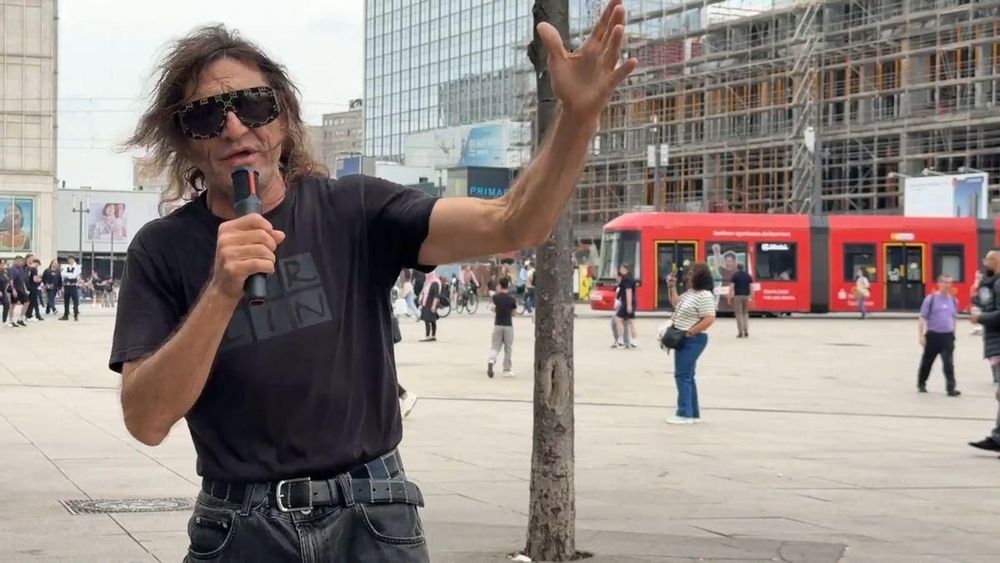
There is something faintly ridiculous about the idea that a man with a portable speaker and a microphone might have stumbled onto a small answer to one of the great problems of modern life.
No manifesto. No movement. No political theory.
Just music... and dancing... and twenty minutes.
In Berlin, Yakup, better known as MrBerlinParty, has developed a peculiar talent for turning places where people normally hurry past one another into places where they stop.
On Alexanderplatz, in the U-Bahn, around the city's streets, he appears with his music, his microphone and his extravagant energy, and begins doing what he calls his work: getting people to party. His appearances typically last around 20 to 30 minutes. He has become a familiar street figure and an increasingly viral social-media presence, but the thing that is most striking about him is not his online popularity.
It is what happens to the people around him.
They smile.
Then somebody dances.
Then somebody else.
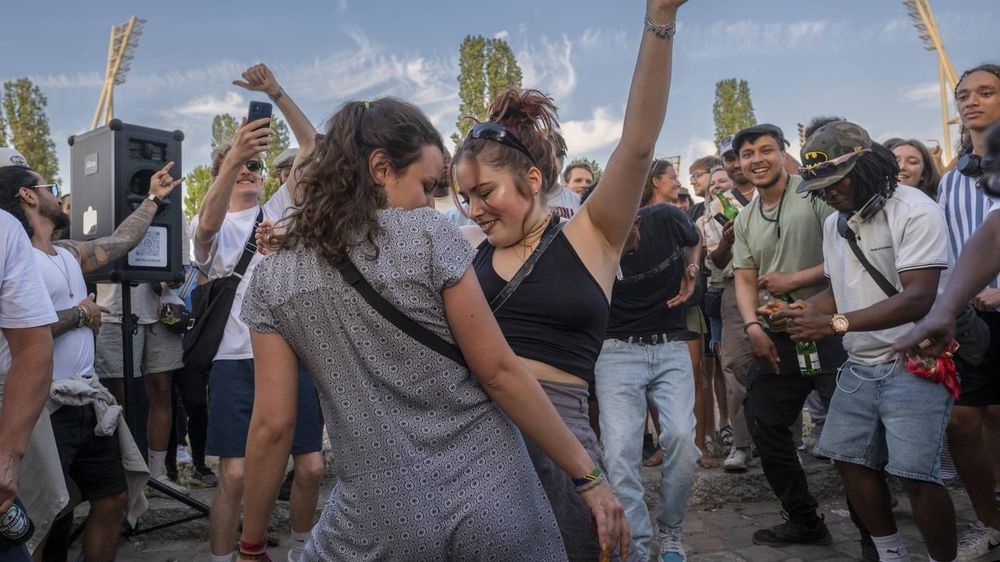
A person who had been standing there looking at their phone suddenly looks up. Someone who had been walking somewhere stops. A stranger laughs at another stranger. People who had arrived in the square as separate individuals begin, however awkwardly at first, to participate in the same thing.
Nothing important, in the conventional sense, has happened.
No law has changed.
No election has been won.
Nobody has been persuaded to alter an opinion.
And yet something has happened.
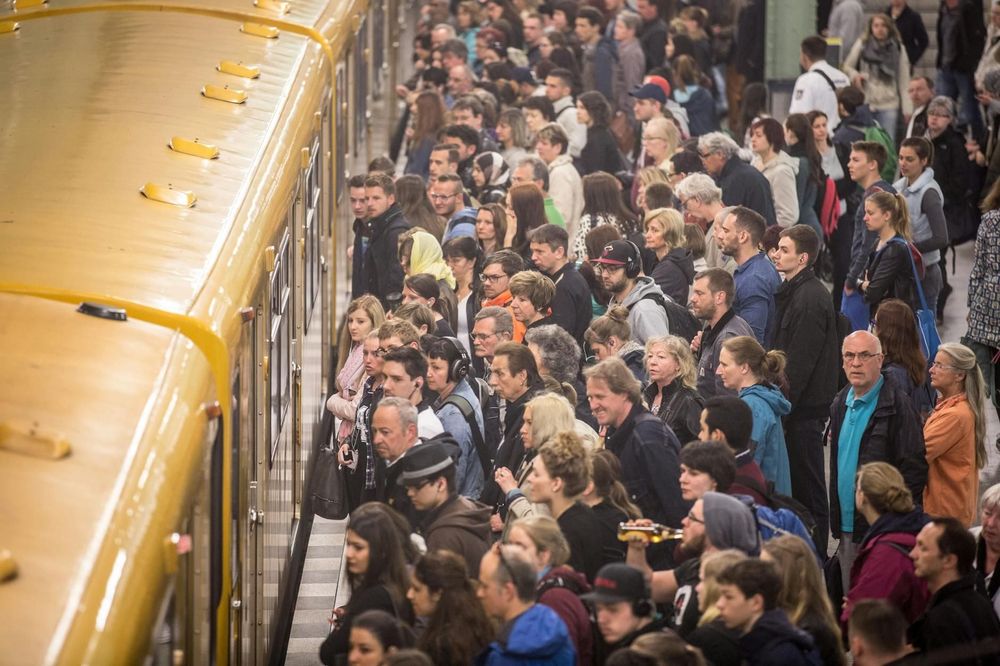
For twenty minutes, a public space has become a little less anonymous.
That may be more important than it sounds.
Because we have become remarkably accustomed to thinking of the things that hold societies together in very large terms.
We think of constitutions, laws, courts, elections, schools, economies, armies, public services and political institutions. We measure unemployment, inflation, voter turnout and economic growth. We debate the health of democracy by examining institutions and political behavior.
All of these things matter.
But societies are not only held together from above.
They are also held together horizontally, through millions of tiny encounters between people who do not know one another.
The centerpiece of every society is the people.
A nod.
A joke.
A shared meal.
A football match.
A concert.
A festival.
A stranger holding a door.
Someone laughing at exactly the same ridiculous moment as you.
A smile.
We tend to regard these things as the decorative parts of social life. Nice, perhaps. Pleasant. But ultimately frivolous.
Politics is serious.
War is serious.
Poverty is serious.
Climate change is serious.
Inequality is serious.
Polarization is serious.
A man getting strangers to dance in the street?
That's entertainment.
But perhaps this hierarchy is backwards.
Perhaps some of the things we call frivolous are part of the infrastructure that makes everything else possible.
The strange seriousness of having fun
MrBerlinParty is interesting precisely because he does not appear to be trying to solve anything.
He isn't standing in Alexanderplatz explaining political philosophy. He isn't asking people to sign a petition. He isn't telling them which side to take. He isn't trying to persuade a conservative to become a progressive or a progressive to become a conservative.
He is trying to make them have a good time.
That sounds almost embarrassingly simple.
It may also be the point.
Modern life has become extremely good at telling us what we should care about. Every day brings another crisis, another outrage, another political confrontation, another reason to be afraid or furious. We are constantly invited to take positions.
What do you think?
Whose side are you on?
Who is to blame?
Who is threatening you?
What must be defeated?
What must be defended?
What should we be outraged about today?
And then, in the middle of all this, somebody turns on music and says, essentially:
Come on.
Let's dance.
There is something almost subversive about the absence of an argument.
Because the people who gather around MrBerlinParty do not need to agree.
The conservative can remain conservative.
The progressive can remain progressive.
The religious person can remain religious.
The secular person can remain secular.
The wealthy person remains wealthy.
The poor person remains poor.
The immigrant remains an immigrant.
The Berliner remains a Berliner.
The visitor remains a visitor.
Nothing about their identities needs to disappear.
They simply don't need to discuss them for twenty minutes.
And that distinction is crucial.
We have become so accustomed to thinking that human beings meet each other primarily through their identities that we sometimes forget there is another order in which a person can be encountered.
Before the opinion comes the face.
Before the political affiliation comes the laugh.
Before the ideology comes the human being.
The category and the person
One of the peculiarities of contemporary politics is that we increasingly encounter people as categories before we encounter them as individuals.
The other side.
The liberals.
The conservatives.
The elites.
The populists.
The activists.
The nationalists.
The immigrants.
The establishment.
The extremists.
The woke.
The reactionaries.
The labels change according to country and political moment. The mechanism does not.
The individual disappears behind the category.
And categories are remarkably easy to hate.
It is much easier to despise “them” than to despise the person standing three feet away from you.
It is easier to be furious at an anonymous account than at the woman whose eyes you have just met.
It is easier to believe that a political group is stupid, dangerous, selfish or morally defective when you have never actually had to experience one of its members as a complicated human being.
Then something strange happens.
You dance beside one.
They laugh.
You laugh.
Someone makes an absurd movement.
You both see it.
Someone smiles.
You smile back.
And suddenly the category has acquired a face.
The “other” has become a person.
The disagreement hasn't vanished.
But the abstraction has been interrupted.
That may be one of the quiet powers of genuine shared experience: it makes caricature harder.
It is difficult to maintain a completely abstract hatred of humanity while standing beside actual human beings enjoying themselves.
This is not an argument against political disagreement.
It is an argument against dehumanization.
Democracy does not require us to agree.
It requires us to live with people who don't agree with us.
That sounds obvious, but it is increasingly difficult to practice.
We have become very good at disagreement.
We have become less good at remaining human while disagreeing.
The politics of outrage
Part of the problem is that our political and media environments have developed extraordinary incentives for conflict.
This does not require a conspiracy.
Nobody has to sit in a dark room deciding how to divide the population.
It is enough that anger attracts attention.
Outrage generates clicks.
Humiliation is shareable.
Conflict keeps people watching.
Algorithms are exceptionally good at discovering what provokes us and showing us more of it.
The result is an environment in which the person on the other side of a political argument rarely appears as an ordinary human being.
They appear as an avatar.
A profile picture.
A username.
A comment.
A position.
An enemy.
Or the, oh so beloved, NPC.
Online, we encounter people at their most argumentative.
In physical life, we encounter them in all their awkwardness.
They drop things.
They laugh at the wrong moment.
They dance badly.
They get embarrassed.
They smile when they weren't expecting to.
These are small details, but they are precisely the details that make a person difficult to reduce to a political symbol.
The internet has given us unprecedented access to one another's opinions.
Perhaps what we need more of is access to one another's humanity.
That is one reason physical public space matters.
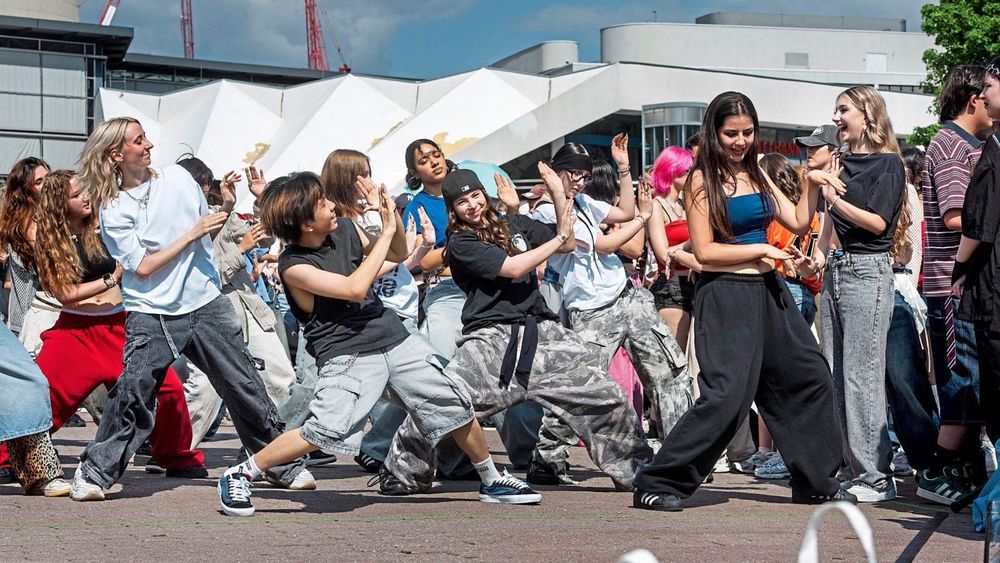
A flash mob puts bodies back into the equation.
There is no comment section.
No anonymous username.
No carefully edited argument.
There is music.
There is eye contact.
There is embarrassment.
There is laughter.
There is the unmistakable fact that the person you were prepared to categorize is standing there, moving badly to the same song as you.
For twenty minutes, you inhabit the same world.
A smile is a tiny thing
Consider the smile.
Not the corporate smile.
Not the politician's campaign smile.
Not the smile instructed by a customer-service manual.
The genuine smile.
The one that arrives before you have decided to smile.
A tiny muscle contraction, a fleeting change in the face, that doesn't pass legislation, redistribute wealth or change constitutions.
And yet one human being smiles at another and communicates something extraordinarily basic:
I see you.
I am not threatening you.
We are okay.
Another person smiles back.
For a second, there is a relationship where previously there was none.
Then another smile.
And another.
And another.
Multiply that by a crowd.
Then multiply it by thousands of ordinary interactions taking place every day.
The result is something we are not very good at measuring.
But perhaps that doesn't make it unreal.
Society is partly made from these tiny acts of mutual recognition.
We talk constantly about social trust as though it were an abstract quantity. But trust is experienced at human scale.
It is the feeling that the stranger beside you is probably not your enemy.
It is the assumption that most people will behave reasonably.
It is the willingness to occupy the same public space without suspicion.
It is the sense of belonging that we have long since forgotten.
And perhaps one of the simplest ways to create that feeling is to give people opportunities to enjoy one another, be it through a 20-minute dance session or playing with sidewalk chalk.
The infrastructure nobody counts
We know what infrastructure looks like.
Roads.
Bridges.
Railways.
Hospitals.
Schools.
Telecommunications.
We also understand institutional infrastructure: courts, elections, governments, public administrations.
But there is another kind of infrastructure that rarely appears in government budgets.
Call it social infrastructure.
It consists of the places, rituals and experiences that allow people who do not know each other to encounter one another without fear.
Sport is social infrastructure.
Festivals are social infrastructure.
Public squares are social infrastructure.
Music is social infrastructure.
Shared meals are social infrastructure.
Humor is social infrastructure.
So is play.
So is dancing.
The function is not that everyone becomes friends.
That would be absurd.
The function is that people become familiar.
And familiarity matters.
The stranger becomes less strange.
The person from another neighborhood becomes someone you have seen before.
The person from another generation becomes someone you have laughed with.
The person from another political tribe becomes, inconveniently, a human being.
Modern societies spend enormous amounts of time worrying about loneliness, alienation and polarization.
Perhaps we should spend a little more time asking whether we have built enough places for people to simply be together without having to buy something, argue about something or identify with something.
The miracle of purposelessness
There is another reason the twenty-minute party feels oddly significant.
It doesn't seem to have a productive purpose.
Nobody has to become more informed.
Nobody has to purchase anything.
Nobody has to join an organization.
Nobody has to change their worldview.
Nobody has to become a better citizen.
The point is simply to enjoy the moment.
We have become uncomfortable with leisure.
Everything must have an outcome.
What did it achieve?
How many people did it reach?
What was the engagement?
What was the economic value?
What was the political impact?
What did it change?
But perhaps there are experiences whose value is precisely that they are not instrumental.
We don't need a justification for laughing.
We don't need a policy paper explaining why a child playing is productive.
We don't need to prove that a dance is economically efficient.
There is something deeply human about doing something because it feels good to do it together.
And there may be something quietly liberating about that.
A political culture obsessed with winning can be exhausting.
A commercial culture obsessed with selling can be exhausting.
A digital culture obsessed with engagement can be exhausting.
For a matter of fact, it is.
Fun offers an alternative.
For twenty minutes, nobody needs to win.
Nobody needs to persuade anybody.
Nobody needs to monetize anybody.
Nobody needs to be right.
They can simply be.
The limits matter
Of course, a flash mob cannot repair a broken democracy.
A dance cannot eliminate inequality.
A smile cannot solve a housing crisis.
Music cannot settle an argument over immigration.
Twenty minutes cannot heal historical grievances.
It would be both naïve and insulting to pretend otherwise.
The value of MrBerlinParty's phenomenon lies precisely in its modesty.
The world does not change.
The people do not necessarily change.
The disagreements remain.
When the music stops, everyone goes back to their lives.
But something has happened that is perhaps easier to underestimate than to measure.
For twenty minutes, people have experienced something that contradicts the emotional logic of polarization.
They have shared something with people they did not know.
Perhaps some of those people hold political views they would strongly oppose.
Perhaps some belong to social groups they rarely encounter.
Perhaps some have completely different ideas about the future.
None of that prevented them from laughing together.
That does not mean agreement is unnecessary.
It means agreement is not a prerequisite for human connection.
And that distinction could be one of the things we most urgently need to remember.
Belonging without an enemy
There is a deeper question underneath all of this.
What if people are not only hungry for political answers?
What if they are hungry for belonging?
For recognition.
For spontaneity.
For physical presence.
For celebration.
For the feeling of being part of something.
For permission to be ridiculous.
For an experience in which they do not have to perform an identity.
Politics has become one of the principal providers of belonging in modern life.
But political belonging has a structural weakness.
It often defines the group by contrast.
We are us because they are them.
We are the people who understand.
They are the people who don't.
We are defending the country.
They are destroying it.
We are the good people.
They are the problem.
The enemy is often what makes the group feel coherent.
A flash mob offers a different kind of belonging.
Belonging without an enemy.
You don't need someone else to be wrong for you to be happy.
You don't need an outsider to hate in order to feel included.
You don't need ideological agreement.
You simply belong to the moment.
That may be one of the most attractive things about it.
Joy without ideology
There is a strange political power in something that is not political.
MrBerlinParty doesn't need to tell people what to think.
Indeed, the absence of a political message may be precisely what makes the experience interesting.
He creates a situation in which political identity becomes temporarily irrelevant.
Not false.
Not erased.
Just irrelevant.
And perhaps that is healthy.
We have spent years asking people to become more politically aware, more politically engaged, more politically conscious.
Perhaps we should also occasionally give them permission to stop being political for twenty minutes.
Not forever.
Just long enough to remember that there is a person underneath the political identity.
That may be the precondition for healthy disagreement.
Before we can disagree as citizens, we have to be capable of encountering each other as human beings.
Berlin's accidental lesson
There is something particularly appropriate about this happening in Berlin.
The city has made an art form out of contradiction.
It carries immense historical weight and a famously irreverent present. It is a city of memory and reinvention, seriousness and absurdity, trauma and nightlife.
And somewhere between the U-Bahn and Alexanderplatz, a man with a microphone and a portable speaker has become a kind of street-level reminder that a city is not only its buildings, its politics or its history.
A city is also the emotional relationship between strangers occupying the same space.
MrBerlinParty's story is, in part, a story about that relationship.
Recent reporting describes Yakup as someone who began performing on the streets only a few years ago, after a previous career as a businessman. He had arrived in Berlin as a child of Turkish guest workers and later returned to the city after the death of his wife, turning what had been a hobby into a new purpose. His performances, which began in the U-Bahn and now frequently appear around Alexanderplatz, have become increasingly visible online.
There is something touching about the trajectory without needing to romanticize it.
A person loses something.
A person finds something.
And what he finds is not an ideology.
It is people.
The stated ambition is remarkably modest: bring people together, make them happy, create a good moment.
Perhaps that modesty is exactly why it resonates.
Twenty minutes
Twenty minutes is not enough to change the world.
But perhaps it is enough to change a person's experience of the world.
Enough to make somebody who was lonely feel briefly included.
Enough to make somebody who was having a terrible day laugh.
Enough to make somebody put their phone away.
Enough to make two strangers exchange a smile.
Enough to create a memory.
Enough to remind somebody that public space does not have to mean anonymous space.
Enough to demonstrate, however briefly, that hundreds of people can occupy the same place without being reduced to competing tribes.
This is why the question raised by MrBerlinParty is ultimately larger than MrBerlinParty.
It is not really:
Can dancing solve polarization?
Of course not.
The more interesting question is:
Can shared joy make polarization less dehumanizing?
Can people disagree more peacefully if they have occasionally experienced one another outside the framework of disagreement?
Can someone be politically opposed to you and still feel familiar?
Can the “other side” contain people you have laughed with?
Can belonging exist without an enemy?
Can a society remain democratic not because everyone agrees, but because enough people still recognize the humanity of those with whom they disagree?
We don't know.
But we know something simpler.
People who have never met one another can meet.
People who were strangers can laugh.
People who would never agree can share a song.
And for twenty minutes, at least, nobody has to ask who is right.
They just have to move.
When the music stops, the political world will still be waiting.
The arguments will still be there.
The elections will still come.
The algorithms will still find new ways to make us angry.
The divisions will not magically disappear.
But perhaps someone will walk away smiling.
Perhaps they will remember the face of the person beside them.
Perhaps, somewhere inside the vast machinery of modern political identity, there will be one tiny memory that refuses to fit:
I don't agree with this person.
I don't know anything about this person.
I may even disagree with them about almost everything.
But we danced together.
And maybe that is not a solution.
Maybe it is something more modest, and therefore more useful.
A reminder.
A reminder that before we became voters, tribes, demographics, political identities, social-media profiles and opposing camps, we were people.
And people, it turns out, still like to have fun.
Perhaps the opposite of division is not agreement.
Perhaps sometimes it is simply twenty minutes in which agreement isn't necessary.
The music starts.
Someone smiles.
Someone else smiles back.
And for a moment, nobody asks what side they are on.
Or maybe this is a statement piece to show that we have come to a point where a man with a microphone and portable speaker making it his life's purpose for people to smile needed to become the element of this text to show the absurdity of humans forgetting what it means to be human at all.
Comments