When we try to understand why someone votes for a particular political option, we often begin by looking at what that option offers: its programme, economic measures, positions on important issues or record in government.
We assume that the voter gathers information, compares alternatives and chooses the option that brings the greatest benefit. This is the logic of rational choice: what do I want, what are my options and what will happen if I choose one of them?
The problem is that real voters do not behave quite like this.
People have neither enough time, enough information nor enough cognitive energy to turn every political decision into a detailed calculation. Instead, we rely on what Herbert Simon called bounded rationality. This means that we make decisions based on the information available to us and on solutions we judge to be good enough, while using as little cognitive effort as possible.
In this process, heuristics, cognitive biases and emotions all play an important role.
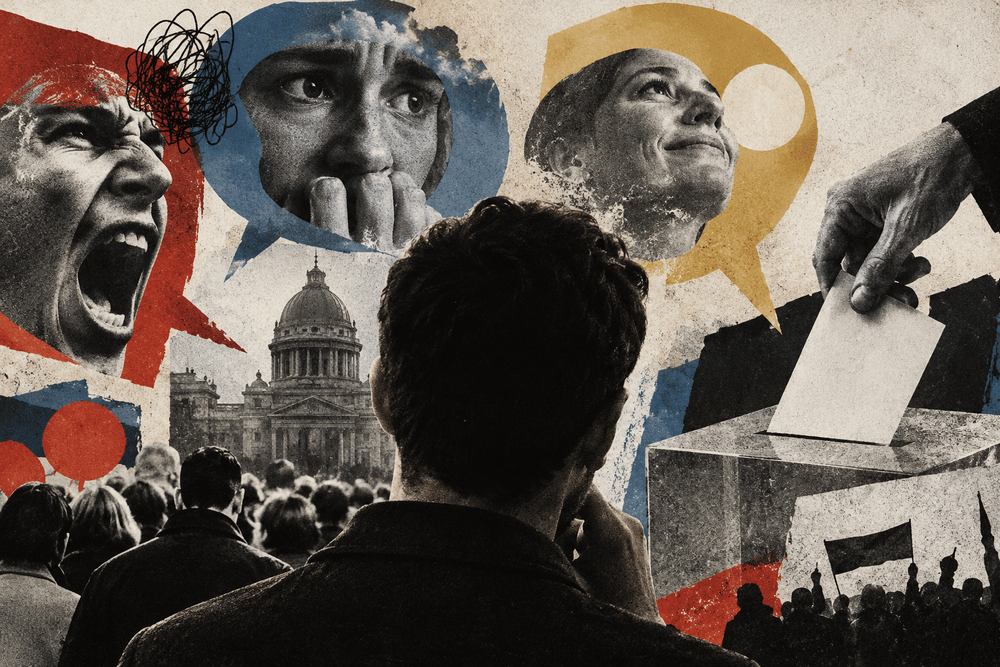
The question, therefore, is not simply whether voters vote rationally or emotionally. It is much more useful to ask how emotions become part of the way voters assess political reality.
Anger, fear and hope do not lead to the same choice
Jon Elster does not view emotions as the opposite of thought, but as mental states that influence both behaviour and the formation of beliefs. An emotion can be triggered by the way we assess our own actions, the behaviour of other people or a particular state of affairs.
Anger, for example, may arise when we judge another person’s behaviour as harmful or negative towards us, while resentment or indignation may be triggered by the perception that someone else has been treated unfairly. Fear and hope, on the other hand, are connected to uncertainty about what might happen.
In politics, this distinction matters because an angry voter does not assess the political offer in the same way as a frightened voter.
Anger can increase a willingness to punish those whom the voter sees as responsible for a problem. The choice is then no longer only about which programme suits me better, but also who should pay the price for what happened.
Fear can have a different effect. It increases the importance of risk and may make voters more inclined towards a safer and more familiar option.
Hope, by contrast, can open space for change, especially when voters begin to believe that a different outcome is not only desirable but possible. Something similar could be seen during the wave of student protests in Serbia that developed after the collapse of the railway station canopy in Novi Sad in November 2024. The feeling that change may actually be possible can be politically as important as dissatisfaction with the existing situation.
Emotions change the way we interpret facts
This reveals another important point. Emotions do not have to directly produce a political choice. They can change the way we interpret the information on which that choice is based.
Elster points precisely to the fact that emotions can influence our beliefs. A strong emotion can make a particular interpretation of reality seem far more convincing than it might appear if we viewed the same situation with less emotional intensity.
Imagine a voter who has believed for years that “politicians only look after their own interests”. If we show that person research suggesting otherwise, it is not enough to assume that new information will automatically change their mind.
Their distrust is not merely a position about facts. It may be connected to experience, disappointment and emotions that have become associated with politics and institutions over time. The same information may therefore be interpreted very differently by a voter who already trusts institutions.
People, then, do not respond only to information. They also respond to the meaning they attach to it.
The mental shortcuts of political choice
This is where cognitive biases also enter the picture.
Confirmation bias describes our tendency to pay more attention to information that confirms what we already believe.
A voter who already believes that a particular politician is corrupt will find it easier to accept a report that confirms that suspicion, while perhaps giving less attention to information that contradicts it.
The availability heuristic works by causing us to assess the probability or importance of an event according to how easily we can recall it.
If a voter has just watched a report about violence, corruption or a migrant crisis, that issue may become psychologically far more important than it was only a few hours earlier. This is not because it has objectively become more important, but because it has become more mentally accessible.
The framing effect works in a similar way.
The same economic measure can be presented as “a salary increase of 20,000 dinars” or as “a new tax burden used to finance salary increases”. The measure itself may be the same, but the way it is presented can produce a different emotional reaction.
In political communication, it is therefore not enough to ask what voters were told. It is also important to ask how the information was framed and what emotion that frame produces.
A campaign that speaks about “danger”, “threat” and “loss” does more than communicate a political programme. It activates an emotional frame through which voters may then view political options.
The same is true of messages that generate pride, belonging, hope or a sense of injustice.
Anchoring bias works by making us rely too heavily on the first piece of information we receive when making a decision.
If a politician first says that a project will cost one billion euros, a later estimate of 700 million may appear reasonable or even favourable to voters, even though they may have too little information to judge whether either figure is realistic. The first number has established a psychological reference point.
By contrast, reactive devaluation shows that we do not evaluate a political proposal only according to its content, but also according to who presents it.
A voter may reject the same proposal when it comes from a political opponent and accept it when it is presented by an option they trust. The source of the proposal then affects the assessment of its value.
In other words, voters do not react only to what is said, but also to who says it, how it is said and what that message already means within their existing view of the world.
Emotion is not the same as irrationality
It is important to emphasise that the fact that emotions influence voters does not automatically mean that voters are “irrational”, nor that political communication can be reduced to the manipulation of emotions.
Emotions are part of the way people give meaning to political events.
Fear can be a completely justified response to a real threat. Anger can be a response to injustice. Hope can emerge when a genuine possibility for change appears. The problem arises when an emotional reaction closes off space for checking facts, changing one’s mind or seriously considering a different argument.
The problem begins when emotion replaces every possibility of reconsideration.
For this reason, it is more useful to understand political behaviour by viewing the voter as homo (almost) economicus, someone who wants to make a good decision but also wants to reach it with as little cognitive effort as possible.
Political choice then becomes a combination of interests, experience, identity, emotions, social norms and mental shortcuts.
How political opinion actually emerges
In the end, perhaps the most important point is that emotions do not simply come after political thought. They often participate in the very process through which political thought is formed.
A voter does not choose only between candidates and programmes. They choose between different interpretations of their own experience: whom they trust, what they fear, what makes them angry, what they hope for and what they consider fair.
When we understand these mechanisms, it becomes clearer why the best political argument is not always the one that is formally the most logical.
Often, the most politically persuasive message is the one that manages to connect with what the voter already feels, remembers and considers important.
Comments