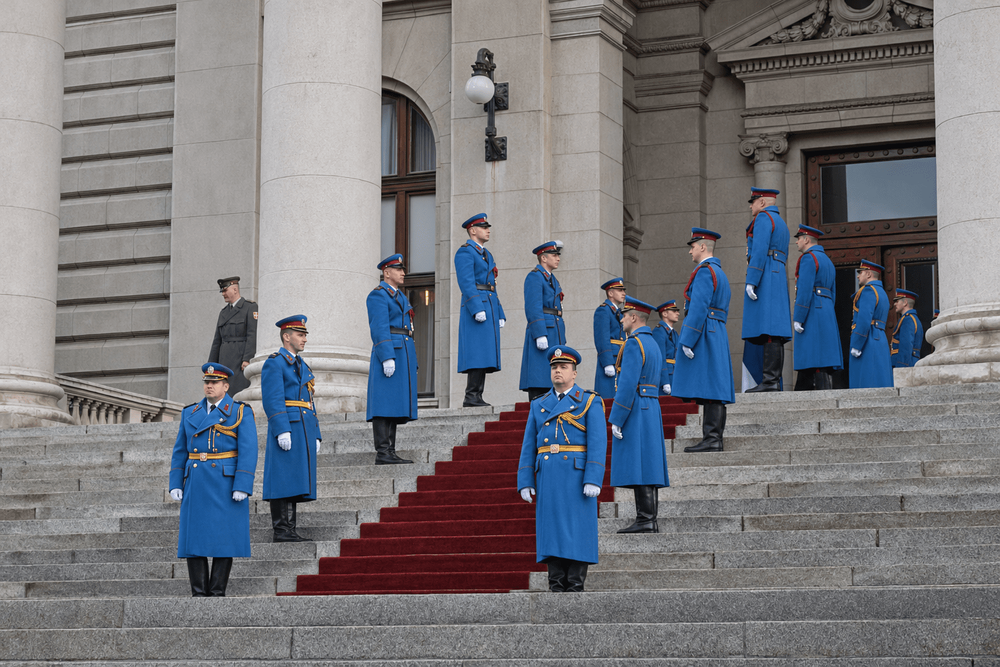
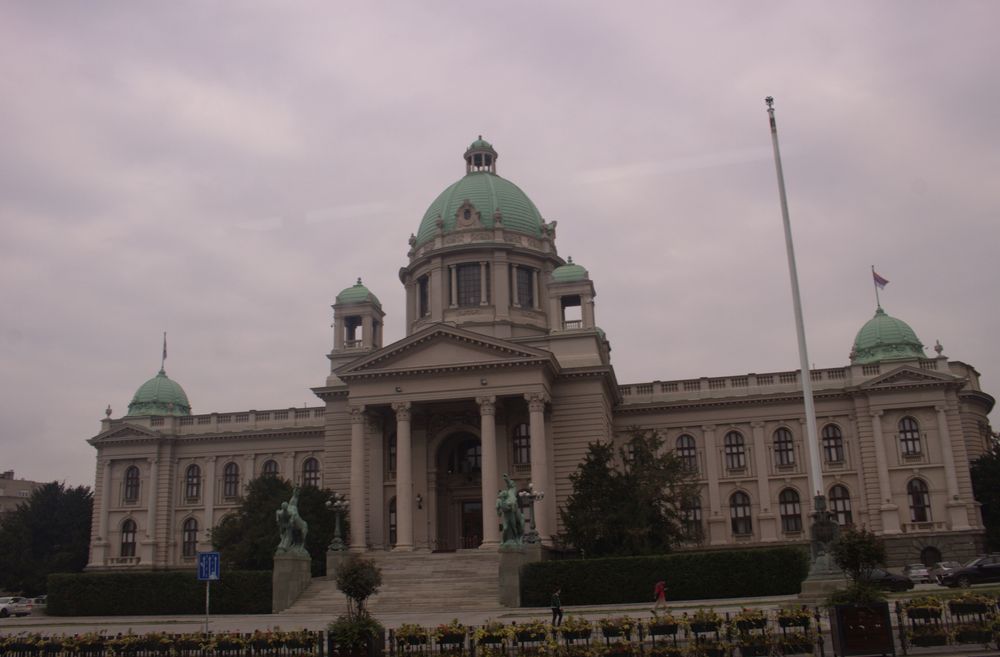
On the steps of Serbia's National Assembly, members of the Serbian Armed Forces Guard stood on either side of a red carpet. Their blue uniforms, white gloves and almost motionless posture were part of the protocol for welcoming the new parliament. Behind them were the building's enormous wooden doors; in front, citizens, journalists and newly elected MPs were gathering. Following the October elections, the change in parliamentary majority was taking institutional shape for the first time.
Inside, the atmosphere was somewhat different from the ceremony suggested by the scene at the entrance. There was excitement among the MPs, but also tension. For many, this was their first visit to the National Assembly as elected representatives of the people. Some were getting to know the building, talking with colleagues and trying to find their way through the journalists, cameras and parliamentary procedures. Others already had experience in parliament, except that this time they faced a different place in the distribution of political power. Joy and anticipation were not limited to one parliamentary group. They were visible among newly elected members of the Students' List and MPs from other electoral lists, although their reasons for looking ahead were different.
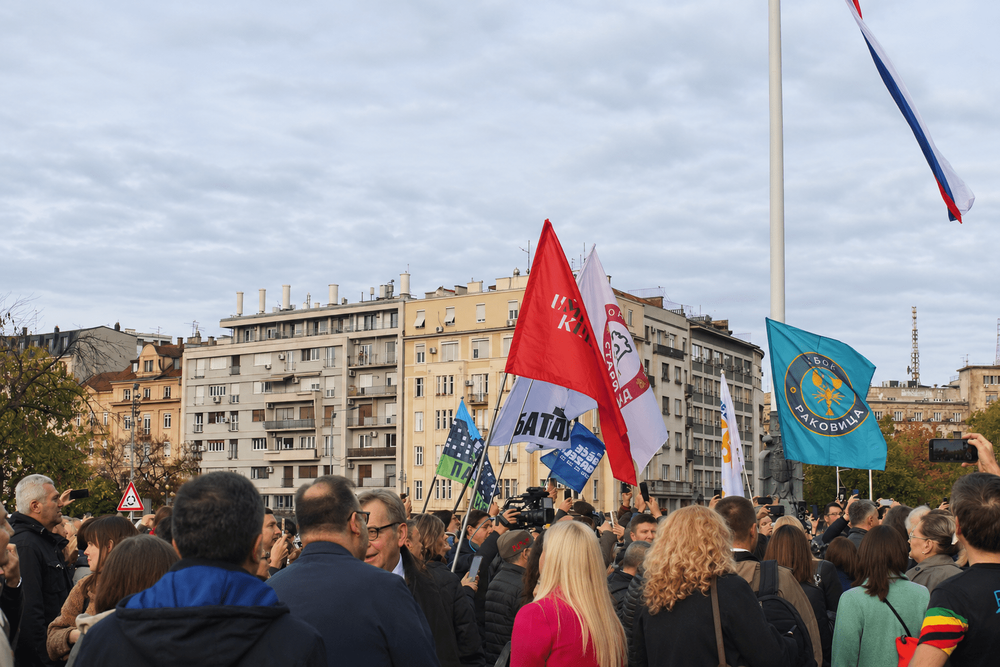
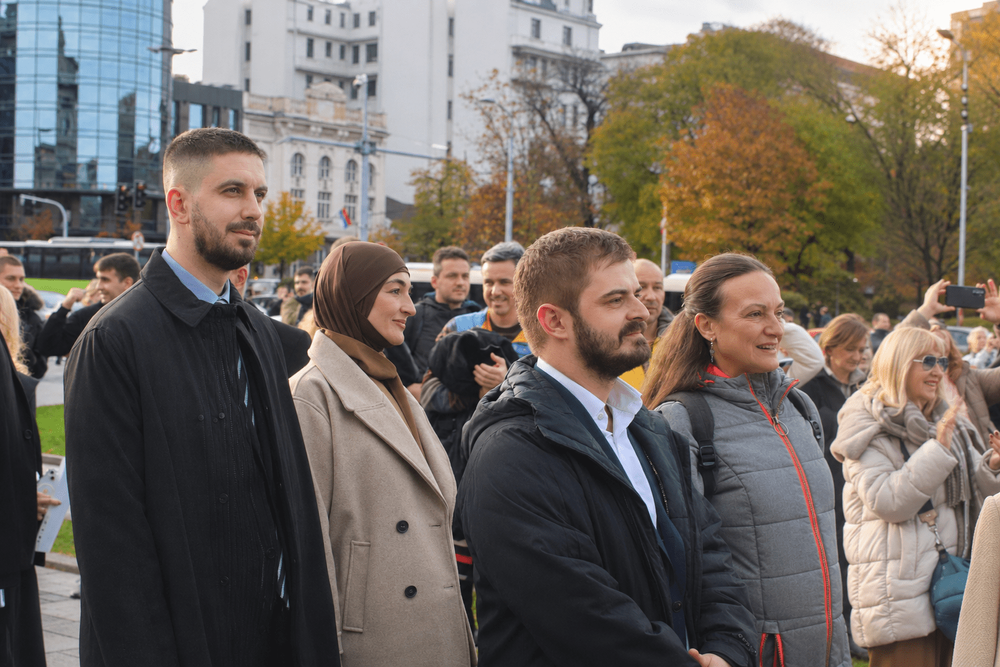
Outside the Assembly, citizens who had come to support the Students' List applauded as its MPs entered the building. The gathering in Pionirski Park had begun at around eight in the morning before moving towards the parliament's main entrance. There were chants of support and a song that had accompanied the student movement throughout its campaign. Some representatives of the “Aleksandar Vučić – United Serbia” list were met with boos. An incident was also reported in which MP Lidija Vukićević was doused with yoghurt. Students occupying the Faculty of Medicine publicly distanced themselves from the act, saying it was inconsistent with the values they stood for.
Even before the session began, it was clear that the election result had not removed the political conflicts of the previous two years. It had changed the balance of power, but it had not erased the distrust between political opponents.
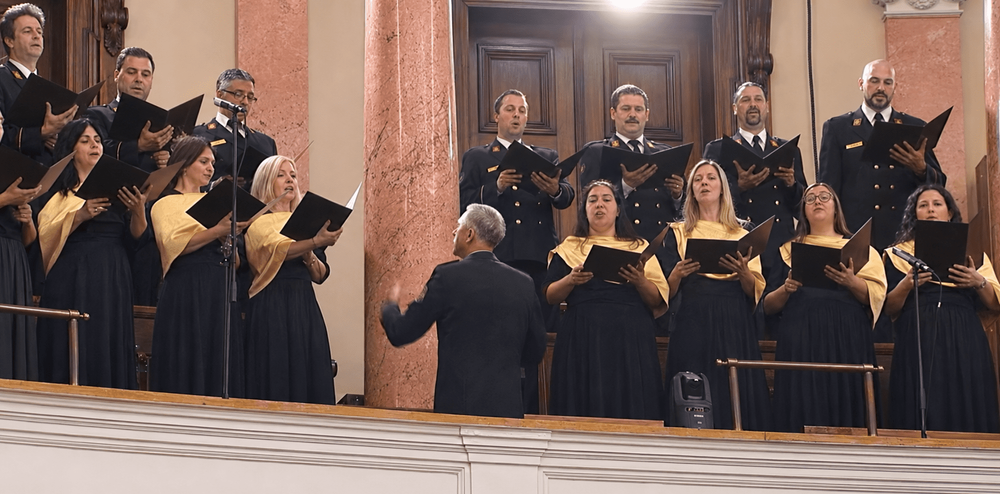
The session began shortly after ten o'clock with the national anthem, “Bože pravde” (“God of Justice”), performed by the mixed choir of the Ministry of Defence's “Stanislav Binički” Artistic Ensemble. MPs stood, and the chamber, which had until then been filled with conversation, briefly fell silent. Once the ceremonial opening was over, the Assembly turned to the work without which a new parliament cannot begin to function.
Under the Rules of Procedure of the National Assembly, the first sitting is chaired by the oldest MP until a speaker has been elected. If that MP is unable or unwilling to chair the session, the responsibility passes to the next oldest MP present. This time, the presiding member was Stojan Radenović, a mathematician and university professor elected from the “Aleksandar Vučić – United Serbia” list.
This meant that the first proceedings of the new parliament were led by a representative of the list that had lost its majority in the October elections and moved into opposition. That arrangement was not a political concession but a procedural rule established in advance. Radenović chaired the session because he was the oldest MP, not because his parliamentary group held the most seats.
He was assisted by the youngest MPs from the four electoral lists that had won the largest number of seats: Sara Valentin from the Students' List, Miloš Pavlović from “Aleksandar Vučić – United Serbia”, Boris Bajić from the Alliance of Vojvodina Hungarians and Visar Mehmeti from the Albanian Coalition. Also present were the Secretary-General of the National Assembly, Srđan Smiljanić, and his deputies, Dragana Odović and Vladimir Dimitrijević.
Their role was organisational and procedural. The presiding member opens the sitting, directs its proceedings and applies the rules until a speaker is elected, while the youngest MPs and parliamentary staff assist in carrying out those duties. The presence of representatives of different electoral lists at the same presiding desk is itself an important feature of the process of constituting parliament.
The first substantive task was the verification of parliamentary mandates. The Assembly established a three-member committee consisting of Dražen Drašković and Petar Mitov from the Students' List, and Vjerica Radeta from “Aleksandar Vučić – United Serbia”. Its task was to check whether the details on each MP's certificate of election matched the official report of the Republic Electoral Commission.
A break of approximately one hour was called for this process. It is a formal check confirming that those taking up parliamentary office were indeed elected according to the report of the competent electoral authority. The committee found that the certificates of all 250 MPs matched the Electoral Commission's report, after which their mandates were confirmed.
With that, the 15th National Assembly of the Republic of Serbia was officially constituted.
The MPs then took an oath to perform their duties with dedication, honesty and diligence, to respect the Constitution and to protect human and minority rights, civil liberties, truth and justice. In a parliament that has witnessed exceptionally bitter political disputes in recent years, those words carry particular weight. Their real value, however, will become clear only through the MPs' work, the laws they adopt and the way they treat citizens and political opponents.
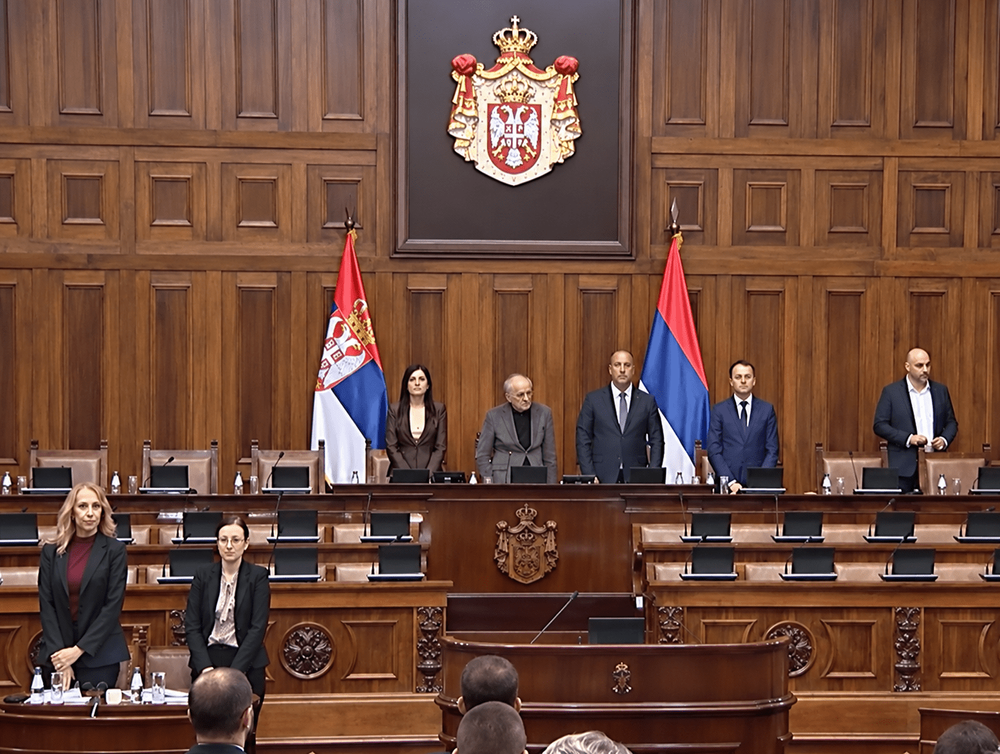
After the mandates had been confirmed, a longer break followed, this time to allow parliamentary groups to be formed and nominations for speaker of the National Assembly to be submitted. Proceedings resumed at 2 p.m. According to the parliament's official statement, two parliamentary groups had been established.
The first was the “Students' List”, led by Jovo Bakić, with Aleksandra Štimac as deputy chair. The second was “Aleksandar Vučić – Serbia Wins”, chaired by Aleksandar Vučić, with Milenko Jovanov as his deputy. It is important to distinguish the name of this parliamentary group from the official name of the electoral list on which its members were elected: “Aleksandar Vučić – United Serbia”.
The Students' List holds 140 parliamentary seats, while “Aleksandar Vučić – United Serbia” holds 103. The remaining seven seats went to representatives of five minority electoral lists. This gives the Students' List an outright parliamentary majority, while the political organisation that previously held power finds itself on the opposition side of the chamber for the first time in fourteen years.
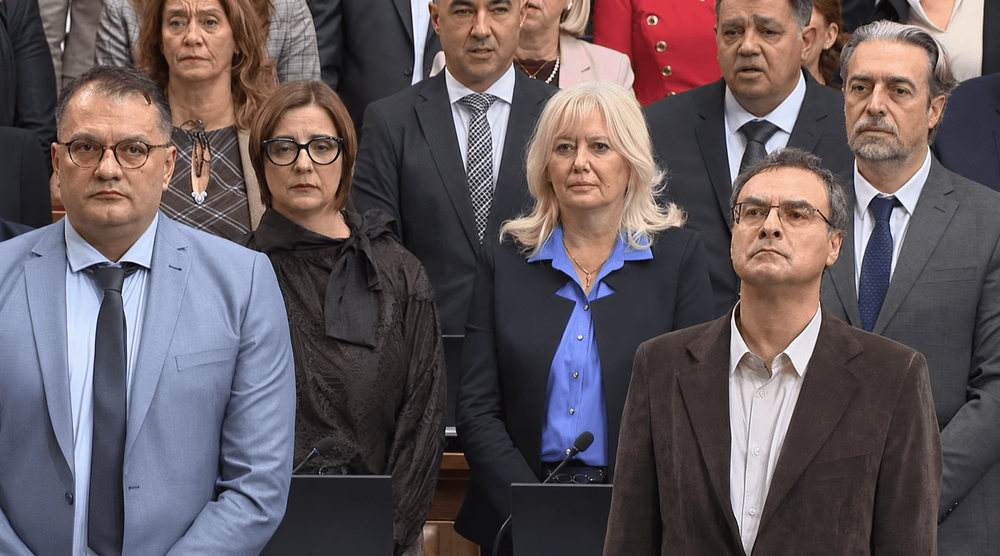
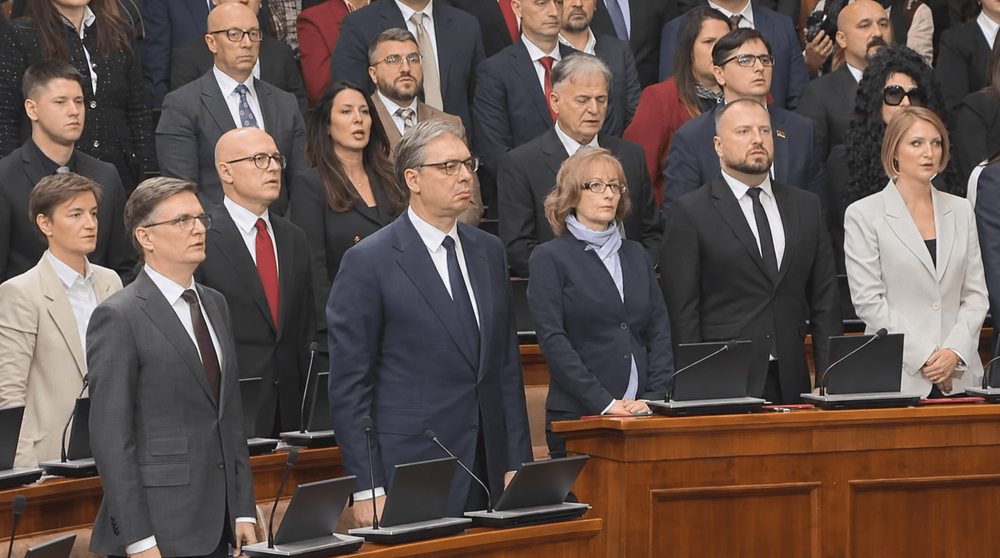
For minority MPs, a separate question has emerged concerning parliamentary organisation. The Rules of Procedure currently require at least five MPs to establish a parliamentary group. Bálint Pásztor of the Alliance of Vojvodina Hungarians has called for consideration of a rule change that would allow minority lists to establish a group with at least three members. The proposal matters because the number of MPs affects their ability to participate in parliamentary work in an organised manner, the speaking time available to them and their role in proposing members of parliamentary committees.

Once the formal process of constituting parliament was complete, a much more politically sensitive procedure began: the election of the speaker of the National Assembly.
Under Article 8 of the Rules of Procedure, a candidate for this position must be nominated by at least 30 MPs, and each MP may support the nomination of only one candidate. A nomination must include the candidate's name, the electoral list on which they were elected, information about the representative of the nominators, an explanation, a biography and the candidate's consent. Nominations are submitted in writing to the presiding member, after which representatives of the nominators may present their arguments and MPs may debate the candidates.
Two candidates were nominated. The “Aleksandar Vučić – United Serbia” list put forward Stojan Radenović, while the Students' List nominated Aleksandar Čupić, a university professor and one of the more recognisable figures in the student movement. Aleksandar Vučić presented the case for Radenović, while Jugoslav Gašić spoke in support of Čupić.
It was during this debate that the political relationships the new parliament might inherit, and those it would still have to establish, became clearer.
Vučić's speech lasted approximately one hour and forty-three minutes. A substantial part of it concerned political opponents, earlier events and accusations that were not directly related to Radenović's biography or candidacy. The presiding member did not interrupt him for straying from the agenda item. Petar Mitov, an MP from the Students' List, consequently requested that the Assembly rule on a breach of the Rules of Procedure, while Jovo Bakić argued that Radenović had failed to demonstrate the impartiality expected of a parliamentary speaker.
Vučić, for his part, claimed that his political opponents were attempting to restrict the opposition's right to speak. Milenko Jovanov criticised the Students' List candidate and expressed his disagreement with the new majority's intentions regarding the allocation of leadership positions.
Situations like this raise a genuine question that parliament must resolve. The opposition has the right to speak, criticise the government and take part in debate, even when the majority dislikes what it has to say. But that right also entails respect for the rules that apply to all participants. The presiding member is responsible for maintaining order and applying the same procedural standards regardless of a speaker's political affiliation.
For that reason, Stojan Radenović's conduct became more than a matter of personal judgement. It opened a debate about what parliament would look like now that the majority had changed, while the political habits of the previous period had not necessarily disappeared. Until a permanent speaker was elected, the presiding member had a limited but important responsibility. His task was to enable parliament to function, not to predetermine the outcome of political competition.
Nevertheless, the speaker of the National Assembly was not elected on the first day. The session ended in the evening, with proceedings scheduled to resume on Wednesday, 18 November, at 10 a.m.
Under the Rules of Procedure, MPs must first conclude the debate on the candidates. The Assembly then decides whether the vote will be public or secret. If a public vote is chosen, it is conducted by roll call. At least 126 votes are required to elect a speaker, representing a majority of all 250 MPs. If neither of the two candidates receives the necessary majority, the procedure is repeated.
With 140 seats, the Students' List has a clear numerical advantage for its candidate, Aleksandar Čupić, provided that its parliamentary group remains united during the vote. Still, until MPs actually cast their votes, the election should not be presented as a completed outcome.
The stakes of this vote are especially high because of the political situation following Aleksandar Vučić's resignation as President of the Republic on 27 September. Since then, Ana Brnabić, the speaker of the previous National Assembly, has been temporarily performing the duties of president. Under the Constitution and the Law on the President of the Republic, those duties pass to the newly elected speaker of the National Assembly until a new president is elected.
The vote scheduled for 18 November is therefore not merely a decision about who will preside over parliamentary sittings. It also determines who will exercise the duties of head of state during this transitional period.
After the speaker has been elected, parliament must still elect deputy speakers and appoint a secretary-general, as well as, in the ordinary course of proceedings, elect members of parliamentary working bodies and permanent delegations to international parliamentary institutions. These matters were not completed on 17 November because the session remained focused on the second agenda item. Their consideration will depend on the completion of the speaker's election and the subsequent course of proceedings.
There is also a wider reason why the efficiency of the new parliament matters. Its constitution triggered the constitutional deadline of 90 days for electing a government. The Students' List now has a majority that enables it to assume responsibility for forming institutions, but political negotiations, the formation of the executive and the implementation of the programme on which it won voters' confidence still lie ahead.
The first day of the new National Assembly did not provide answers to all these questions. It brought the confirmation of mandates, the oath and the opening of the debate on parliamentary leadership. It also showed how difficult it may be to separate institutional work from the conflicts that have defined recent years.
In the parliamentary chamber were people who until recently had represented political power, people who had protested against it and representatives of communities whose interests are often pushed into the background by large parliamentary groups. Among newly elected MPs, there was visible excitement about taking office, but also the uncertainty that comes with a first encounter with parliamentary procedures and the responsibilities of public office. For those with longer parliamentary experience, the circumstances had changed, but the rules remained the same.
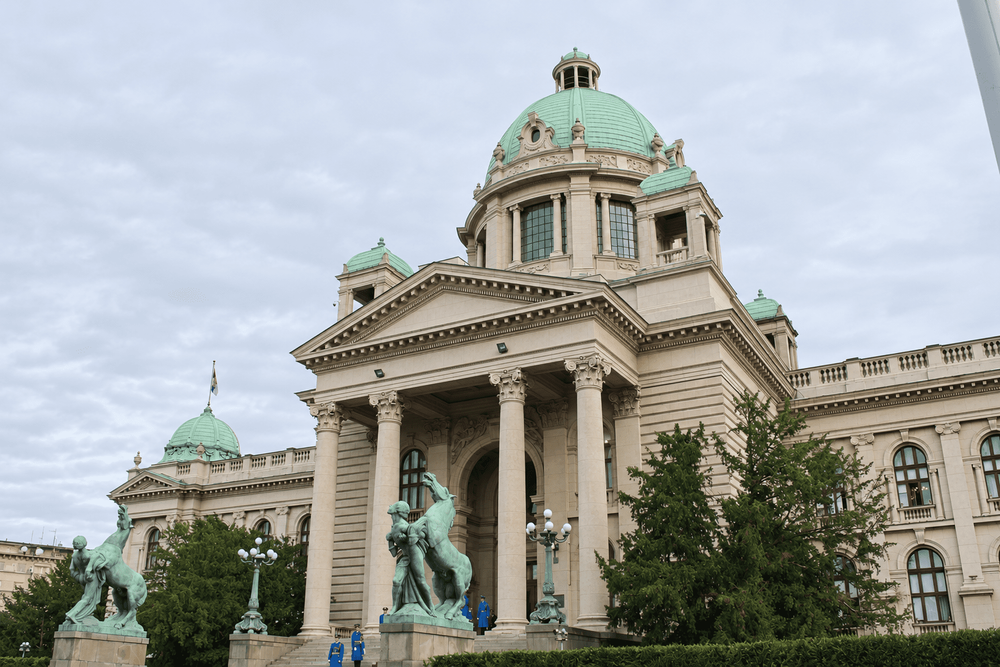
On the steps outside, everything appeared to have been decided in advance. Members of the Serbian Armed Forces Guard knew where to stand, when to move and whom to welcome. Inside the Assembly, there was no such certainty. The new majority had secured its seats, but it still had to show how it would govern an institution in which political conflict had often taken precedence over legislative debate.
The citizens who voted for change on 25 October did not choose merely a different arrangement of people on the parliamentary benches. The new majority now has to demonstrate whether parliament can make decisions, hold the executive to account and protect citizens' rights without turning every sitting into a political confrontation that pushes its own agenda aside.
The Guard performed its duties according to protocol. The MPs have only just begun theirs.
The resumption of proceedings on 18 November will not provide a final answer to what kind of parliament this new assembly will become. But it will show who will lead the institution in which that answer will be sought over the coming years.

Comments