A few months before the student protests began in Serbia, I became interested in the work of the American political scientist Gene Sharp and his 198 methods of nonviolent action. Until then, I must admit, I had a rather different idea of how major political change happens. We grow up with historical accounts in which power is won or lost through conflicts, revolutions, wars and uprisings. When we talk about overthrowing authoritarian regimes, we almost automatically imagine a crowd breaking through a police cordon, occupying institutions or physically confronting those who represent the government. For a long time, I too believed that in societies where institutions do not function, there is little room for any other kind of resistance. That if people truly want change, at some point they simply have to rebel, and that rebellion almost inevitably involves violence.
Sharp's research surprised me precisely because it offered a much broader understanding of political struggle. His 198 methods, first systematically presented in the 1973 book The Politics of Nonviolent Action, range from public statements, petitions, protests, silence, symbolic gestures and commemorations to strikes, boycotts, civil disobedience, refusal to cooperate and nonviolent interventions. Seemingly ordinary actions through which people withdraw obedience, express dissatisfaction or temporarily disrupt the normal functioning of society can become a serious source of political pressure. Sharp did not argue that every peaceful protest would succeed. On the contrary, he insisted on strategy, the selection of appropriate methods and an understanding of the sources of an opponent's power.
What particularly interested me was how many such examples already existed in history. In India, Mahatma Gandhi organised the Salt March in 1930, during which participants walked to the sea to openly defy colonial salt regulations. In Poland, the Solidarity movement grew out of workers' strikes and trade-union organising and, through sustained social pressure and negotiations, played a part in the changes of 1989. In East Germany, citizens gathered for Monday demonstrations, which grew into a mass movement against the one-party regime during 1989. In Estonia, Latvia and Lithuania, around two million people formed a human chain stretching more than six hundred kilometres in August of that same year, demanding freedom and independence from the Soviet Union.
These events were not identical, nor does nonviolent resistance alone explain all the political changes that followed. International circumstances, economic crises, political decisions and the behaviour of institutions also mattered. But they showed that mass political action can take far more forms than physical confrontation.
Even in Serbia, there is a history that, it seems to me, we do not understand well enough. When 5 October 2000 is mentioned, we most often remember the burning parliament building, the bulldozer and the clashes on the streets of Belgrade. Much less often do we talk about the years of organising that came before: student protests, strikes, local activist networks, humour and the campaigns of the Otpor movement. Researcher Janjira Sombatpoonsiri has shown in detail how important political satire was in opposing Milošević's regime. Through laughter, public actions and persistent organising, activists tried to break the fear and the sense that those in power were invincible.
This history is almost within our reach, yet we often remember only its final, most dramatic images.
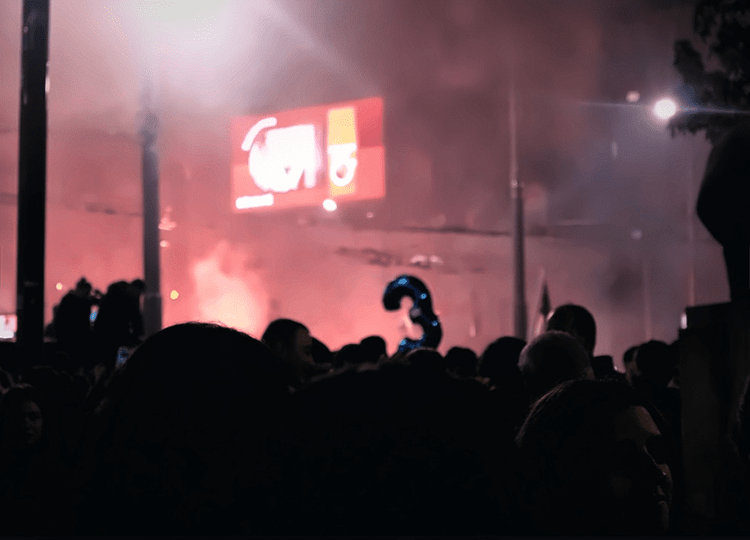
Then came 1 November 2024. The collapse of the canopy at the Novi Sad railway station, which claimed sixteen lives, sparked protests that would spread across almost all of Serbia over the following two years. Demands for accountability, the release of documents and functioning institutions gradually developed into a broader social movement. Students blockaded university faculties, citizens blocked intersections, and protest gatherings, strikes, commemorations and public discussions were organised. Silence in memory of those who died became one of the most recognisable forms of protest.
I remember how interesting it was to look at some of these actions through Sharp's classification. Minutes of silence corresponded to symbolic protest and political mourning. Walks from one city to another resembled protest marches and pilgrimages. Blockades represented forms of nonviolent intervention, while the suspension of work and classes was linked to methods of noncooperation. Student assemblies, public forums and conversations with citizens opened up opportunities for people who had not previously been politically active to become part of collective action. I am not claiming that the students took all these methods from Sharp's books. What interests me is the similarity between how they organised themselves and the forms of nonviolent resistance he had systematised decades earlier.
And then came 15 March 2025.
Belgrade was packed with people. The number of citizens who gathered in the streets was of a scale Serbia rarely sees. The Archive of Public Assemblies estimated that between 275,000 and 325,000 people attended the protest, with the possibility that the actual number was higher. Estimates by state authorities were considerably lower. For the people standing in the streets that day, however, the number could not be reduced to statistics. It was a moment when public dissatisfaction reached a scale that was difficult to ignore.
I think many people expected immediate change at that point. Perhaps they imagined that bringing so many people together in one place would be enough, and that the authorities, confronted with such pressure, would have to step down. When that did not happen, disappointment followed. Debates began over whether 15 March had been a failure, whether the students had missed an opportunity and whether any change could be achieved without more radical action.
I understand why that disappointment arose. When hundreds of thousands of people take to the streets and nothing changes immediately, it is easy to conclude that peaceful protest is not powerful enough. Especially when, for months, people have faced ignored demands, political pressure and instances of violence against demonstrators.
During the summer of 2025, protests did indeed turn into confrontations on some occasions. There were attacks on police officers, damage to party offices and other violent incidents. At the same time, human rights organisations documented serious allegations of excessive police force, injuries and arbitrary arrests of demonstrators. Neither the conduct of the police nor the actions of individual participants can be attributed to an entire group. But that period showed how difficult it is to maintain nonviolent discipline when protests go on for a long time and frustrations grow.
I do not think that every person who lost patience at the time deserves condemnation without any understanding of the circumstances. But neither am I convinced that turning the whole movement into a violent confrontation would have enabled it to achieve its demands. Violence narrows the space for participation. Older people, parents with children, people who cannot physically endure confrontation and citizens who simply do not want to hurt anyone find it much harder to be part of that kind of resistance.
This reminded me of the research of political scientists Erica Chenoweth and Maria Stephan, who analysed major resistance campaigns between 1900 and 2006. They found that nonviolent campaigns during the period studied were more than twice as successful as armed ones. One key explanation lies in the ability of such movements to bring together much broader and more diverse groups of people. Nonviolence does not guarantee victory in itself, but it can make participation possible for those who would never take part in armed or physical conflict.
Perhaps that was one of the most important things the students came to understand over the following months.
They kept going out to meet people. They walked, rode bicycles, organised gatherings in smaller towns and talked to citizens who did not attend major protests and did not necessarily follow student announcements on social media. They even reached Strasbourg by bicycle, while marathon runners made it to Brussels. In Serbia, they developed a network of contacts that gradually connected university cities with villages, suburban neighbourhoods and communities often left on the margins of major political campaigns.
I found the door-to-door campaign particularly interesting. A September 2026 report in the weekly Vreme described how student teams visited apartments in New Belgrade, spoke with residents, accepted refusals and carried on. According to the report, the earlier initiative “A Student in Every Village” had visited more than four hundred places and tens of thousands of households.
This does not look particularly revolutionary when compared with images of crowds in front of parliament. There are no fireworks, no police cordons being broken and no dramatic moment destined to become a front-page photograph. There is a person who rings a doorbell, introduces themselves and tries to speak with someone who may think completely differently.
Yet it is precisely through conversations like these that politics can escape the closed circle of people who already agree with one another. A protest that remains confined to the like-minded has limited reach. When it reaches people who are uncertain, who do not trust political organisations or who have not voted for years, it creates the possibility for public dissatisfaction to grow into broader social participation.
We cannot claim that knocking on doors, by itself, delivered the electoral victory. Such a precise conclusion would require serious research into voter behaviour. But we can see that sustained, direct engagement with citizens became a recognisable part of the student movement, and that the elections on 25 October recorded exceptionally high turnout.
According to the preliminary results published by the Republic Electoral Commission on the evening of 26 October, the Students' List received 2,267,615 votes, or 52.71 per cent, which would give it 140 of the 250 parliamentary seats. The “Aleksandar Vučić – United Serbia” list received 39.17 per cent and 104 seats. The results are not yet final, but a major electoral change has already been confirmed. The Crta election observation mission estimated turnout at around 69 per cent and pointed to the significance of exceptional voter mobilisation.
There is no need to portray this victory as a miracle. It was the result of many different circumstances: long-standing dissatisfaction, protests, organising, political decisions, the election campaign and large numbers of citizens going to the polls. At the same time, observers documented serious problems with the conditions of electoral competition, media representation and the electoral process. Those circumstances should not be erased from the story simply because the result is now known.
But something else matters to me.
When I was reading Sharp's methods two years ago, I seriously considered for the first time that political change did not have to look like the scenes we are used to seeing in films and historical documentaries. We have now had the opportunity to observe an entire social process in which an enormous number of people used different, predominantly nonviolent forms of action, persisted through several stages and ultimately reached an electoral outcome that, until recently, many had considered difficult to achieve.
Of course, I did not like everything that happened during those two years. There were decisions that seemed wrong to me, actions I disagreed with and moments when I did not understand what the students were trying to achieve. I do not think such things should be left unspoken now. No political movement is beyond criticism, and its victory cannot retroactively make every previous decision the right one.
Nor do I believe that a single electoral victory is enough to declare a democratic transition complete. What comes next is often much harder than mobilisation: making institutions work, holding elected representatives accountable, protecting the rights of political opponents and accepting that democratic rules must also apply when their outcomes do not suit us. Those who have earned the trust of voters will have to show how they intend to use it. The right to criticise the government does not end when the people who hold power change.
Still, there is a reason why 25 October matters to me beyond the election result itself.
It reminded me how inclined we are to underestimate patience. We live in a time when almost every political debate demands an immediate answer, an immediate solution and an immediate victory. When that does not happen, we quickly decide that the attempt has failed. After 15 March, that impatience was understandable. But a political struggle does not have to be defined by a single date, however important that date may be.
Sometimes the hardest part is carrying on after a major gathering has ended, the cameras have gone, people have returned to their everyday responsibilities and the institutions remain unchanged.
The students carried on.
That may be the greatest lesson of this entire period for me. That between silence and violence lies an enormous space for action that we often do not even try to explore. That there are many ways to challenge those in power, express dissatisfaction, organise people and demand accountability. That persistence is not the same as passivity, and that nonviolence does not mean a person must quietly accept injustice.
There is also something striking about the fact that it was precisely young people, so often described as uninterested, dependent on their phones and incapable of serious political organising, who became the driving force behind such a prolonged process.
So many things have been said about Generation Z: that they do not read, that they have no patience, that they do not understand politics, that their attention spans last only a few seconds. And of course, an entire generation cannot be judged on the basis of a single movement. But what we witnessed over these two years demonstrated how superficial such generalisations can be. Among these young people were those who travelled hundreds of kilometres, organised complex actions, learned how institutions work and tried to speak with fellow citizens several decades older than themselves.
And perhaps that is what will stay with me longest.
Not the image of election night, nor the percentage of votes, nor even the scenes of hundreds of thousands of people on the streets of Belgrade. I am more interested in what often went almost unnoticed between those major events: all those kilometres, conversations, refusals, renewed attempts and days when seemingly nothing was changing.
I do not know whether Serbia became a better country on 25 October. That cannot be established two days after an election. Nor do I know how many of the expectations that arose during the protests will be fulfilled.
But I do know that I no longer see nonviolent resistance in the same way I did two years ago.
Back then, I was trying to understand how people manage to change society without a violent uprising. Today, I have before me an experience that shows how far persistent, organised and broadly based civic action can go, even when at first it seems to have no realistic chance of success.
Not every change began with a grand speech, a confrontation or a historic scene.
Some changes were built much more slowly, almost imperceptibly, while someone was walking to the next village, talking to a neighbour or ringing again at a door that nobody had answered the first time.
Perhaps that is the part of history we have forgotten most often.

Comments