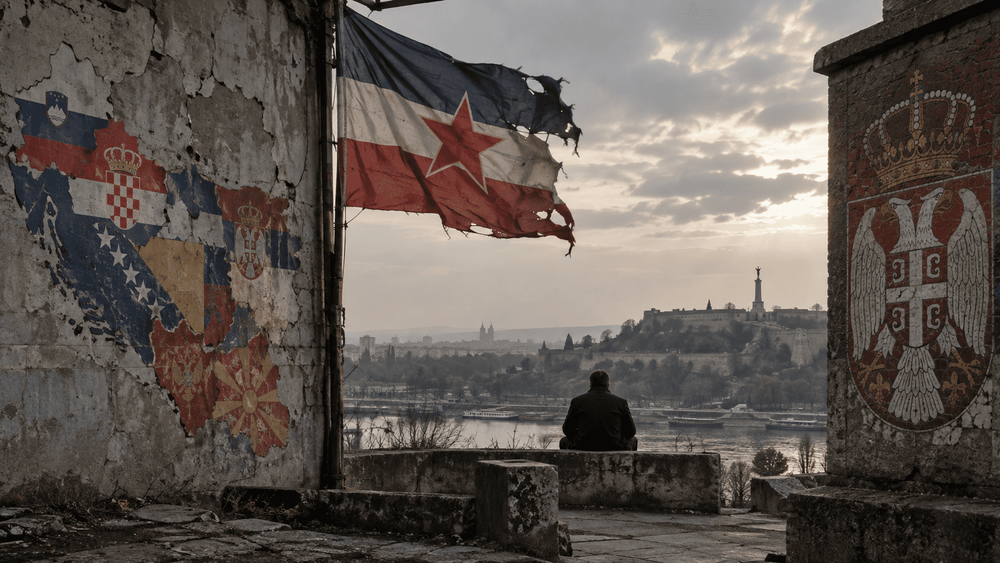
The attitude towards the breakup of the SFRY, as well as towards the states that emerged from that breakup, reveals a great deal about the collective consciousness within the Serbian people, as well as about the influence of the processes of heroization and victimization on contemporary society in Serbia and the consequences these processes leave on political life. In short, there are two dominant political narratives in Serbia that appear to be opposed and divide society, both concerning the creation and breakup of the SFRY.
Both political narratives view the creation of the former common state in almost the same way: the Kingdom of Serbia, and above all the Serbian people, made the greatest sacrifice during the First World War, “liberated” the other South Slavs and ultimately created the Kingdom of Serbs, Croats and Slovenes, later renamed the Kingdom of Yugoslavia. The “sacrifice and concessions” of the Serbian people were rejected, and after little more than two decades this “goodwill of the Serbian people” was supposedly abused against them through the establishment of the NDH, which targeted the Serbian people above all others and subjected them to systematic persecution and mass crimes.
Both political narratives see socialist Yugoslavia as a kind of continuation of the Kingdom of Yugoslavia. Once again, according to this interpretation, Yugoslavia was “rebuilt on Serbian sacrifices” and thanks to Serbian military achievements. This sacrifice and goodwill were allegedly “repaid” to Serbs and Serbia with autonomy for Vojvodina and Kosovo, thereby weakening Serbia and placing it in a subordinate position within the Yugoslav federation.
The two political narratives differ only in their interpretation of the breakup of the SFRY. One claims that all peoples and all republics were equally guilty and responsible for the breakup, while the other shifts the blame onto all the other “treacherous peoples” and declares Serbs to be “victims of their own goodwill”.
On the surface, these two political narratives are opposed. A deeper analysis, however, shows that this is a kind of false dichotomy, or false division. In reality, it is the same basic narrative appearing in two forms for the needs of different political actors. The process of heroizing one people, that is, declaring it heroic, necessarily requires presenting other peoples as treacherous or collaborationist. Likewise, the victimization of one people requires other peoples to be portrayed as aggressors or criminals.
These two narratives are presented as mutually opposed, with heroism set against victimhood. In the first, Serbia and the Serbian people are declared heroic and courageous, while other states and peoples are presented as collaborationist or treacherous. In the second, Serbia and the Serbian people are declared victims, while the other peoples are presented as aggressors. Yet these two narratives are closely connected, and one can hardly be imagined without the other.
Both are tied to interpretations of modern Serbian history, particularly Serbian history during the twentieth century, and to the inability of part of the Serbian public and political sphere to explain analytically the complex processes that took place during that period. The consequence is an absence of a clear and analytical relationship towards Yugoslavia, both the Kingdom and the SFRY. Instead, Yugoslavia is either idealized or demonized over time. On one side, it is proclaimed the peak of Serbian influence in the world; on the other, it is presented as the principal culprit for the position in which Serbia finds itself today.
These sharply opposed attitudes can also be seen in public opinion research in Serbia. Citizens of Serbia simultaneously blame Yugoslavia for many negative processes that affected Serbia while also idealizing it and expressing a desire for its restoration. Such wide fluctuations, or diametrically opposed views of the same historical period, may essentially be a symptom of deeper social problems, above all the fact that contemporary Serbian society has still not managed to process critically and analytically the political manipulation, myths and propaganda patterns that have been presented to it for decades.
The creation and duration of the first Yugoslavia are particularly important to both the process of heroization and that of victimization and therefore lie at the heart of both political narratives mentioned above. The Kingdom of Serbs, Croats and Slovenes is seen as a state created by the Kingdom of Serbia, or by the Serbian people through their own sacrifice. The facts surrounding the creation of the State of Slovenes, Croats and Serbs and its subsequent unification with the Kingdom of Serbia are forgotten. The existence of the Kingdom of Montenegro, which was, as a matter of fact, an internationally recognized state before the creation of the Kingdom of SHS, is also forgotten.
Even during the short existence of the Kingdom, significant resistance to its state structure emerged, most notably in Croatia but also in Bosnia and Herzegovina, Montenegro, Macedonia, Kosovo and Sandžak. Serbian textbooks omit the projects of colonization in Bosnia and Herzegovina, Kosovo and Sandžak, particularly the violent expulsions of Albanians and Bosniaks from the Kingdom of Yugoslavia to Turkey, as well as the mass confiscation of property belonging to Muslim landowners. These facts change the image of the Yugoslav monarchy, which on the one hand opened madrasas and mosques and permitted the functioning of Sharia courts within the Kingdom, while on the other hand imposing serious restrictions on political and economic rights. In contrast to this complex reality, propaganda creates simplified and empty stories about the freedoms and religious rights of Muslims in the Kingdom.
The dominant narrative in Serbia, by contrast, creates an image of the Kingdom of Yugoslavia in which Serbs “gave everything they had” and received betrayal in return during the Second World War. There is insufficient understanding of the position of Croats in the Kingdom of Yugoslavia; everything is viewed through the Ustaše movement and the establishment of the NDH. Everything is reduced to the story of “Croatian and Ustaše betrayal of well-intentioned Serbs” and a sinister plan to exterminate Serbs west of the Drina. The author of this text in no way justifies the horrors and atrocities committed by the NDH and the Ustaše during the Second World War. Rather, the text criticizes a view in Serbia that completely disregards the complexity of relations within the Kingdom of Yugoslavia and its multinational composition.
Socialist Yugoslavia, much like the Kingdom, is viewed as a kind of product of “Serbian sacrifice, Serbian heroism and resistance”. It is an indisputable fact that Serbs formed a majority in many Partisan units, but this was to a large extent also conditioned by the fact that Serbs were among the first and most numerous victims of the NDH, as well as by the fact that the NDH was the principal collaborationist force on the territory of occupied Yugoslavia. The Partisans fought against the Nazi-Fascist occupation of Yugoslavia, but they also considered collaborators, meaning those who cooperated with the occupying forces, to be enemies. Conflicts with Chetnik units, and especially with Ustaše units, were therefore inevitable. The Ustaše and the NDH, as the principal collaborationist structure created on part of the territory of the occupied Kingdom of Yugoslavia, represented one of the main enemies of the Partisans alongside the Nazi and Fascist forces of Germany and Italy. It is therefore understandable that Serbs made up a large part of the resistance movement, particularly given that they were simultaneously the group most heavily exposed to attacks by the principal collaborationist regime, the Independent State of Croatia.
These historical facts, however, are disregarded in order to construct a propaganda narrative. Narratives about heroic and fearless Partisans are simultaneously attached to the Serbian people, as are narratives about the victims of the NDH and the Ustaše regime. The supposed reward for all the sacrifice endured by Serbs during the war is presented as the “dismantling of the state”, for which the Croat Broz is blamed above all, and the Slovene Kardelj to a lesser degree. Socialist Yugoslavia, although far from being completely equal or just, nevertheless represented to a certain degree a step towards more equal relations among the Yugoslav peoples compared with the Kingdom of Yugoslavia. The existence of six peoples and a large number of nationalities, meaning national minorities, was recognized. The concept of six equal republics, together with two provinces within Serbia, created hope for more equal relations among the Yugoslav peoples.
The attitude towards the Albanian and Bosniak populations also changed, and they were no longer viewed as inherently hostile populations of the state. Although Aleksandar Ranković pursued policies until the mid-1960s that contributed to the emigration of large numbers of Bosniaks and Albanians to Turkey, that process was stopped during the 1970s. During the 1980s, smaller peoples and nationalities within Yugoslavia acquired increasing political importance and influence, further demonstrating how mistaken it is to reduce the entirety of socialist Yugoslavia exclusively to a story of “Serbian sacrifice” and the alleged systematic weakening of Serbia.
The very end of socialist Yugoslavia and the breakup of the state are completely devoted to the victim narrative of the Serbian people. The autonomies of Vojvodina and Kosovo are viewed as betrayals and anti-Serbian acts, while equality between the republics and provinces is interpreted as the subordination of Serbia. The 1980s, and particularly the second half of that decade, are devoted to Kosovo, the emigration of Serbs from Kosovo and Serbia’s unequal position within Yugoslavia. One particularly interesting aspect of this entire narrative is that while an attempt was being made to achieve a form of equality in a multinational state, Serbian nationalism regarded equality itself as the central problem and considered such a relationship “humiliating for Serbia”.
Only at the very beginning of the breakup of the SFRY does the political narrative supposedly split into two, though they remain essentially one propaganda narrative. On one side are the “Europeans and civic-minded”, who would distribute responsibility among all the peoples and republics of the former SFRY, while the other narrative blames everyone except the Serbs. Slovenes, Croats and Bosniaks are separatists and traitors, Macedonians are hypocrites because they do not want to remain in the “rump Yugoslavia”, Albanians are terrorists and separatists, while Montenegrins, at least temporarily, are considered acceptable.
The narrative presented to the Serbian people throughout the twentieth century, about a Yugoslavia created by Serbs, reaches its inglorious conclusion with the establishment of the Federal Republic of Yugoslavia. The state entity established in 1992, composed of Serbia and Montenegro, declared itself the successor and legal continuation of the SFRY and asked the UN and the international community to recognize FR Yugoslavia as the successor to the SFRY. In Resolution 777 of 1992, the Security Council considered that the state formerly known as the SFRY had ceased to exist and recommended to the UN General Assembly that the FRY should apply for membership in the UN and could not participate in the work of the General Assembly. Thus, the Federal Republic of Yugoslavia was not recognized as the successor to the SFRY and became a full member of the UN only after the fall of Milošević. These facts, however, do not prevent certain lawyers in Serbia from claiming even today that the FRY was the legal successor to the SFRY and that Serbia, as the successor to the FRY, which is true, is simultaneously the legal successor state of the SFRY. Freeing Serbia and the Serbian people from the “Yugoslav burden”, meaning from the propaganda that only Serbs created Yugoslavia, would also free both Serbia and Serbs from the burden of endless debates about its breakup and responsibility for it.
Part of this narrative also draws on the Russian narrative of the Soviet Union and Russia as the legal successor to the Soviet Union. Here we arrive at the crucial difference: all the other former Soviet republics recognized Russia as the legal successor state of the USSR, as did the United Nations. The Russian Federation inherited the permanent seat on the Security Council and did not apply again for membership in the UN. On the other hand, the FR Yugoslavia was not recognized as the legal successor to the SFRY but was subsequently admitted to the UN and had to accede again to certain international legal instruments. Another important difference is the percentage of Serbs in Yugoslavia compared with the percentage of Russians in the USSR. While Serbs made up 36.2 percent of Yugoslavia’s population according to the last census, Russians made up around 51 percent of the population of the Soviet Union. Thus, Serbs constituted a relative majority in Yugoslavia, while Russians constituted an absolute majority in the Soviet Union. It should also be kept in mind that a large number of Serbs lived, and still live, outside Serbia, and that Serbia and Montenegro did not together account for more than 50 percent of the population of the SFRY. The Russian Federation did represent more than half of the population of the former USSR. Therefore, even this parallel does not hold when viewed through simple mathematics.
Therefore, neither Serbia nor the Serbian people are the successors of Yugoslavia in a legal, international legal or statistical sense. The FRY acknowledged this by signing the Agreement on Succession Issues of the former Socialist Federal Republic of Yugoslavia in 2001. Through this international agreement, Serbia itself, or rather the then Federal Republic of Yugoslavia, acknowledged that it was not the sole legal successor of the SFRY, but that the breakup of the SFRY produced five new sovereign and equal states: Slovenia, Croatia, Bosnia and Herzegovina, the FRY and Macedonia. All the newly created states had to join the UN and other international organizations again, while the state property of the SFRY was divided among these five successor states.
Later, with the dissolution of the FRY, or rather Serbia and Montenegro, Serbia was recognized as the legal successor of the FRY, while Montenegro had to join the UN again. If we look from the perspective of international law, or the United Nations, when it comes to the territory of the former Yugoslavia, the oldest are Bosnia and Herzegovina, Croatia and Slovenia, which were admitted to the UN in 1992. Macedonia followed in 1993, the FRY, that is Serbia, in 2000, and Montenegro in 2006. Kosovo’s international legal status remains disputed because it is not a member of the UN, although it is recognized by 105 UN member states. If we looked exclusively from the perspective of the United Nations, Serbia as a state would be younger than Slovenia, Croatia and Bosnia and Herzegovina, and older only than Montenegro. Giving up “ownership” over Yugoslavia would free Serbia from this historical burden and allow it to become the owner of its own future in the twenty-first century.
However, strong propaganda centred on Serbia and Yugoslavia remains present in Serbia, and among the majority of the Serbian people there is still an understanding according to which Serbia and Yugoslavia are inseparably linked. This also produces certain bizarre phenomena. For example, the Museum of Yugoslavia recently shared a post on its social media dedicated to 15 September, the Day of Serbian Unity, Freedom and the National Flag. The holiday was established relatively recently and is commemorated in Serbia and in the Republika Srpska entity in Bosnia and Herzegovina. The majority of Serbs remain trapped in Yugoslavia even today and, thanks to decades of propaganda, understand Serbia as the successor to Yugoslavia. As already mentioned, the centuries-old statehood of Bosnia and Herzegovina and Montenegro is forgotten, as are the different state and political communities within which Croats and Slovenes developed their political identities. The centuries-long aspiration of Macedonians to create their own state is also pushed aside, while Partisan resistance during the Second World War is particularly neglected. The fact that during the Second World War there existed the Land Anti-Fascist Council for the People’s Liberation of Sandžak, the Main National Liberation Committee of Vojvodina and the National Liberation Committee of Kosovo is also forgotten, while the entire history of the Partisan movement is still often subordinated to the fact that Serbs were its numerically largest people.
It is precisely from this understanding of the past that the widespread notion in Serbia arises today that only Serbia is truly a state, while all the other states that emerged from the former Yugoslavia are merely “former Yugoslav republics”. From this derives the idea that only the Serbian people are state-building, while others possess temporary political entities that will eventually disappear. Paradoxically, the only entity that exists today in the territory of the former Yugoslavia and carries a national designation in its name is Republika Srpska. And this is, in a certain sense, one of the clearest responses to the propaganda pattern explained earlier: while the statehood of other peoples is presented as historically temporary and derived from Yugoslavia, one’s own national political projects are presented as natural and permanent. Reality, in a certain sense, mocks Serbian national narratives. Serbia is also the only former Yugoslav republic that does not control the entire territory it claims as its own. While Slovenia, Croatia or North Macedonia are supposedly temporary political projects, none of these “projects” has a part of its territory functioning as a de facto independent state.
The greatest problem arises when Serbia describes all the other states created through the breakup of Yugoslavia as “former republics” or simply as the region, while it does not see itself as one of the successor states but rather as a state that simply “continued to exist”. This is a historically and politically incorrect perspective. Serbia too went through the breakup of the SFRY, the FRY, the state union with Montenegro and finally became today’s Republic of Serbia. Erasing these changes from its own image of itself produces a historical asymmetry in which others are denied what is granted to oneself. There was no special historical line that exempted Serbia from this process.
This is bad for Serbia because it forces it to view the present constantly through a state that no longer exists. As long as others are “former republics” and Serbia is “the state”, Serbia does not speak with its neighbours as equal states but as though they were still parts of a former common state. This creates a distorted image of its own size, position and influence and thereby distances Serbia from reality. The consequence is also a closed view of the region: Serbia psychologically places itself at the centre of a state that no longer exists and thereby fails to accept that it too is part of the new political reality created by that state’s breakup. A more mature relationship with its own past does not mean renouncing Serbia, but rather the opposite: freeing itself from the need to prove its own statehood by constantly diminishing the statehood of others. Serbia can be historically important to the creation of Yugoslavia and at the same time be one of the states that emerged from its breakup; these two facts are not contradictory.
Serbia must finally stop living in a Yugoslavia that ended almost four decades ago and accept that it too is one of the states created through its breakup. As long as it uses its own history as proof of a special right to territory and the past, it will remain trapped in the past it is trying to overcome. Yugoslavia should be left in the twentieth century, in some kind of museum exhibition. That exhibition should be dedicated to Yugoslavia, not to some days of the Serbian flag. As long as Serbia places an equal sign between Serbia and Yugoslavia, the “other republics” will continue to place an equal sign between Serbia and the breakup of Yugoslavia.
Comments