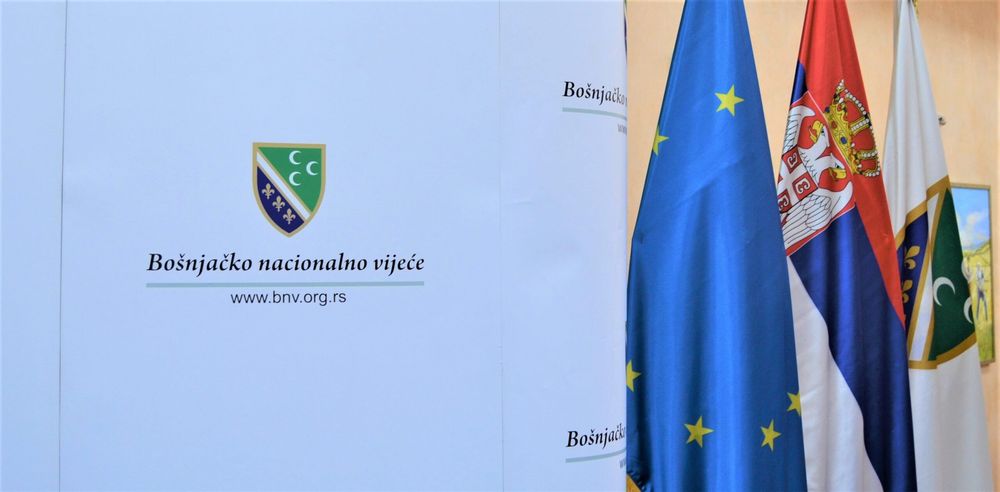
Elections for the Bosniak National Council, as well as for the other national councils of national minorities, have been scheduled for 8 November. This means that members of national minorities will return to the polls just two weeks after Serbia's parliamentary elections.
However, not all national councils will be elected through direct elections. Of the 24 national councils in total, 21 will be elected directly in elections scheduled for 8 November. Two national councils will be elected through electoral assemblies, a procedure that differs from direct voting and is, to some extent, simpler. The Executive Board of the Federation of Jewish Communities of Serbia has recognised status as a national council but conducts its elections separately.
Among the 21 national councils elected directly is the national council of the Bosniaks, known as the Bosniak National Council (BNC).
THE BNC BETWEEN 1991 AND TODAY: THE SEARCH FOR A NEW MODEL
These elections will certainly raise tensions and further complicate the already complex political situation among Bosniaks in Sandžak. It is almost certain that the three most important Bosniak political parties will participate: the Sandžak Democratic Party (SDP), the Justice and Reconciliation Party (SPP) and the Party of Democratic Action (SDA). There is also a possibility that smaller citizens' groups will emerge, as happened in previous elections. According to certain indications, a list backed by the Bosniak diaspora may also take part.
The aim of this article is not to predict election results but to critically reassess existing understandings of the Bosniak National Council: what it is today and what it should actually be. The three largest Bosniak parties have their own models of political activity and different visions of how the Council should be run. Nevertheless, the author of this article believes that all three approaches are fundamentally mistaken and that, rather than strengthening Bosniaks, they contribute in the long term to their weakening and to the reduction of their political influence in Serbia.
This article also attempts to synthesise different understandings of the Bosniak National Council from its establishment to the present day. At the centre of the analysis lies the question of how to reconcile the idea of the Council in 1991, when it was founded as a political and representative body of Bosniaks in Sandžak, with today's BNC, which must operate within the minority legislation of the Republic of Serbia.
The author will not attempt to find some kind of “golden middle ground”, but will instead seek to present a new model for the Council's functioning. This model should take into account the BNC's historical legacy, the existing legal framework and the real needs of Bosniaks in Sandžak. Its aim is not merely to reconcile different approaches, but to create added value and devise a more functional model capable of responding to today's challenges. Democracy, pluralism, Sandžak and the Bosniaks' relationship to geopolitical circumstances are identified as key elements of that model.
Before beginning the analysis, it is necessary to clarify the difference between what is most commonly understood as the Bosniak National Council of 1991 and today's National Council of the Bosniak National Minority, which operates within the Republic of Serbia's minority legislation.
The Muslim National Council of Sandžak (MNVS) was established on 11 May 1991 in Novi Pazar as the highest political and representative body of Muslims, that is, Bosniaks, in Sandžak. Created during the breakup of Yugoslavia, the Council advocated the protection of its people's rights and political autonomy for Sandžak, and represented Bosniak interests at important international peace conferences. In 1993, the organisation changed its name to the Bosniak National Council of Sandžak. Its founding date, 11 May, is still officially celebrated as Bosniak National Flag Day.
The adoption of the Law on the Protection of the Rights and Freedoms of National Minorities in 2002, followed by the Law on National Councils of National Minorities in 2009, established the legal framework within which today's Bosniak National Council must operate. National councils were entrusted with responsibilities in culture, education, information and the official use of languages and scripts. During the process of institutionalisation and legal regulation, Sandžak also disappeared from the Council's name. Today, therefore, we have the Bosniak National Council, without the territorial designation that formed part of its original name.
These two understandings of the BNC are often in conflict, both among Bosniak political representatives and among Bosniaks themselves. SDA and SDP frequently stand on opposite sides of this debate. SDA's leadership, members and supporters often emphasise the Council's political and representative role, whereas SDP representatives argue that its work should be limited to the four areas established by law. SPP, on the other hand, because of its more limited experience of working within the BNC but considerable experience in the activities of the Islamic Community, emphasises the idea of the Council as a place for bringing Bosniaks together. This approach, however, demonstrates an insufficiently clear distinction between different institutions, their responsibilities and their roles in Bosniaks' political and social life.
As already emphasised, the purpose of this article is not to find a “golden middle ground” between existing approaches but to propose a new model for the functioning of the Bosniak National Council, directed towards the long-term well-being of Bosniaks in Sandžak. To build such a model, we must first clearly determine what the BNC should not be, and then define what it should become.
WHY THE BOSNIAK NATIONAL COUNCIL MUST NOT BE APOLITICAL
The Bosniak National Council must by no means be an apolitical or depoliticised institution. Anyone advocating such an approach can hardly be said to be protecting Bosniak interests. The very fact that Council members are chosen in elections, and that elections are political by their nature, clearly demonstrates that the BNC is a political body, whether its representatives like it or not.
In direct elections, citizens choose their representatives, but they also choose between different political programmes, visions and priorities. It is therefore absurd to claim that the Bosniak National Council must be depoliticised or should function as an apolitical institution. Debates within the Council are political, as are decisions on education, culture, information and the official use of languages and scripts. Whether its representatives want this or not, the BNC is always part of broader political processes shaping the position of Bosniaks in Serbia and Sandžak. Its activities therefore necessarily have a political dimension.
That does not, however, mean that the BNC should be excessively politicised, or that every decision and event must become the subject of political confrontation. The Council must not contribute to further polarisation within the Bosniak community or turn every matter it addresses into an opportunity for partisan disputes. Political activity and partisan instrumentalisation are not the same. The former is necessary for representing Bosniak interests, while the latter can seriously undermine the Council's ability to protect those interests.
Consequently, opposing the depoliticisation of the BNC must not be understood as a call to politicise its every activity, but as an effort to preserve its political role and its capacity to articulate the collective interests of Bosniaks. The Council should not be an extension of any political party, but neither should it be an institution that renounces politics, because in doing so it would also renounce part of its essential role.
The Sandžak Democratic Party (SDP) has most frequently advocated the depoliticisation and apolitical character of the BNC, although such rhetoric has been heard less often in recent years. Nevertheless, this debate is worth reopening precisely because the Council's political character is not simply a question of how it operates. It is also a question of whether the BNC will be capable of independently articulating and representing Bosniak interests or whether its role will be reduced to a narrow interpretation of its statutory responsibilities.
THE BNC IS NOBODY'S TEKKE: AGAINST UNQUESTIONING LOYALTY
The next major “NO” concerns the understanding of the Bosniak National Council as a kind of tekke, a place of unquestioning submission to a single authority, usually the Council's president. In previous articles, the author associated this problem with SDA and Sulejman Ugljanin, and this model of functioning genuinely represents one of that party's weaknesses.
The Bosniak National Council is not a place of spiritual instruction, nor an institution in which a single “sheikh” should decide on the most important matters affecting Bosniaks. On the contrary, the BNC can advance only through the confrontation of different opinions, open debate and the possibility of challenging authority. No president, regardless of political influence, achievements or years of experience, should be exempt from criticism. When the authority of an individual is placed above the institution, the Council ceases to be a space for collective decision-making and becomes a means of implementing one person's will.
This criticism in no way challenges the long tradition of Sufism among Bosniaks in Sandžak. On the contrary, it is an important part of Bosniaks' spiritual and cultural heritage that should be preserved and nurtured. The problem arises when the hierarchical relationships characteristic of a tekke are transferred to an institution that should be founded on democratic representation, pluralism and free debate. The boundaries between different forms of authority and their social roles then become blurred, opening the way to the misuse of Bosniaks' religious and national sentiments alike.
It is particularly important to understand that such a model does not merely create a problem of internal democracy. It can also create room for the influence of various actors who are not accountable to citizens and are not subject to democratic scrutiny. When decision-making is based on personal loyalty rather than clear rules and institutional accountability, the Council becomes more vulnerable to pressure and manipulation. This applies particularly to the possible activities of various intelligence and security structures whose interests may not coincide with those of Bosniaks.
The Bosniak National Council must therefore be an institution in which authority is not taken for granted, but must continuously justify itself through work, accountability and the trust of those it represents. Bosniaks do not need an institution in which obedience is expected of them, but one in which they have the right to ask questions, challenge, criticise and decide. Because wherever authority cannot be challenged, a community ceases to be a political subject and becomes a follower.
RELIGION, NATIONAL IDENTITY AND DEMOCRACY: THE LIMITS OF THE BNC'S ROLE
The Bosniak National Council must not be organised along the lines of a religious organisation, nor understood as part of any religious community. Simply put, the BNC is not part of the Islamic Community, nor should it ever become so. It is true that most Bosniaks practise Islam and that Islam has substantially shaped Bosniak history, culture and identity. The BNC must respect these facts, as well as the significance of the Islamic Community in Bosniaks' lives, but it must not adopt its organisational structure or its role.
The distinction is fundamental: the Islamic Community brings together Muslims on the basis of religious affiliation, while the BNC represents Bosniaks as a national community. The Islamic Community deals primarily with religious life and the protection of religious rights, while the BNC operates in the spheres of politics and political representation, national identity, culture, education, information and the official use of languages and scripts, as well as other matters important to Bosniaks. If the BNC were to be understood as a gathering place for Muslims rather than an institution representing Bosniaks, there would be a serious danger of reducing Bosniak national identity to religious affiliation. This would disregard the fact that Bosniak identity is broader than religion and that a national community must have space for different beliefs, views and ways of life.
For example, the BNC is not the place to organise a mevlud with the distribution of halva and sherbet, because that belongs to religious life and the work of the Islamic Community. The BNC is, however, a place where a panel discussion, academic gathering or exhibition devoted to mevlud as part of Bosniak intangible cultural heritage could be organised. The difference between these two approaches clearly illustrates where religious tradition and national culture meet, but also why it is important for their institutional roles to remain distinct.
The second major “NO” concerns the understanding of the BNC as an institution in which some form of “unity” must be achieved or a “unified Bosniak policy” established. Such an approach disregards the fundamental principles of democracy and pluralism. Unity is often presented as a predetermined goal towards which everyone must strive, whereas consensus is built through debate, negotiation, compromise and mutual respect. This distinction is central to understanding how the BNC should function.
As a political and representative body, the BNC must enable the confrontation of different opinions and interests within the Bosniak community. Its role is not to manufacture the appearance of unanimity, but to allow different positions to be considered and, whenever possible, common solutions to be reached. Consensus does not mean that everyone must think alike, but that they are prepared to find an acceptable solution despite their differences. Such agreements have greater legitimacy because they arise from a process of reconciliation and negotiation rather than the imposition of predetermined positions.
By contrast, insisting on unity can lead to the suppression of disagreement, the marginalisation of different opinions and the creation of an illusion that there is only one correct way to represent Bosniaks. Solutions imposed in the name of unity can endure while the political power necessary to enforce them exists, but they can easily change when the balance of power shifts. Consensus based on agreement and compromise provides a more stable foundation for long-term action.
This insistence on unity and the presentation of the BNC as a place where a single Bosniak policy must be formed is associated, among other things, with the approach of the Justice and Reconciliation Party (SPP). The problem with this understanding is not the desire for cooperation among Bosniaks itself, but the assumption that cooperation requires a single position and the suppression of political differences. Bosniaks do not need an institution that will persuade them they must all think alike, but one that will allow their differences to be expressed, reconciled and transformed into legitimate decisions.
The strength of the BNC should not be measured by the degree of unity it succeeds in imposing, but by its ability to build consensus among people who do not have to think alike.
THE BNC IS NOT AN NGO: AN INSTITUTION MUST HAVE A BROADER MISSION
The Bosniak National Council, as the highest representative body of Bosniaks in Serbia, must not be reduced to a non-governmental organisation managing projects and donations. Projects and programmes should certainly be part of its work, but overemphasising this function can turn the BNC into a kind of citizens' association that occasionally addresses matters important to the Bosniak community, rather than an institution that systematically represents its interests.
The BNC is not an ordinary citizens' association, nor should it become a “project centre” whose influence and work are measured by the number of completed projects and the amount of donations collected. Its role cannot be reduced to designing project activities, applying for funding and implementing projects. Projects are instruments for achieving broader objectives, not the reason the Council exists. If its work is directed primarily towards projects and donations, there is a danger that the Bosniak community's priorities will start to depend on available funding sources and donor interests rather than Bosniaks' actual needs.
Likewise, the BNC is not a folklore society, and Bosniak culture cannot be reduced to folklore. Preserving traditional dances, costumes, music and customs is important, but a people's culture encompasses much more: language, literature, art, science, historical memory, cultural heritage and contemporary creative work. The BNC should support and preserve folkloric traditions, but its cultural role must not be reduced to the occasional organisation of folklore festivals and similar events.
The point is that Bosniaks do not need an institution that merely implements projects and organises cultural events, but one that shapes cultural and educational policies over the long term, protects national identity and represents the community's interests. Projects, donations and folklore events may form part of that work, but they must never become its main purpose.
The BNC does not exist to implement projects, but to represent Bosniaks. Projects are an instrument of that mission, not a substitute for it.
THE BNC IS NEITHER A PARTY BRANCH NOR A BOSNIAK GOVERNMENT
The Bosniak National Council is not a party organisation, nor a place that should serve to unite political parties, because such an approach would lead to uniformity of thought from the very beginning. As noted earlier, appeals to unity often involve a form of imposition, whereas consensus achieved through agreement and compromise is certainly desirable. Unfortunately, all Bosniak political parties view the BNC as a kind of prize to be managed like a local party branch.
By contrast, the Bosniak National Council, as a national institution, should be above party politics and independent of political parties, and must never be subordinated to their interests. It is precisely here that its role as a space of political pluralism and democracy comes to the fore, as well as its role as a place where completely opposing positions can be openly confronted.
Furthermore, the BNC is not an institution whose activities must be limited exclusively to the four areas prescribed by law. The history of the BNC does not justify such a limitation, and Bosniaks have specific needs that go beyond the four statutory responsibilities of a national council.
Of course, this also means that the BNC must not be understood as some kind of government, or as a political or executive authority. The Council is above all a representative body and cannot “govern” anything, nor can it be regarded as an executive institution, because that would mean assuming responsibilities it has no ability to fulfil. Such an understanding results from the excessive politicisation of the BNC, which can portray it as an exclusively political institution and create opportunities for manipulation that could ultimately weaken it.
WHOEVER DESTROYS THE BNC CONTRIBUTES TO THE POLITICAL DISAPPEARANCE OF BOSNIAKS
Having defined what the Bosniak National Council must not be, we come to the question of what it should be, or what model of functioning the author considers most appropriate for both Bosniaks and the institution itself. Above all, the BNC must have a clearly defined representative, non-partisan and secular function, while also serving as a space of political pluralism and democratic decision-making. It should be an institution Bosniaks regard as a barrier against different forms of pressure, whether originating from the state or from Bosniak political parties themselves. The BNC should protect Bosniaks from negative political tendencies coming from outside Sandžak, but also from those arising within their own political community. Its task is to be an institution where every Bosniak man and woman feels at home, rather than like someone visiting an institution appropriated by a particular party or group of individuals.
Regarding the political directions and values that the BNC should particularly safeguard, the author identifies several key questions.
The first concerns Sandžak and its preservation as a historical and cultural region with which Bosniaks in Serbia are inseparably connected. This does not mean that the BNC should advocate political autonomy for Sandžak, but that it must preserve awareness of Sandžak as a historical, cultural and social reality. The BNC should be a kind of “guardian of Sandžak”, rather than a political party that views its existence through the lens of immediate political interests. A party can change its programme, political alliances and priorities, but a national institution has a longer-term responsibility: to protect the history and culture of the people it represents and preserve their historical memory. Sandžak is precisely such a reality, and the BNC must have a clear role in preserving it.
The second important question concerns democracy, egalitarianism and pluralism. The Bosniak National Council must remain a space for the free confrontation of different opinions, because only in this way can a culture of political and social differences within the Bosniak community be preserved. The Council should promote egalitarianism, meaning the idea that no individual, family, political party or informal group has a predetermined right to govern Bosniaks. In a society where different hierarchical structures are present, egalitarianism can be an important principle for preserving Bosniak distinctiveness and internal freedom.
Democratic values are also important for preserving the authenticity of Bosniak identity, which brings together European historical experience and Islamic cultural heritage. This distinctiveness should not be demonstrated by closing oneself off or imposing a single worldview, but precisely through the ability to embrace differences and recognise freedom of thought as a value. A BNC that does not cultivate democracy risks becoming an instrument for suppressing the political rights of Bosniaks, whose position and opportunities for political influence certainly require additional attention and protection.
The third question concerns the European Union and European integration, which, in the author's opinion, should form part of the BNC's political orientation. Bosniaks in Sandžak occupy a specific geopolitical position: they have no kin-state on which they can rely unconditionally, either politically or economically, and they lack the capacity to depend independently on major geopolitical actors such as Turkey, Russia or the United States. For that reason, European integration should be viewed as an important framework for protecting rights, strengthening democratic institutions and ensuring the long-term political security of Bosniaks in Sandžak.
To put it most directly, Bosniaks in Sandžak have no state on which they can rely unconditionally to protect their national interests. The historical experience of the Serbian state's relationship with Bosniaks provides further reason for caution and for the need to protect their rights through stable institutional and international mechanisms. The European Union therefore represents a logical strategic choice, not as an idealised solution to every problem, but as a political framework within which minority rights, democratic standards and the rule of law can be further strengthened. Commitment to European integration should not be merely a declarative message, but a principle guiding the BNC's activities and its understanding of Bosniaks' long-term interests.
Ultimately, Bosniaks must regard the BNC as one of the key institutions of their own political and national security, a kind of umbrella that can protect them from different political storms. This does not, of course, mean that the Council is infallible or can replace all other institutions. Its strength, however, lies in the fact that it should belong to all Bosniaks, regardless of their party affiliation, political beliefs or attitude towards the current leadership. Bosniak political parties must finally understand that the BNC is not a prize to be won in elections or a party department run from party headquarters. It is an institution whose weakening threatens the entire community in the long term.
If Bosniak parties continue to treat the BNC as spoils of war or an electoral prize, eventually there will be nothing left worth winning. Every party that weakens the Council today for short-term interests will face the consequences of such policies tomorrow. Without a strong, pluralistic and independent national institution, Bosniak parties will gradually lose their reason for existing as authentic representatives of Bosniaks and will increasingly become local branches of the political parties of Serbia's majority population. This process is already unfolding before our eyes. And once an institution that preserves collective political identity is lost, changing a president, a party or an election slogan will not be enough to repair the damage.
Bosniaks can survive the defeat of a party, the replacement of a leader and the loss of an election. But if they allow their parties to destroy the only institution that should belong to all of them, they will lose more than the BNC. They will lose the ability to decide independently, as a people, about their own future. And a people that allows others to determine its future sooner or later ceases to be a political subject and becomes merely an instrument in someone else's political calculations. Bosniaks are well on their way to becoming precisely that.
Comments