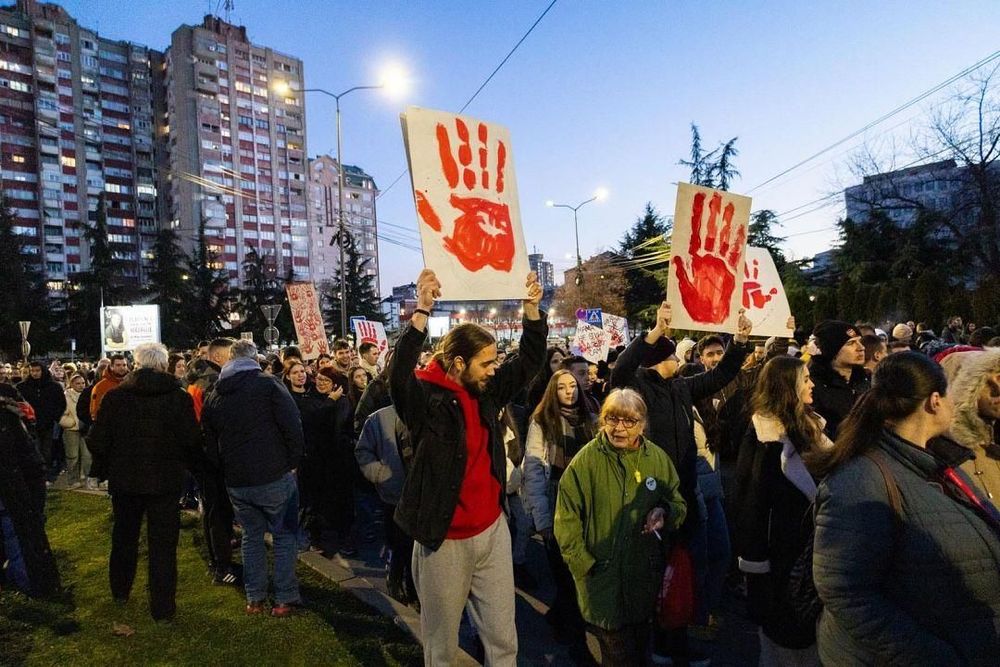
The red hand appeared on the streets of Serbia soon after the collapse of the railway station canopy in Novi Sad on 1 November 2024. Printed in paint on cardboard, drawn on asphalt, raised as a red glove, pasted onto windows or facades, it became a visual shorthand for the phrase “Your hands are bloody.” By spring 2025, it was almost impossible to avoid. By summer 2026, it had lost some of its original centrality, but it remained part of the protest repertoire.
No art education is needed to understand it. The colour red, the hand, blood and responsibility work almost instantly. That is precisely where the political value of a successful protest symbol lies. It shortens the distance between an event and its meaning.
The collapse ultimately claimed 16 lives. The protests that followed grew into a prolonged social movement, led primarily by students, with demands concerning the release of documentation, institutional accountability, violence against demonstrators and, later, elections.
But the hand did something that a document hundreds of pages long cannot. It made one claim visible at a glance: someone is responsible.
That is where protest art begins.
A symbol has to arrive before the explanation
Art created in protest rarely has the luxury of a long production process. It works with whatever is available: cardboard, spray paint, fabric, paint, a photocopier, a phone, a wall. The author often remains unknown, and the work begins to change as soon as others take it over.
In Serbia, the bloody hand moved from a graphic sign into a gesture. Actors raised red gloves while taking their bows. Banners combined it with new slogans. Different versions appeared on the streets, while the protests also used silence, noise, marches, blockades and the symbolic occupation of space. A study published in 2026 in TDR: The Drama Review describes how visual signs, time and space became part of the shared political performance of the student movement.
That distinction matters. Protest art does not have to hang on a wall or have an author whose name will later enter a catalogue. Sometimes the artistic material is 16 minutes of silence. Sometimes it is a body wearing a red glove. Sometimes it is a message someone writes on a facade overnight, knowing it may be painted over by morning.
In May 2026, Mašina wrote about a kind of sticker and graffiti war in Belgrade and Novi Sad. Mural artist Jana Danilović explained the advantage of public space in one simple sentence: “those messages will reach you when you go out to buy bread.”
You can change the television channel. You can block a profile. A wall on your way to the shop does not ask whether you want to see the message.
That is why the struggle over public space is almost always also a struggle over who gets to decide what society will see.
Paris 1968: the print shop as part of the revolt
During the protests and general strike in France in May 1968, art students and demonstrators organised a workshop known as Atelier Populaire inside the occupied École des Beaux-Arts in Paris.
The working principle was simple. People discussed the events of the day, chose a message, developed a design, screen-printed posters and then pasted them around the city. MoMA describes how new images emerged as immediate responses to the police, the government, workers’ strikes and political developments.
The aesthetic followed the conditions. Few colours. Strong contrasts. Short messages. A police officer with a baton. A raised fist. A factory. De Gaulle. A sentence large enough to be read while walking past.
Authorship was largely collective and anonymous. Earlier MoMA materials note that students and workers discussed and selected motifs together, while anonymity reflected both the way the workshop operated and a political necessity.
Only a few months later came the paradox that follows almost every successful art of rebellion. In November 1968, some of those posters were already being exhibited at the Museum of Modern Art in New York. Objects made to be pasted onto walls, torn down, covered over or removed by police hands were placed under museum lighting and given inventory numbers.
The museum preserved them. It also changed their setting.
On the street, a poster is part of a conflict. In a museum, it becomes evidence that the conflict once happened.
That change does not necessarily destroy the political force of the work, but it changes how we look at it. In front of a police cordon, a poster is a message to those in power. Fifty years later, behind museum glass, it can easily become a document of an exciting historical period.
Anger acquires a date.
Chile: when a piece of fabric becomes a document
During Augusto Pinochet’s dictatorship in Chile, political testimony was often produced far from art academies.
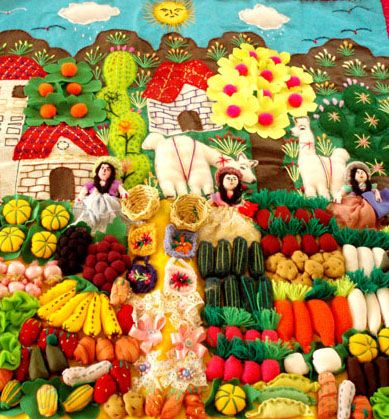
Women, including wives, mothers and relatives of detainees and the disappeared, made arpilleras, textile images assembled from scraps of fabric and coarse cloth.
They did not depict repression in abstract terms. They showed food queues, unemployment, police, prisons, demonstrations, disappearances, poor neighbourhoods and daily life under dictatorship.
The Museum of Memory and Human Rights in Santiago holds a collection of 55 such works covering the period from the 1973 military coup to the return of democracy in 1990. The museum states that women used them to document human rights violations and social events, while also earning money for households affected by unemployment and political imprisonment. The works were taken out of Chile and shown in other countries as a form of information and solidarity.
Here, the art object assumes an almost documentary function.
A state can control television, newspapers, court records or the official version of events. It is much harder to prevent someone from using a piece of blue fabric to make a police van, red thread to represent blood, and an empty space in a family scene to show a man who never came home.
An arpillera does not, by itself, prove a specific crime. Its value lies elsewhere. It preserves the experience of people whose public speech was restricted and shows what political violence looked like from the kitchen, the neighbourhood and the family.
The history of repression is usually written through the names of generals, laws and dates. On these fabrics, you can see how much bread cost.
When silence became an equation
New York, 1987. AIDS had already claimed tens of thousands of lives, while the epidemic was accompanied by intense stigma against gay men and people living with HIV.
A group of six activists and artists created a black poster. On it was a pink triangle and two words:
SILENCE = DEATH.
The pink triangle came from the symbol used by the Nazis to mark certain prisoners persecuted for homosexuality. The collective turned it upright and transformed it into a sign of political mobilisation. The poster was later adopted by ACT UP and became one of the most recognisable symbols of AIDS activism.
The design was ruthlessly economical. No photograph of a sick body. No attempt to provoke pity. No half-page explanation.
A single equation accused political silence.
ACT UP and the collective Gran Fury continued to use graphic design, advertising techniques, posters and public interventions to pressure institutions, pharmaceutical companies and political actors. The Metropolitan Museum records how their work entered the media, protests and popular culture, while offset printing enabled messages to be reproduced cheaply and at scale.
Today, Silence=Death is held in the collections of major museums.
That is a victory for memory, but it carries a risk. An icon can outlive the politics that produced it.
For precisely that reason, in 2018 The Met published an essay titled Reconnect Images of Protest with Their Context. Without context, the pink triangle can easily become excellent graphic design. With context, disease, death, homophobia, institutional delay and the activists who refused to accept all of it as normal return to view.
Serbia already knows the power of a good symbol
The bloody hand is not the first case in which a political movement in Serbia has developed a visual identity that outlives individual actions.
In the late 1990s, Otpor used a black-and-white clenched fist as a sign that could be reproduced almost anywhere. Research on student and youth protests of that period records how humour, street performance and a recognisable visual identity helped the movement spread beyond conventional opposition rallies.
That experience also reveals a problem that follows political aesthetics.
A good symbol can help a movement spread. Trouble begins when the symbol starts standing in for the movement itself.
A T-shirt, badge, poster or viral photograph can produce a sense of belonging without the political risk that gave the original sign its meaning. Otpor can become retro design. Silence=Death can become an object in the history of graphic design. May 1968 can end up as a poster in the room of a student who has never read what happened then.
The same will one day happen to part of the visual culture of the current protests in Serbia.
Some photographs will end up in books. Banners will enter archives. The bloody hand may eventually be displayed in a museum as a symbol of the political crisis of the 2020s.
The question then will not be whether the object is valuable enough to be called art.
What will be far more interesting is what the curator writes on the label beside it.
Who controls the memory of protest
Those in power usually have an institutional advantage in producing an image of themselves. They have press conferences, state ceremonies, television broadcasts, archives, official statements, monuments and money.
Protest operates with a different economy. Its image has to be cheap, portable and easy to reproduce.
That is why protest symbols are often brutally simple.
A fist.
A triangle.
A hand.
A piece of fabric.
A single sentence.
Their power comes from repetition. A thousand identical hands in a thousand different places create the impression that the message no longer has a single owner.
That creates a problem for those in power. Removing one poster removes a piece of paper. The symbol already exists in thousands of phones and minds.
That is why painting over graffiti, tearing down posters and removing stickers carry political meaning even when presented as routine maintenance of public order. Public space determines who is allowed to speak outside media channels controlled by someone else.
Present-day Serbia offers an almost laboratory-clean example of this conflict. During the protests, the bloody hand was reproduced, crossed out, removed, redrawn, parodied and attacked with competing symbols. Its centrality changed over time, but its historical function did not disappear with it.
It connected one construction structure, 16 dead people and the question of institutional accountability in an image that can be drawn in a few seconds.
That is what the strongest protest art does.
It does not provide a complete explanation of an event. Investigations, courts, journalists, documents and history exist for that.
It prevents the event from quietly disappearing from view.
And when someone persistently tries to remove a particular image from a wall, they have already admitted that they understand the message.
Comments