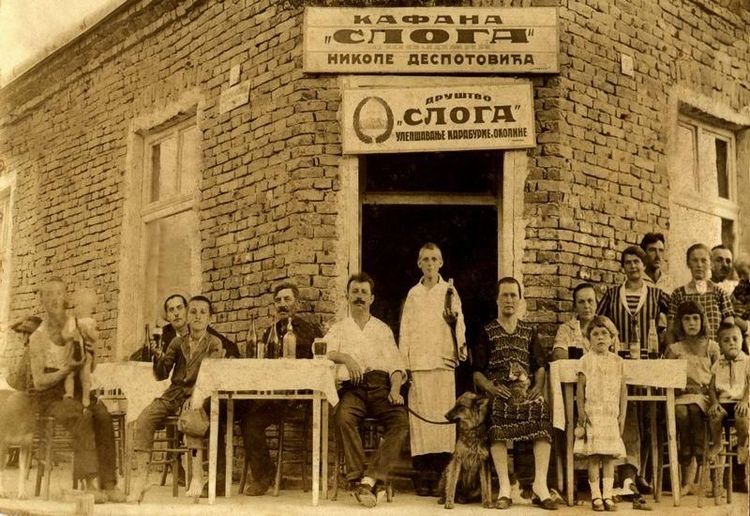
The name of one of Belgrade’s best-known kafanas was born out of a dispute.
At the end of the 19th century, the kafana in today’s Kralja Petra Street was called “By the Cathedral Church”. Church authorities objected, and the name also conflicted with the regulations governing kafanas at the time. While waiting for the dispute to be resolved, the owner placed only a question mark above the establishment. The temporary sign has remained the kafana’s name to this day.
The Cultural Heritage Preservation Institute of Belgrade records another detail. In this house, built in 1823, people from public and cultural life gathered, including Vuk Karadžić, and discussed cultural and public affairs. The building was declared a cultural monument in 1946. When the possibility arose at the beginning of this century that it might change owner and purpose, guests and others who wanted its function preserved protested. The Institute later wrote that the place had over time become “an institution in itself.”
That phrase says much more than the usual story of rakija, tamburica players and bohemians.
For centuries, the kafana performed functions for which cities today have newsrooms, offices, cultural centres, clubs, meeting rooms, noticeboards and social networks. People learned the news there, looked for work, negotiated trade, discussed politics, listened to music, found temporary accommodation, connected with people from the same profession or region and, quite simply, spent hours outside their homes.
The history of the kafana therefore tells us how people in the Balkans created public life before public space became what we understand by that term today.
A city organised around a table
The roots of kafana culture lead back to the Ottoman world of the 16th century. The kafana developed alongside the spread of coffee, but very quickly became something much larger than the cup itself. Historian Aleksandar Fotić, who studied the arrival of coffee and tobacco in the central-western Balkans, shows how early this institution spread and how adaptable it was to local life.
In the mid-17th century, Evliya Çelebi recorded around forty kafanas in Bitola. When a major fire struck Sarajevo in 1788, chronicler Mula Mustafa Bašeskija wrote that fifty or sixty kafanas had been destroyed. In Belgrade there were at least twenty in the second half of the 18th century. Fotić also mentions Novi Pazar, where inns had separate rooms functioning as kafanas. On the Adriatic and Habsburg sides, development followed a different rhythm: sources associate Zagreb with a coffeehouse in 1749 and Split with one in 1772.
The boundaries between the kafana, mehana, han, inn and restaurant were unclear for a long time. In Christian settlements, where alcohol was permitted, the offers overlapped. Hans served coffee, kafanas served food and alcohol, and some places also provided accommodation. It is precisely this ability to combine several functions that explains why the word “kafana” cannot be fully translated today as café, pub or restaurant.
For that reason, ethnomusicologist Ana Hofman retained the original word kafana in her work on professional musicians in Yugoslavia. According to her explanation, foreign terms capture only parts of an experience that includes food, drink, music and socialising. The kafana was particularly associated with Serbia, Bosnia and Herzegovina and Macedonia, but as a concept it was understood throughout Yugoslavia. It also had a very concrete economic function: it represented one of the main labour markets for professional musicians.
The kafana therefore did not become a cultural institution by decision of a ministry of culture. It became one through the repetition of everyday life.
A place where power listens
Where people gather, power appears as well.
Historians of Ottoman coffeehouses have long pointed out that authorities regarded these spaces as a potential political problem. Conversations, satire, stories and rumours could circulate among people who otherwise had no formal access to centres of political power. More recent research on popular politics in the Ottoman Empire shows that political ideas spread through oral storytelling, conversation, handwritten texts and performances long before the modern mass press became the main channel of public communication.
The kafana table was therefore also a space of surveillance.
In the 19th century, Belgrade authorities attempted to regulate kafana opening hours, nighttime gatherings, gambling and contact between different groups of residents. Historian Miloš Jovanović shows that state intervention included tax, moral and spatial regulations, followed by police surveillance. Some prohibitions simply did not work. Documents record that people continued to gather, drink, gamble and socialise despite the regulations.
This is an important part of kafana history that is easily lost when the past is transformed into a sentimental photograph with a checked tablecloth.
Power understood very early what both states and technology platforms know today: a space through which information circulates is also a space in which political power is produced.
In Belgrade in the 19th and early 20th centuries, that connection became even clearer. Historical studies connect kafanas with political parties, newspaper editing, elections, commercial agreements, cultural events and everyday meetings. Boško Mijatović, one of the authors of An Illustrated History of Belgrade Kafanas, explains the position of the kafana very practically. The city simply did not have many other public spaces in which people could do all these things.
The institution emerged partly from the absence of institutions.
A public sphere that was not everyone’s for a long time
The romantic version of the kafana often presents it as a democratic space where social differences disappear around the same table.
Reality is more complicated.
Ottoman coffeehouses were overwhelmingly male spaces. Research into public life in the Ottoman Empire shows that people from different occupations, social strata and religious communities could meet there, but women’s access was heavily restricted by social rules governing public space.
The kafana expanded one kind of public sphere while maintaining other boundaries at the same time.
Women, of course, had their own communication networks in homes, hammams, neighbourhoods and other spaces. The problem arises when we write the history of public life only through the places where men were present. Then conversation around a kafana table becomes “politics”, while the exchange of information in other spaces remains private or invisible.
During socialist Yugoslavia, women’s relationship with the kafana began to change, although older patterns did not simply disappear. Ana Hofman studied kafana singers in the 1950s and 1960s and showed how their professional lives existed between official policies of gender emancipation, the development of the entertainment industry and social ideas about women working in kafanas. Performing provided some singers with income, public visibility and greater control over their own lives, while the profession itself remained burdened by moral judgement.
The kafana was therefore a cultural institution of the Balkans also because social relations could be seen there as they actually were: who was allowed to sit, who served, who sang, who paid, who spoke the loudest and whose reputation changed simply by entering the room.
Music that cannot be separated from the place
Few parts of kafana culture have endured as strongly as music.
In Serbia and the wider Yugoslav space, the kafana was for decades a workplace for musicians, a space in which repertoire developed in direct interaction with the audience. A song was not a programme fixed in advance. A guest made a request, the musician read the room, the repertoire changed throughout the evening, and money passed from hand to hand.
Marija Dumnić of the Institute of Musicology at the Serbian Academy of Sciences and Arts describes kafanas as important communication spaces of Serbian culture and as one of the environments that contributed to the professionalisation of musicians and the development of urban folk music. Historically, kafana performance was simultaneously condemned as a corruption of “pure folklore” and presented as a particularly authentic experience.
That contradiction survives today.
Skadarlija is a good example. Its present appearance is not simply the preserved remnant of an untouched old Belgrade. The street’s reconstruction, begun in 1966, consciously shaped the area according to an image of an old bohemian quarter, conceptually compared with Paris’s Montmartre. Dumnić shows how the area later became part of Belgrade’s tourist image, in which “authenticity” is produced through a particular architecture, food and music.
Something interesting happens here.
A culture created by generations of ordinary guests and musicians can become a product that sells its own past to the next generation.
The kafana acquires a menu in several languages, a prepared repertoire and a carefully designed “old kafana” appearance. The visitor receives what they expect the Balkans to look, sound and smell like.
Dumnić also connects this with auto-Balkanism, the acceptance of a stereotypical image of the Balkans as a European periphery full of complicated history but excellent food, music and nightlife.
Such an image can be pleasant. At the same time, it erases much of what made the kafana important in the first place.
What remains when the regulars disappear
The kafana still exists today, but very different things live under the same name.
There is the village kafana where everyone knows who comes in after work. The city kafana where waiters remember guests for decades. The restaurant where “traditional” means a designed interior, a tourist menu and music adapted to TripAdvisor visitors. There are also places that have kept the name while the social function that once made them important has almost disappeared.
Research on contemporary Belgrade and relations between local residents and foreigners still recognises the traditional kafana as a place through which someone can enter the local social world. The authors also describe it as a kind of extension of private space, in contrast with standardised venues that may look almost identical in different European cities.
Perhaps this offers a more useful definition of the kafana than trying to determine exactly what must appear on the menu.
A kafana functions when people feel that the space belongs to them, at least in part. When it is known who sits where, when a conversation from the next table can become part of yours, when the staff know the rhythm of the neighbourhood, when the venue also serves people who did not come to consume a “Balkan experience”.
That is why the disappearance of an old kafana matters for more than its interior or historical name. A city may lose part of its informal social infrastructure.
Some kafanas deserve protection because of their architecture. Others do not have a single valuable wall, but carry decades of relationships between people. That kind of heritage is far harder for the law to register. It cannot be restored like a facade.
The “?” kafana survived changes of states, owners, political systems and tastes. Its name was born as an improvisation in a dispute with authority. Today it is protected cultural heritage.
Perhaps that history is the best argument for taking the kafana seriously. Balkan cities did not only drink and sing through it. They practised public life there.
And when the last regular guest leaves and only the scenery remains, the building can still look exactly the same.
The institution has already disappeared.
Comments