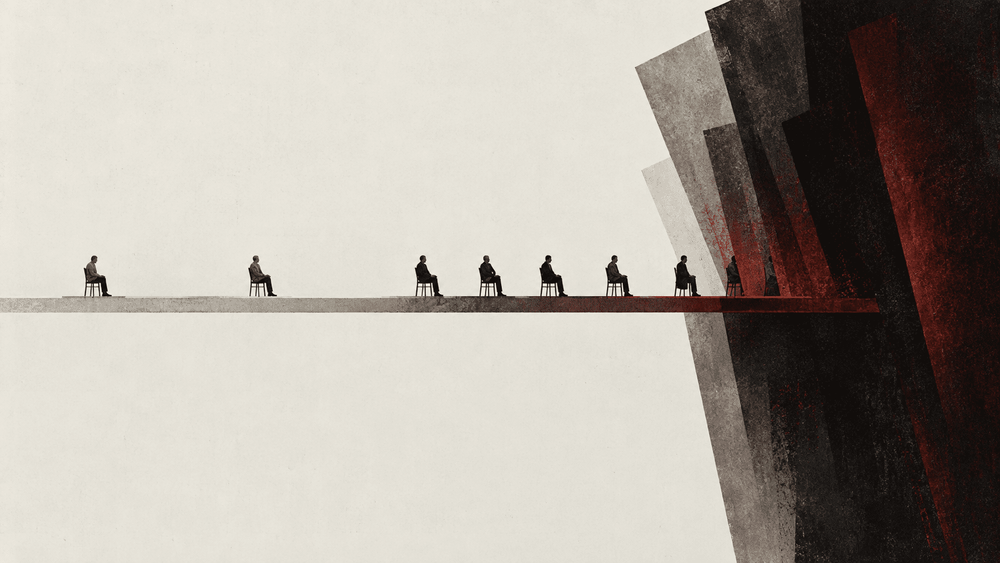
There is a mistake that occurs in everyday thinking, one that concerns the position of the moderate middle. It assumes that reasonable behavior is behavior located somewhere between two extreme forms of behavior, or that a reasonable position is one that compromises between two diametrically opposed positions without examining their characteristics or the values contained within them.
Compromise and the moderate middle are certainly desirable positions when we are dealing with relatively moderate views and behaviors that do not endanger anyone and are not considered extreme. If we were to represent compromises and centrist positions on a horizontal axis, this would make sense as long as the positions furthest from the center remained relatively close to it. The further those extreme positions move away, and the more distant they become from one another in terms of values, the more questionable the position of compromise becomes. This text does not seek to reject compromise as such or the position of the moderate middle, but rather to examine how compromise and the moderate middle can lead to the normalization of extreme behavior.
If we take the banal example of a manager trying to resolve a problem within a workplace, where two employees are in dispute and both claim that their rights have been violated, we can easily see how compromise can produce negative consequences. Let us say that one employee has the arguments on their side, while the other is more emotional in their presentation, speaks more persuasively and has a better relationship with the manager. Although the arguments are visible, because of the second employee’s more emotional performance and their personal relationship with the manager, the manager seeks a compromise solution. That compromise automatically comes at the expense of the employee whose arguments are stronger, meaning that by creating a compromise solution, the manager effectively enters the territory of violating one employee’s rights.
It is therefore extremely important to examine the quality of the arguments, as well as one’s own emotions, before attempting to reach a compromise. In this case, compromise leads to the violation of one employee’s rights and legitimizes an emotional approach to disputes, which in turn creates the possibility of further violations of rights.
If we go one step further and consider the current situation surrounding the death of Ratko Mladić and the attempts by some media outlets to cover it, we once again encounter an effort to create a compromise that can only legitimize extreme behavior. Some media in Serbia say that Serbia is divided between two poles: those who claim that Ratko Mladić was a war criminal and those who claim that he was a hero who defended the Serbian people in Bosnia and Herzegovina. The likely aim of such headlines is to find some kind of compromise or to try “to reconcile the opposing sides.” This is where the fatal flaw of the moderate middle and compromise appears, because the outcome is the normalization of extreme behavior.
Ratko Mladić, although there are strong arguments that he was responsible for war crimes in Bosnia and Herzegovina, is set against a fictional Mladić who is presented as a hero of the defense of Serbs in Bosnia and Herzegovina. The second argument is more emotional in nature, because there are no records of Mladić’s defensive campaigns, only of his participation in the most heinous war crimes. One politician from the Bosniak community, wishing to close the story surrounding Mladić, said that “Ratko Mladić is a man who was convicted before the Hague Tribunal and not another word should be said about it.” The same politician said that “the tears of the people of Srebrenica will bear witness against Ratko Mladić in the world to come.”
Such formulations are precisely the product of an attempt to find compromise where, in essence, compromise is impossible. These terms are certainly a very poor and unintelligent attempt at compromise and agreement, in which the very attempt leads to the normalization of an extreme position, because it recognizes the possibility that Ratko Mladić was a hero who defended Serbs in Bosnia and Herzegovina. Technical formulations describing him simply as a person convicted before the Hague Tribunal, without specifying the crimes for which he was convicted, also leave room for the claim that he was unjustly accused. Emotional statements about “some kind of punishment in the world to come” perform the same function, because they ignore the crimes for which Mladić was convicted. Such moves are generally driven by personal interest: in the first case by the need to “smooth relations with Belgrade,” and in the second by an emotional-religious component intended to bring political points and popularity within the Bosniak community.
In this way, Ratko Mladić as a person becomes the subject of dispute and therefore the subject of possible compromise. This leads to facts about his responsibility for the gravest war crimes being labeled an extreme position, while he himself is presented as a controversial figure. More than 25 years ago, a similar process opened the debate about the relationship between Chetniks and Partisans during the Second World War. First Draža Mihailović and his Chetniks became “controversial” and “factors dividing Serbia,” after which Draža Mihailović was rehabilitated, while Chetniks and Partisans were equated and both groups were credited with fighting against the occupier. We are now in a phase in which even the participation of the Partisans has become controversial, and soon, probably, we will find ourselves in a situation in which the Partisans are declared collaborators of the occupier and the socialist period is described as the “communist occupation of Serbia.” All of these are consequences of making compromises and of the need to remain in the middle, even when on one side there is a fact and on the other its denial.
Another very clear example is the way part of the Serbian public treats the genocide in Srebrenica. There is a powerful narrative that seeks to present the definition of the events in Srebrenica in the summer of 1995 as a dispute between two opposing camps: one claiming that genocide was committed against the Bosniak civilian population in Srebrenica, and the other claiming that everything was fabricated, that no genocide took place and that Serbs were in fact the ones who survived genocide in the territory of Srebrenica. The narrative that seeks compromise and speaks of the importance of moderate positions offers a highly malicious and hypocritical position: that a terrible crime took place in Srebrenica, but that it was not genocide.
The malicious and manipulative nature of this way of thinking is already present in a large part of the Serbian public, even among supporters of the Student List and student representatives themselves, who believe that “the issue divides rather than unites” and that “there are different interpretations.” Many of them, in a highly malicious way, say that crimes were committed on all sides and that victims must not be divided along national lines, thereby consciously or unconsciously legitimizing genocide denial. The problem with such a position is that, because of the emotional charge and the need to find a “middle ground,” it can very easily shift further toward the completely opposite side. We may therefore reach a situation in a few years in which the dominant narrative is no longer based on the fact that genocide was committed against Bosniaks in Srebrenica, but on the claim that a crime against the Serbs of Srebrenica took place there, eventually reaching the point where genocide itself begins to be attributed to crimes against Serbs. Once an opinion becomes sufficiently widespread, it stops being perceived as extreme and begins to be presented as a “normal” opinion that “does not divide the people.” What was unacceptable yesterday, through the constant search for the “middle,” gradually becomes acceptable through relativization, then normal, and finally part of majority thinking. In this way, the boundary between the extreme and the normal shifts step by step until the extreme is no longer recognized as extreme at all.
The clearest example of this kind of thinking is the attitude of the majority of Serbia’s population toward the 1999 NATO bombing. In the early 2000s, it was rarely discussed, but there was a part of the public that understood the broader context that led to the bombing of the then Federal Republic of Yugoslavia, including the armed conflict in Kosovo, as well as crimes and serious violations of the rights of Kosovo Albanians by forces under the control of the Yugoslav and Serbian authorities at the time. However, by framing the issue as polarizing, we have now reached a majority position that the NATO bombing was an act of military aggression against Serbia, while the context that preceded it is often completely suppressed. Representatives of the student movement even commemorated this date. The issue was never how old they were when Srebrenica or the NATO bombing occurred, but rather how society relates to these questions. Had the student uprising taken place some ten years later, students would probably also have commemorated a genocide against Serbs in Srebrenica and the Drina Valley, because by then such a position, through the process of normalization, would probably have been presented as normal and “balanced.”
We therefore have to return once again to the political position of the center and the way in which, when turned into dogma, it can corrode a society. The problem with a politics that seeks the middle at any cost is that it often does not stop extremes, but gradually normalizes them. Every time a concession is made to an extreme demand for the sake of “compromise,” the boundary of what is acceptable moves a little further. What was unthinkable yesterday becomes a subject of debate today, a compromise tomorrow, and the new normal the day after tomorrow. In this way, the extreme stops looking extreme because society becomes accustomed to it step by step. The most dangerous consequence of a politics that seeks the middle at any cost is therefore not merely a bad compromise, but a systematic shifting of the boundary of the acceptable. When we constantly move toward the extreme in order to find the “middle,” what we eventually obtain is not the middle. We obtain a society that, through its concessions to extremism, has helped the extreme become normal.
Extremism is therefore not countered by diluting its demands until they become acceptable, but by clearly establishing boundaries. Compromise should concern methods and means, but not fundamental principles, facts and elementary values. A society must have enough political and intellectual courage to say that something is unacceptable even when doing so is the easiest path to an apparent peace and consensus. Because when, for the sake of peace, we constantly make concessions to those who move the boundaries, we do not obtain peace. We produce a new boundary of the acceptable. And once a boundary has been crossed enough times, we no longer even notice that it has been crossed. This is precisely how the extreme becomes normality: not through one great step, but through hundreds of small compromises.
Comments