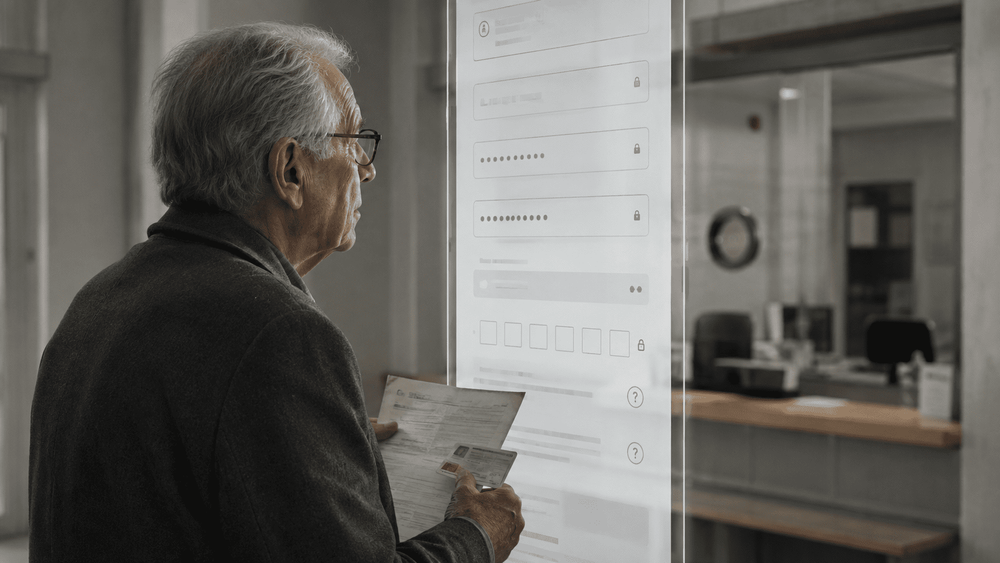
When the State Moves Behind a Screen
Serbia can point to the fact that 90.1 percent of households have internet access. At the same time, its main survey on citizens’ digital lives does not include people over the age of 74 at all. In that gap between statistics of progress and the people those statistics fail to see lies a much larger problem: what happens to citizens’ rights when the state, banks, healthcare providers and other services begin to assume that everyone has a device, an account, a password and someone who can explain where to click?
On paper, digitalisation looks almost flawless.
A document can be ordered without visiting an institution. A bill can be paid from the living room. An application can be submitted electronically. An appointment can be booked online, the status of a case checked through a portal, and a notification delivered to a phone.
For many people, this really is progress.
The problem begins when an option turns into an expectation, and that expectation gradually starts to resemble a requirement.
What happens to someone who does not own a smartphone? To a 78-year-old woman who uses her mobile phone only for calls? To someone who struggles to read text on a screen, cannot tell a PIN from a verification code, or simply does not want to enter card details on a website they do not trust?
The system’s most common answer is not: we will help you.
Much more often it is: ask someone younger to do it for you.
That is where digitalisation stops being merely a technological issue. It becomes a question of equality.
Because a citizen who can exercise a right only if a child, grandchild, neighbour or copy-shop employee opens an account and enters their data has not been given a simpler system.
They have been given a new intermediary.
Ninety percent are online. But who is missing from the statistics?
According to the Statistical Office of the Republic of Serbia, 90.1 percent of households in Serbia had an internet connection in 2025, while 90 percent of surveyed individuals had used the internet during the previous three months.
The figure makes it sound as though the digital divide has almost disappeared.
It has not.
Having internet access at home is not the same as being able to use online banking, eGovernment services, health portals or digital certificates independently. A phone connected to the internet tells us nothing about whether its owner can recognise a phishing message, change a password, locate an electronic form or understand why a system is asking for a code that has just arrived by SMS.
There is a major difference between access to technology and digital independence.
Someone may speak with family through Viber every day, check the weather and watch videos, yet still be unable to submit an electronic request or manage their own money safely without help.
But there is something else that the figure of 90.1 percent does not show.
Serbia’s survey on the use of information and communication technologies among individuals covers people aged 16 to 74. Eurostat uses the same age range. People aged 75 and over are not included in this survey.
That is not an insignificant methodological footnote.
It is precisely among people of advanced age that we may expect more difficulties related to eyesight, motor skills, memory, income, access to devices and previous exposure to digital technologies. And yet, when we talk about how “digital” Serbia has become, their experience does not enter one of the main statistics used to measure that progress.
This does not mean that the state has no data whatsoever about people over 74. It means something more specific: the main survey measuring the use of digital technologies stops precisely at the age threshold beyond which the risk of digital exclusion may become even more pronounced.
If the data does not include the oldest citizens, we cannot behave as though it describes everyone.
Internet access is not the same as digital power
European data makes the generational gap even clearer.
According to Eurostat, 60 percent of people aged 16 to 74 in the European Union had at least basic digital skills in 2025. Among those aged 65 to 74, the share was only 33 percent. Educational differences are equally striking: 82 percent of highly educated people had at least basic digital skills, compared with 38 percent of those with little or no formal education.
That matters more than the familiar story about a “generation that did not grow up with technology”.
Digital inequality is not only generational. It has a class, an education level, a geography, a gender and a health dimension.
A retired professor who spent the last two decades of their career using a computer is not in the same position as a woman who spent her working life in manufacturing or agriculture. Someone who can replace a phone when an old device stops supporting an application is not in the same position as a person whose pension barely covers basic expenses.
Still less comparable are a person living with their children in Belgrade and someone living alone in a village, without a computer, with poor eyesight and dozens of kilometres between them and the nearest institution.
When all these differences are described simply as a “lack of digital skills”, the problem sounds easy to solve: the person only needs to learn something.
But what if the device is too expensive?
What if the design is bad?
What if there is no support?
What if the language used by the institution is difficult to understand?
What if one mistake can mean a blocked account, an incorrectly submitted application or lost money?
At that point, the problem is no longer the user.
It is the system that has declared one imagined user to be universal.
A service counter may still exist without access being equal
Digital public services are not a problem in themselves. On the contrary, for someone with reduced mobility, someone who lives far from an institution or simply wants to complete an administrative task without waiting in line, they can make life considerably easier.
The problem begins when the digital channel becomes dominant while the analogue alternative still exists formally but becomes slower, more complicated or harder to access.
That is the difference between digitalising a service and digitalising a right.
The first means that citizens gain another way to get something done.
The second begins when access to a right effectively depends on the ability to use technology.
The European Union Agency for Fundamental Rights warned in 2023 that the digitalisation of public services creates a risk of excluding older people and stressed the need for equal access to services, including support and the availability of non-digital options.
The Council of the European Union took the same position as early as 2020. In its conclusions on the rights and well-being of older persons in the era of digitalisation, it called on states and the European Commission to ensure that digitalisation of healthcare, social and long-term care services facilitates access while maintaining non-digital services.
That distinction is essential.
It is not enough to say that a physical counter still exists if someone must spend half a day waiting there because the entire system has been optimised for those who went online.
A telephone number that leaves a citizen speaking only to an automated message is not an alternative.
Nor is it equal access when someone must first book an appointment online in order to appear in person.
A right does not become accessible simply because there is a button somewhere.
The state gets digitalisation. The family gets a new job.
One of the least visible consequences of digitalisation is not simply the inability to access a service.
It is the loss of independence.
When an older person cannot check a medical result, pay a bill, change personal information, book an appointment or submit an application independently, the task is often taken over by family members.
“Give me your phone.”
“What’s your password?”
“You’ve received a code.”
“Give me your ID card.”
“Send me a photo of the card.”
Most of these situations are not family dramas. People help their parents and grandparents because they want to.
But behind this ordinary everyday assistance lies an institutional problem.
A system that works because a citizen has a child who knows how to use it is not an inclusive system.
It is a system that has transferred part of its own work onto the family.
And not everyone has family.
Not everyone has a child living in the same city. Not everyone has someone they trust with their medical records, bank balance or personal information.
Digital dependence can therefore easily become dependence on other people.
The loss of autonomy does not begin only when someone can no longer make decisions about their own life. It can start much earlier, at the moment when a person can no longer communicate independently with an institution that decides about their health, money or rights.
Privacy does not end at retirement.
Neither does dignity.
Fear of fraud is not proof that someone “doesn’t understand technology”
There is another convenient label often attached to older people: they are afraid of technology.
Perhaps they have reasons not to trust it.
The digital world demands a strange combination of behaviours from users.
Institutions tell us not to click suspicious links, and then send us links themselves.
Banks warn us not to share codes, and then regularly ask for verification codes.
Delivery companies send messages about parcels. Fraudsters send almost identical messages about parcels.
A legitimate application asks for a card number. A fake application asks for a card number.
The user is expected to understand context, web addresses, sources, security procedures and signs of fraud, often on a screen the size of a hand.
That is not the same as “knowing how to use a phone”.
Digital literacy includes safety, privacy, source assessment and understanding risk. Eurostat’s indicator of digital skills therefore covers five areas, including information and data literacy, communication, problem solving and safety.
An older person’s caution therefore does not have to be irrational technophobia.
Sometimes it is exactly the opposite.
It is an attempt to protect oneself inside a system whose rules they did not help create, but in which one wrong click can have very real consequences.
Old age is not a technical error
Nothing is easier than speaking about “older people” as though they were one group.
But a 66-year-old and a 91-year-old do not experience ageing in the same way. Nor do two people of the same age with different education, health, income, place of residence and professional experience.
Some people in their seventies work, edit photographs, use electronic banking and communicate across several platforms.
Others received their first smartphone only after retirement.
Assuming that an older person cannot or does not want to learn to use technology is ageism.
But there is another side to the same problem: assuming that they are obliged to learn simply because we have decided to move the entire system onto a screen.
The World Health Organization describes ageism through stereotypes, prejudice and discrimination related to age. Global data cited by WHO suggests that roughly one in two people holds moderately or strongly ageist attitudes towards older people.
Digital ageism does not need to look like open discrimination.
It can be an application designed on the assumption that every user sees well.
A portal that automatically logs someone out while they are slowly reading the instructions.
A form that reports an error without explaining where the error is.
A system that requires an email address from someone who has never used email.
A button represented only by a tiny icon whose meaning seems “intuitive” to the designer.
When such a user fails to complete the process, it is very easy to conclude that they “do not know how”.
It is far more uncomfortable to ask whether the system knows who it exists for.
The problem is not that people cannot learn
Experiences from Serbia show how wrong it is to write older people off in advance as digitally incapable.
UNFPA and the Red Cross of Serbia organised digital literacy training in Kragujevac, Kruševac, Velika Plana, Zaječar, Boljevac and Niš under the programme “PRO – Local Governance for People and Nature”. More than 500 older people participated in training that included creating an email account, using electronic documents, accessing eGovernment services, electronic banking and other practical skills.
This does not prove that the problem has been solved.
It proves something else.
People learn when they have time, support, a reason to learn and a space where making one mistake will not have serious consequences.
Training several hundred people is therefore valuable, but it is not a substitute for a good system.
We cannot build a complicated service for millions of citizens and then try to solve the social problem of using it through occasional workshops.
Citizens’ digital literacy matters.
But there is also something we might call institutional digital literacy: the ability of the state and companies to understand that people are not supposed to adapt themselves to platforms; platforms should be adapted to people.
The right to live without a password
Fair digitalisation does not mean going back to the typewriter.
No serious person is suggesting that online services, mobile banking or eGovernment should be abolished because some citizens have difficulty using them.
The question is who pays the price of modernisation.
Every essential public service should have a genuinely functional non-digital channel. Not a counter that formally exists, but a way for a person to actually exercise a right without a smartphone.
Telephone support must eventually lead to a human being.
Digital platforms must be tested with older users before being launched.
Text must be readable. Steps must be clear. Errors must be correctable. Design must be accessible to people with impaired vision, hearing or motor abilities.
Training should exist where people live: in libraries, local communities, health centres, pensioners’ associations and smaller towns and villages, not only in occasional projects in large cities.
And finally, if we genuinely want to know who is being left behind by the digital transition, we must begin measuring the people whom today’s ICT usage surveys leave out.
The right to an analogue life does not mean the right to stop technological development.
It means something far more modest.
That a person does not lose access to a doctor because they do not have an app.
That they can manage their own money without giving their password to someone else.
That they can communicate with the state even if they do not have an email address.
That their citizenship does not depend on how quickly they can recognise a tiny icon in the top-right corner of a screen.
Digitalisation is progress when it opens a new path to rights.
When it closes the old one and tells people to manage on their own, it is no longer a question of innovation.
It is a question of power.
And perhaps, instead of measuring the success of digitalisation by the number of closed service counters and newly opened accounts, we should ask a simpler question:
Can a person still exercise their rights independently?
If the answer depends on whether they have someone younger to help them, the system has not become smarter yet.
It has simply moved bureaucracy behind a screen.
Comments