Walls, trains, bridges, passageways, schools and residential buildings.
Graffiti is part of almost every city. It can be art, political commentary, a trace of subculture or simply a way for someone to leave a message in a space we all share.
But what happens when a wall says “foreigners out”? When a swastika appears? When messages against a particular national, religious or sexual minority are repeated across an entire city? When people convicted of war crimes are celebrated on facades or new violence is openly called for?
At that point, we are no longer talking only about graffiti.
We are talking about who has the right to feel safe in public space.
Hate graffiti has one important characteristic: the message is not intended only for the person who wrote it or for those who agree with it. It is also a message to the people it targets.
It tells them that someone is watching them.
That they are not welcome.
That the street they walk through may not belong to them in the same way.
That is precisely why hate graffiti cannot be viewed solely as a question of freedom of expression, taste or vandalism.
When public space becomes a zone of fear
Far-right and extremist graffiti is often relativized as youthful provocation, hooligan folklore or an attempt to attract attention.
Such explanations ignore what happens to the people at whom the message is directed.
Public space is not abstract.
It is the bus stop where we wait, the passage a child takes to school, the market, the facade of a building, a park, a stadium, a railway station or the wall beside someone’s home.
When messages threatening particular groups remain in those places for months, the space acquires a different meaning.
Organizations working against racism and far-right extremism use the idea of “fear zones” to describe places where the presence of extremist groups, their symbols and messages affects how other people behave and how freely they move.
A person who belongs to a targeted group may begin avoiding a particular street.
Someone may no longer want to speak their own language on a bus.
Someone may remove a symbol showing their religious identity.
Another person may start calculating whether it is safe to hold their partner’s hand.
At that point, the graffiti has already done more than damage a wall.
It has changed people’s behavior.
Serbia and the politics left on walls
In Serbia, nationalism, the legacy of war, hostility toward minorities and political conflict have for years been visible on the facades of cities.
Graffiti is therefore an interesting indicator of processes taking place far beyond the wall itself.
It can display political frustration, historical revisionism, national myths, homophobia, xenophobia, support for extremist organizations and direct threats.
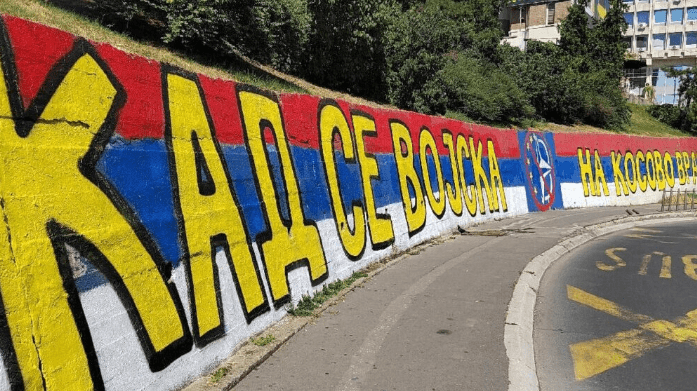
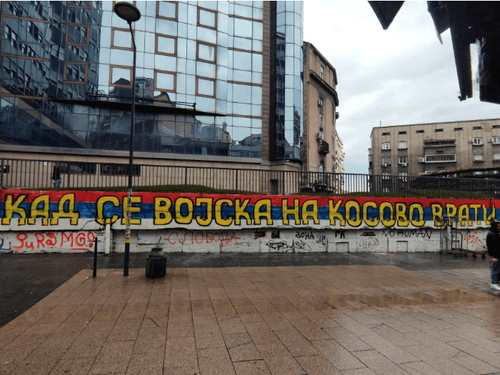
“When the army returns to Kosovo”
One message that spread across Serbia was “When the army returns to Kosovo”, often painted alongside the Serbian flag.
The graffiti appeared in Belgrade and other cities, and its spread was also linked to football supporter groups.
At first glance, someone might say that this is merely a political position on Kosovo.
But context matters.
Serbian and Yugoslav forces withdrew from Kosovo in 1999 following the Kumanovo Agreement, after a war in which serious crimes against civilians were committed. Senior officials of the Yugoslav and Serbian authorities of that period were later convicted before international courts for crimes against Kosovo Albanians.
A message about the “return of the army” is therefore not politically neutral when it is written without any acknowledgement of the history of violence evoked by such a formulation.
For one person, it may be a nationalist slogan.
For another, it may be a threat.
Ratko Mladić as a face on the wall
Perhaps one of the most recognizable examples in Serbia is the murals and graffiti dedicated to Ratko Mladić.
His face and name have appeared on walls across the country for years.
Mladić was finally convicted of genocide in Srebrenica, crimes against humanity and war crimes committed during the war in Bosnia and Herzegovina.
Despite this, parts of public space present him as a hero.
One particularly well-known case involved a mural in Belgrade that activists attempted to remove or paint over, while the location itself remained for a long time a site of political conflict, police presence and gatherings of far-right groups.
Such murals perform a function that goes beyond remembering one individual.
They change the way a crime is discussed.
If a convicted wartime commander is presented as a hero for long enough, his legally established responsibility can begin to appear as merely one possible narrative, while his glorification becomes part of the everyday landscape.
The wall then participates in the politics of memory.
From relativizing crimes to direct threats
Nationalist messages in public space do not always end with the glorification of individuals.
Messages targeting Bosniaks and Muslims, including explicit threats of violence, have appeared in Belgrade, Novi Pazar and other cities.
In such messages, words such as “Turks” are not used to describe citizens of Turkey, but as a derogatory term for Bosniaks and Muslims in Bosnia and Herzegovina and Sandžak.
At that point, there is little room left for debate about political messages or historical positions.
It is intimidation.
The wall becomes a place where one group tells another what could happen to them.
Homophobia written in capital letters
A similar pattern exists in relation to the LGBTQ+ community.
For years, graffiti has appeared in Serbia calling for violence against gay people or directly threatening Pride participants.
Messages such as “Blood will flow through Belgrade, there will be no gay parade” can hardly be reduced to political disagreement.
Their function is very clear.
They create fear.
For an LGBTQ+ person, such a message is not part of a theoretical debate about social values. It is something they see on their way to work, university or their own home.
That is why it is important to understand the difference between an opinion that may make someone uncomfortable and a message whose purpose is to intimidate people because of who they are.
A swastika is not just a scribble
Novi Sad has a strong anti-fascist tradition.
Nevertheless, neo-Nazi, antisemitic and fascist symbols have appeared in the city in recent years, including in periods immediately before anti-fascist gatherings and commemorations of the city’s liberation during the Second World War.
A swastika on a wall is not a political symbol detached from history.
It carries the history of a regime responsible for the mass extermination of millions of people.
Its presence in public space is therefore not the same as that of just any other political graffiti.
And the question is not only who painted it.
The question is also how long it remains on the wall.
If we walk past Nazi symbols for months and nobody removes them, public space sends another message:
that their presence is tolerable.
Migrants as a target
During the migrant and refugee crisis, a similar visual language appeared throughout the region.
Stickers featuring crossed-out mosques, women in burqas and messages such as “Stop migrants” became part of the repertoire of far-right groups.
The ideologies and national symbols may differ, but the pattern is almost identical.
First, a particular group is presented as a foreign body.
Then as a problem.
Then as a threat.
Once such an image becomes sufficiently normal, it becomes much easier to justify discrimination against people who belong to that group.
Wagner on the walls of Belgrade
Extremist visual language in Serbia is not limited to domestic historical and political conflicts.
Symbols of the Russian Wagner Group have also appeared in Belgrade, including alongside markings associated with the organization People’s Patrol.
At the same time, during the war in Ukraine, Serbian-language propaganda content appeared encouraging people to join Russian forces.
This example shows that a wall can also become part of a much broader propaganda infrastructure.
A message that looks like a few strokes of spray paint can be the physical continuation of political campaigns already operating online, on social networks and within extremist communities.
When the wall becomes a tool of political targeting
Graffiti has not been used only against minorities.
Serbia has also seen examples of organized campaigns involving messages painted against opposition politicians and activists.
Thousands of inscriptions containing names and insults aimed at political opponents have appeared on facades, while individual opposition politicians and local activists have been labeled “thieves”, “psychopaths” or traitors.
Messages of hatred and threats directed at activists have also appeared in Novi Sad.
Such campaigns show that graffiti can have another function.
It can become a method of political targeting.
If someone’s name, face or an insult is repeated hundreds of times across a city, the effect is no longer only vandalism.
It becomes a campaign.
Should hate graffiti be removed?
There is a debate over whether hate graffiti should immediately be removed.
One argument holds that it functions as a kind of political barometer of society and that removing it makes it less visible how widespread certain extremist positions actually are.
That argument is not entirely without merit.
Graffiti really can tell us a great deal about a society.
That is why it should be documented.
But documentation does not require a threat to remain on a wall.
A photograph, location, date and record can remain as documentation.
A person who has had a threat written on the facade of their home does not have to look at it every morning simply so that society retains proof that the problem exists.
First: document and report it
One of the simplest steps is to document hate graffiti.
Photograph the message.
Photograph the wider area in which it appears.
Record the date and precise location.
If the message contains a threat, a call for violence or other elements that may constitute a criminal offence, it should be reported to the relevant authorities.
Even when there is little chance that the author will be identified, reporting creates a record of where and how frequently such messages appear.
The number of reports itself can demonstrate that something is not an isolated scribble, but a pattern.
Civil society organizations in Serbia have already used such an approach.
During one campaign mapping murals and graffiti, several hundred requests were submitted for the removal of murals dedicated to war criminals and other hate-based messages.
Second: remove the message
After documenting and reporting it, the next question is simple:
Why should a message of hate remain on a wall?
The longer it remains visible, the longer it continues to perform its function.
If it humiliates a particular community, it humiliates that community every day.
If it threatens, the threat is repeated to everyone who passes it.
Of course, removing graffiti must take account of property ownership and local regulations.
But local authorities, public services and property owners can respond much faster than they often do.
Removing graffiti does not eliminate the ideology that produced it.
But it removes that ideology’s unlimited claim over shared space.
A wall can acquire a different meaning
One response does not have to be limited to painting over a wall.
A wall once used for hate speech can become a space for something else.
In Belgrade, there have been initiatives in which surfaces previously covered with nationalist messages were transformed into murals dedicated to science, culture or other themes.
The same can be done in schools.
At one primary school in Banovo brdo, nationalist messages and calls for violence were removed from the walls, after which students were expected to participate in repainting them.
That distinction matters.
The wall was not merely cleaned.
It was returned to the community.
A city cannot leave everything to activists
In the long term, removing hate graffiti cannot be the job of a few activists carrying buckets of paint.
Local authorities have a responsibility for public space.
Cities can establish simple reporting systems, require public services to respond quickly and train employees who work in public space every day to recognize and document hate speech.
These may include municipal workers, public transport drivers, security personnel, school staff or people responsible for maintaining buildings.
Cooperation with civil society organizations can serve a very practical function here.
One interesting example comes from Vienna, where the organization ZARA cooperated with a construction company on a project called “Graffiti Ambulance”.
The idea was simple.
When racist graffiti appeared on a building, the property owner could report it and the company would remove it.
The organization gained a partner capable of responding quickly.
The company used its everyday professional capacities for something with public value.
Whose city is it?
The most important question in the end is not who wrote one message on one wall.
The question is what kind of space emerges when thousands of such messages are ignored.
Public space is one of the few things we genuinely share.
It does not belong only to the majority.
It does not belong to the loudest political group.
It does not belong to hooligans.
It does not belong to whoever bought the spray paint first.
It also belongs to the person who prays differently, speaks another language, loves someone of the same sex, comes from another country or holds a different political opinion.
For that reason, confronting hate graffiti is not a struggle for cleaner facades.
It is a struggle for people’s right to use their own city without fear.
A wall can be painted over in a matter of minutes.
It is far more difficult to remove a message that society has allowed to go unanswered for years.
Comments