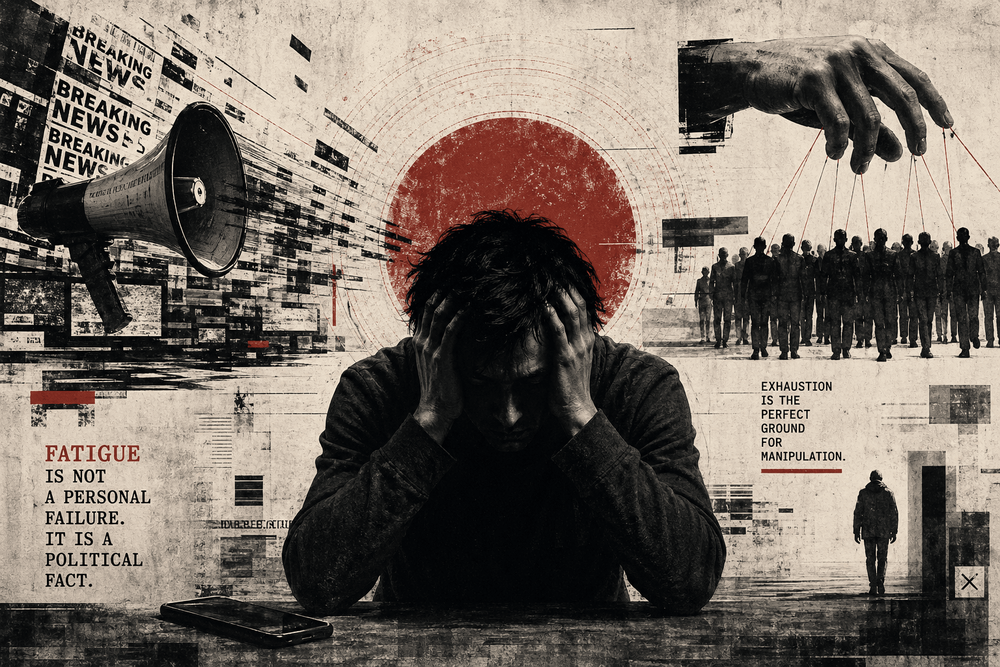
After the noise, silence doesn’t come. What comes is fatigue. That dull, heavy fatigue that doesn’t go away even when the news is turned off, when the phone is put down on the table, when you tell yourself that’s enough for today. It’s not physical exhaustion. It’s the feeling of being constantly exposed, constantly called to react, constantly in a state of readiness.
For a long time, I thought it was something personal. That I was simply overwhelmed with information, that I needed a break, that I was overthinking. But over time, it became clear that the same feeling is shared by people around me, even those who claim they are not interested in politics. In fact, it’s often them who seem the most exhausted.
Fatigue didn’t emerge because too much is happening, but because too much is happening without a clear outcome. Scandals replace one another, affairs open and close, statements are denied and then reaffirmed, but very little ever reaches an end. Everything remains open, unfinished, caught in some kind of permanent process. And after a while, you stop expecting resolution.
That’s when fatigue becomes a political fact. Not an individual weakness, but a condition of society. A tired person doesn’t look for change, but for relief. They don’t seek justice, but normality. And most importantly, a tired person is willing to lower their standards just to stop feeling tense.
I remember a conversation where someone told me: “I know it’s not right, but I just can’t anymore.” That sentence stayed with me more than any slogan. There is no cynicism in it, no ideology, no justification. Just an admission of exhaustion. And in that exhaustion lies an enormous political potential, one that is very often abused.
Because fatigue does not produce rebellion. Fatigue produces adaptation. People begin to choose the lesser evil not because they believe in it, but because they don’t have the strength to fight the greater one. They begin to stay silent not because they agree, but because they no longer see the point in repeating the same sentences that change nothing.
At that point, politics stops dealing with convictions and starts dealing with thresholds of endurance. How much people can still bear. How far things can be pushed before they break. And instead of being seen as a problem, this is often treated as an advantage. Stability is built on exhaustion, not on trust.
The opposition often misreads that fatigue as indifference. As lack of interest, as laziness, as cowardice. And those in power often use it as proof that “there is no alternative,” that people are tired of change, of experiments, of instability. In both cases, fatigue is not understood, but instrumentalized.
The most dangerous moment is when people begin to feel ashamed of their own exhaustion. When they start to think they are bad citizens because they don’t have the strength to be constantly engaged. As if the problem lies in them, rather than in a system that demands constant mobilization without any real result.
And that’s where the circle from the first chapter closes. Noise produces fatigue. Fatigue produces withdrawal. Withdrawal creates even more space for noise. And everything repeats, only with lower expectations and weaker standards.
But fatigue is not the end of the story. It is a signal. A signal that something is not working as it should. That energy is being wasted in the wrong way. That people are being asked to constantly react, instead of being allowed to participate in a meaningful way.
This book does not ask the reader to return to a combative stance. It doesn’t even ask for optimism. It simply asks that fatigue be recognized as a political fact, not as a personal failure. Because only when we stop blaming ourselves for being exhausted can we begin to ask serious questions about the system that makes us this way.
You don’t exit this fatigue by getting louder. You exit it by changing the rhythm, the criteria, and the expectations. And to understand that, we first need to understand the tool that holds it all together. The half-truth.
Comments