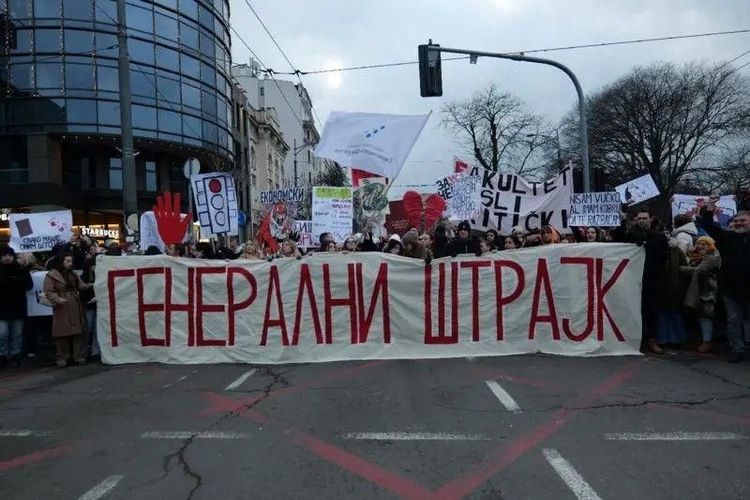
The student movement in Serbia, or more precisely the Student List, has for some time been labelled as traitors, “Ustaše”, “Bolsheviks” and “foreign mercenaries”, as well as a force that will “subordinate Serbia to the interests of the West and NATO”. The fact is that the Student List is accused of treason, of acting against its own people and of promoting “liberal values”, while simultaneously being accused of communist activity and portrayed as an extremely left-wing grouping.
One cannot help noticing a considerable similarity between the conduct of today's pro-government media and Nazi propaganda during the 1930s. As with the pro-government media in Serbia, almost everyone is an enemy except the SNS and the unquestionable leader, Aleksandar Vučić. Nazi propaganda at the time attacked the liberal West, communists and those it declared traitors to the German people simultaneously; today's pro-government media in Serbia apply a similar pattern to students, presenting them at one moment as destroyers of the state and at another as extremists, foreign mercenaries or instruments of external influence.
HOW THE STUDENT MOVEMENT BYPASSED THE ECONOMIC LEFT
The author expresses a certain degree of understanding as to why students refuse to embrace particular ideological positions, such as European integration, NATO membership, the introduction of sanctions against Russia, recognition of Kosovo, the question of the genocide in Srebrenica, or other issues that are sensitive for the majority of the Serbian people. However, it remains a mystery why they simultaneously refuse to embrace a left-wing narrative in its economic sense, which essentially enjoys considerable support among Serbian citizens.
At this point, the author distances himself from taking an ideological position on questions such as Serbia's European integration. He does not justify the student movement's decision but attempts to understand it. Put simply, the vast majority of Serbian citizens hold right-wing positions in political and value-based terms, and any movement founded on opposing values would probably be doomed to fail.
However, this is precisely why the question arises of why the movement refuses to embrace what the majority of citizens already support in economic terms, regardless of their political and ideological orientations. Although most of the population is right-wing in political and value-based terms, Serbian citizens largely support economic ideas traditionally associated with the left: strong public healthcare and education, better conditions for workers, stronger labour rights, and more accessible and affordable rents and housing.
It therefore remains unclear why the student movement did not attempt to incorporate these ideas into its programme. If the aim was to build a movement with broader social support, economic issues could have been precisely the area in which existing political and ideological divisions might be overcome. Rejecting a left-wing economic programme is thus not merely an ideological decision; it is also a missed opportunity to mobilise large numbers of citizens around issues that directly determine their everyday lives.
THE STUDENT MOVEMENT AND THE END OF SPACE FOR A NEW LEFT
Instead, the student movement chose to offer centrist economic positions, or a relatively moderate version of a non-liberal economy, alongside an independent judiciary and a system intended to stop corruption. The only conclusion that can be drawn is that, somewhere within the student movement's decision-making process, the neoliberal concept prevailed. The author assumes this may have been done out of “fear that the student movement would be labelled communist”, but the removal of left-wing policies also meant removing left-wing economic policy.
After almost two years of the student movement, the only possible conclusion is that this was a conscious and deliberate decision, rather than an accident or an unintentional omission of left-wing economic policy, which is, moreover, very popular among Serbian citizens.
The problem with such a decision is that it could have long-term consequences for the possibility of establishing left-wing movements in the future. It could also contribute to a form of “institutionalisation of centrist or centre-right politics” as the only option capable of stopping the SNS or some future right-wing and populist party in Serbia.
In this context, the purpose of this article is to analyse how the student movement occupied the space that might have belonged to the creation of an authentic left-wing movement, and how, perhaps for that very reason, it has further narrowed the possibility of such a movement emerging in the future.
DIRECT DEMOCRACY WITHOUT ECONOMIC DEMOCRACY
The first point that must be mentioned in this analysis is the return of direct democracy to Serbia's political life. Collective decision-making, plenums and horizontal decision-making structures had not been seen in Serbia since the abolition of the self-management system in 1990. After 36 years, plenums, citizens' assemblies and delegation as a form of political process have returned to political life. The return of these forms of decision-making to Serbia's public sphere has dramatically changed the political landscape. This explains the surprise of citizens, political parties and the wider public, as well as their confusion about how the student movement operates. The representative and leader-centred democracy in which we have lived for the past 36 years simply does not understand direct democracy as such. This makes the numerous questions asked of the student movement understandable: Who is in charge? Who makes the decisions? Why is there no leader? And so on.
Those familiar with the delegate system from the period of self-management in the Socialist Federal Republic of Yugoslavia understand why student representatives cannot speak on their own behalf and why they cannot depart from the policies adopted at a plenum, which the “delegate” has been authorised to communicate. In classical representative democracy, representatives of political parties communicate their parties' positions, but they can also act relatively independently, influencing party positions by expressing their own views in public. In a delegate system, however, a delegate speaks exclusively about positions for which the “delegation” appointing them to higher bodies of authority has given authorisation. Similarly, in plenary or direct democracy, student representatives cannot say anything other than what was agreed at the plenum that appointed the representative and gave them the mandate to speak.
This radical form of democracy, which is far more participatory than representative democracy, has certainly brought a kind of “refreshment” to Serbia's stagnant political landscape. Direct forms of democracy, the delegation of issues and candidates, and collective decision-making have traditionally been associated with left-wing movements, democratic socialist movements, or even socialist forms of organisation such as the system of workers' self-management in Yugoslavia.
The one thing that was missing, perhaps the crucial element, is that students never called for or encouraged the establishment of workers' assemblies or councils within companies. Although there were calls for a general strike, the student movement never seriously turned towards workers' assemblies or any form of economic democracy, meaning the inclusion of workers and businesses in their own forms of protest against Serbia's ruling regime.
It is precisely here that it becomes clear that left-wing forms of democracy with high levels of participation are merely a framework that has not been filled with left-wing economic issues, but rather with neoliberal and centrist policies. Although the decision-making system itself may, conditionally speaking, be described as left-wing because it is based on high participation, its political substance has remained right-wing, while its economic substance has remained neoliberal or centrist.
THE DSS WITHOUT KOŠTUNICA: THE IDEOLOGICAL PROFILE OF THE STUDENT MOVEMENT
In broader social terms, the student movement most closely resembles communitarianism. For the sake of a more precise definition, we must distinguish between collectivism, communitarianism and communism. Collectivism, communitarianism and communism are not the same, although they all begin from the idea that a human being is not an entirely isolated individual.
Collectivism places the collective — the nation, class, religious community or another group — ahead of or above individual interests, viewing the individual primarily as part of a wider whole. Communitarianism emphasises the importance of a particular community, shared values, mutual responsibility and belonging, but does not demand the abolition of individual rights, private property or liberal democracy. Communism, by contrast, is a specific economic and political ideology founded primarily on a critique of class relations, private ownership of the means of production and the capitalist economy, with the aim of establishing a classless society.
Thus, collectivism can be nationalist or communist, communitarianism can be conservative or progressive, while communism is a much narrower and historically defined concept. In other words, collectivism concerns the relationship between the individual and the collective, communitarianism the relationship between the individual and the community, and communism classes, ownership and the economic order.
Therefore, in ideological terms, the student movement can approximately be defined as a form of conservative communitarianism. A strong sense of belonging to the community is emphasised, but the substance is not progressive; rather, it is conservative and seeks to preserve existing social and, especially, economic relations. At the same time, the movement is legalistic, sceptical towards the EU, considers Kosovo part of Serbia and opposes introducing sanctions against Russia.
In ideological terms, it is idealistic-legalistic, because legalism, or the insistence on respecting rules and institutions, has practically been turned into an ideology. In social terms, the movement belongs to the conservative communitarian type, while economically it is neoliberal, with certain elements of a welfare state. Since it is ideologically right-wing, we can also speak of certain elements of Christian social democracy in its economic orientation.
Following this relatively brief analysis, the positions supported by the student movement most closely resemble those of the Democratic Party of Serbia during the period when Vojislav Koštunica was its president. Thus, although it uses direct democracy, plenums and certain elements of the delegate system, the student movement is filled with right-wing substance, both politically and economically.
LEFT-WING METHODS, NEOLIBERAL OUTCOME
Furthermore, it is important to emphasise that methods of direct democracy have occupied a space that could have been filled by a left-wing movement, yet the outcome of plenums and direct democracy has been a moderately right-wing movement. This therefore demonstrates that left-wing forms of participation do not automatically produce left-wing politics. Plenums, direct decision-making and horizontal organisation can be merely methods; the substance is determined by values and political objectives. If right-wing substance is inserted into left-wing methods of participation, the result will inevitably be right-wing as well.
There is a certain possibility that the outcome of these models of participation will lead to their destruction the moment someone attempts to introduce left-wing economic issues for deliberation. If we followed the principles of dialectical materialism, the very introduction of class and economic relations into the discussions would probably lead the movement to begin supporting left-wing ideas in political terms as well — condemning Russian aggression against Ukraine, condemning the genocide in Gaza, recognising the genocide in Srebrenica, and so on — and thereby probably losing support among citizens.
For precisely these reasons, the author suspects that someone within the movement understands this danger and, for that reason, does not allow economic and class relations to become a topic of discussion at student plenums. However, this closes the space for a left-wing movement to operate, at least in economic terms, depriving society of that political option and “condemning” it to some form of neoliberal or moderated neoliberal economy. This also prevents the possibility of stronger social policies, let alone the establishment of a welfare state capable of supporting the poorest sections of the population.
We should add that if a political movement has abandoned the class question and economic democracy, direct democracy can easily be left without social substance. Who makes decisions becomes more important than what is being decided and in whose interests. This establishes the idea in society that there is no alternative to the economic model and that all we can have is a “fairer society”, a “fight against corruption” and a strong, independent judiciary.
But even with a strong and independent judiciary and strong democratic institutions, under a neoliberal economic model, we will continue to see wealth accumulating in the hands of a handful of people, while the majority work hard and live relatively poorly. The United States is a good example: although it has a strong political democracy, it does not have a developed awareness of economic democracy. Its two strongest parties are actually very similar in economic terms, because neither questions the existing economic system. The United States is a country with developed political democracy, but it is simultaneously a country with major economic inequalities and significant differences in income. This situation has a considerable effect on society, resulting in persistent tensions, high levels of racism and widespread violence.
All of this is the product of a widespread belief in “trickle-down” economics. This economic approach begins from the idea that, if wealthier individuals and companies are allowed to retain a larger share of their money through lower taxes, less regulation and greater profits, that money will gradually “trickle down” to the rest of society through investment, new jobs and higher wages. The problem is that this mechanism is not automatic: an increase in profits and wealth at the top does not in itself guarantee higher wages, better-quality jobs or a more even distribution of income, because additional wealth can be retained, saved or invested primarily in assets that further increase the concentration of wealth.
This is why the central criticism of the trickle-down approach is that an increase in the wealth of the richest is not the same as an improvement in the living standards of the majority. An economy can grow while most of the benefits remain concentrated at the top, and the costs of lower taxes and reduced public revenue can be shifted onto the rest of society. Thus, American society is one of the wealthiest, but also one of the most unequal among developed Western countries.
WHEN A “NORMAL STATE” REPLACES THE WELFARE STATE
The next argument concerning the suppression of space for a left-wing movement is that student mobilisation has demonstrated just how weakened the traditional left has become in Serbia. The space of public discontent was not filled by an organised left, but by a movement that builds its political identity primarily around opposition to the existing system. However, anti-establishment or anti-system politics are not the same as left-wing politics. Rejecting political elites can lead just as easily to the left, the centre or the right. In the case of Serbian students, almost all political elites were rejected, while a right-wing narrative was simultaneously established as the dominant framework.
Students have managed to replace questions of economic injustice, class politics and economic relations with a general moral demand for a “normal state”. This demand may be politically understandable, but it is fundamentally insufficient: it says nothing about how society should distribute money, power, risks and social resources. In this way, the left has lost one of its fundamental reasons for existing. In fact, the student movement has demonstrated that it is possible to mobilise a large number of people without providing a clear answer to the question of how wealth and power should be redistributed in society.
Without a clear position on labour, capital, public services, inequality and the welfare state, participatory democracy remains a political form without economic transformation. Precisely because of the enormous number of people the student movement has managed to mobilise, the space for the emergence of a stronger left-wing movement has become even narrower. The appearance of an authentic left could easily be portrayed as a “betrayal of the students” or as a “Trojan horse planted by Vučić's regime”. In this way, a movement that is not left-wing can, paradoxically, become an obstacle to the emergence of a genuine left.
The fact is that Serbia needs a new left-wing party, but a new left cannot emerge solely from dissatisfaction with Aleksandar Vučić and his rule. What is needed is a positive vision of the society that should emerge after political change. If a movement's only common denominator is being “against the government”, then the disappearance of that opponent also removes a large part of its internal political cohesion. The left, however, must offer an answer to what kind of society it wants to build, rather than merely what kind of government it wants to overthrow.
The paradox is that rejecting representative democracy in the name of direct decision-making may make the creation of a modern left even more difficult. The left must build institutions, not merely challenge them. It must develop welfare-state institutions, strengthen trade unions, protect public services and establish mechanisms of economic democracy. The student movement, which is primarily anti-system, often moves in the opposite direction through its attitude towards welfare-state institutions.
This is particularly evident in its attitude towards trade unions. In students' public appearances, unions have often been presented as “collaborators of Vučić's regime”, which, regardless of whether criticism of particular trade-union confederations is justified, also marginalises the very idea of trade-union organisation. This poses a serious problem for any future left, because unions are not merely another part of the political system that can be controlled by the authorities; they are among the key institutions through which workers can protect their interests against the state and capital.
At the same time, the attitude towards military, police and security structures reveals a different pattern. Although students recognise that the SNS has established control over significant parts of these systems, they generally see the problem as one of political control, while questioning the nature and structure of the security sector itself far less. In other words, the assumption is that these systems should remain in place, only without SNS control. Such an approach overlooks the fact that the problem of Serbia's security sector is not merely a question of who currently runs it, but also of its institutional structure, political dependence and longstanding connections to centres of political and economic power, which have very often also been involved in criminal activity.
It is precisely at this point that one of the greatest paradoxes of the student movement becomes visible: it simultaneously displays certain features of a right-wing and potentially authoritarian political movement, while weakening or questioning institutions that the left should be building and protecting. Instead of opening space for a stronger welfare state, trade unionism, economic democracy and the protection of workers' rights, anti-system logic views all institutions primarily through the question of whether they are controlled by the existing regime.
This creates another important shift: instead of asking “what kind of institutions do we want?”, the political question becomes simply “who controls the institutions?”. And that is not enough for the left. The left does not exist merely to change the people at the top of the state, but to change power relations within society. If the government changes while the relations between labour and capital, the distribution of wealth and the weakness of social institutions remain the same, political change may be substantial, but social change remains limited.
STUDENTS AND THE CLOSING OF SPACE FOR THE DEMOCRATIC LEFT
The greatest danger the students have created for the emergence of a new left-wing movement does not come from a right wing that openly attacks it, as would be the case with the SNS, but from a movement that adopts the left's organisational methods while setting its political objectives aside. Precisely for that reason, by using left-wing methods, students have simultaneously removed the substance of left-wing politics and offered Serbian citizens a choice between two options that do not differ very much ideologically. De facto, citizens now face a choice between the SNS, which pursues a populist but still neoliberal economic policy, and a kind of Koštunica-era Democratic Party of Serbia, which supports a moderated neoliberal economic policy.
This brings us to the conclusion that the student movement may not have suppressed the left because it is openly right-wing, but because it adopted its most recognisable political forms — participation, horizontality, direct democracy and distrust of institutions — while removing what makes the left the left: class politics, the welfare state, economic redistribution and the question of relations between labour and capital.
To put it even more sharply, we could say that the student movement, by using methods historically associated with the left, has closed the space for the emergence of a new left: it has occupied the space of rebellion without offering left-wing politics; it challenges authority without building institutions; it speaks of political democracy without raising the question of economic democracy.
The author wishes to emphasise that there is a strong likelihood that the student movement has, for an indefinite period, closed the space for the creation of a left-wing movement based on left-wing forms of participation. Yet this may open space for something else — a form of authoritarian left-wing movement. Because when the space for a democratic left closes, the left does not necessarily disappear; it may attempt to return without democracy. And that would be far more dangerous for society: for the left, for the right and for democracy itself.
HOW AN AUTHORITARIAN LEFT EMERGES
Thus, the student movement, which has closed the space for the emergence of a democratic left-wing movement, has not eliminated the need for the left; it may instead create space for a much more dangerous form of it: an authoritarian left. Suppressing economic issues does not eliminate dissatisfaction; it merely pushes it beneath the surface. Wages, housing, insecure work, inequality, ownership and relations between labour and capital will not disappear because politics remains silent about them. If the democratic left does not offer a way to address these problems through institutions, unions, social policy and redistribution, economic anger may be taken over by those offering simpler answers. The suppression of the left may therefore produce precisely the opposite of what is expected — not less left-wing politics, but a less democratic left. This is dangerous for both the left and the right: the former loses its democratic substance, while the latter gains a new enemy through which it can further fuel fear and polarisation. Economic problems that politics persistently suppresses do not disappear. They remain silent, accumulate and may one day begin speaking the language of radicalism — without democracy, without compromise and, ultimately, through violence.
One extreme form of the left that is not democratic may, at the opposite end, also produce an extreme right, thereby creating a new form of extreme polarisation in society. This brings us to the problem of parties and movements that constantly strive towards the political centre or confine themselves to only one side of the political spectrum. An excessive concentration of parties and movements in the political centre or on the political right opens space for extreme and radical forms of both the left and the right. That is why it is dangerous for a stable democratic society when the entire political space narrows and certain ideas are excluded in advance from legitimate political competition. If the democratic left has no room to speak about economic inequality, labour, capital and the welfare state, those issues will not disappear. Someone else will simply raise them one day — much more radically, much more simplistically and without democratic constraints. At that point, the problem will no longer be merely a weak left. It will be a society that, in attempting to prevent one form of extremism, has itself created the conditions for another.
ECONOMIC DEMOCRACY AS A DEFENCE AGAINST AUTHORITARIANISM
Finally, it is extremely important to articulate economic issues and offer society another option alongside neoliberal economics, because doing so opens space for democratic debate about the economic system and reduces the possibility of that vacuum being filled by a far more radical alternative, one that would not be prepared for negotiation and compromise but would instead be radically opposed to the existing economic order.
A similar situation occurred with Vučić and the SNS, who for years suppressed and undermined opposition activity as well as media freedoms. The result was not complete SNS dominance, but the creation of an anti-system movement whose primary objective is to remove the SNS at any cost and potentially also to question political parties and political processes as such.
This is precisely why the articulation of economic issues matters. If the democratic left does not offer a clear alternative to the neoliberal economic model, that vacuum may be filled by an authoritarian and radically left-wing movement that no longer seeks to change the economic system through institutions, democracy and political compromise, but instead wants, at any cost, to suppress or abolish any form of economy based on private property and capital. An economic alternative is therefore not merely a question for the left; it is also a question of preserving the democratic order. The more space there is for economic democracy and debate about economic programmes, the less space there will be for economic dissatisfaction to become the foundation of political radicalism one day.
Comments