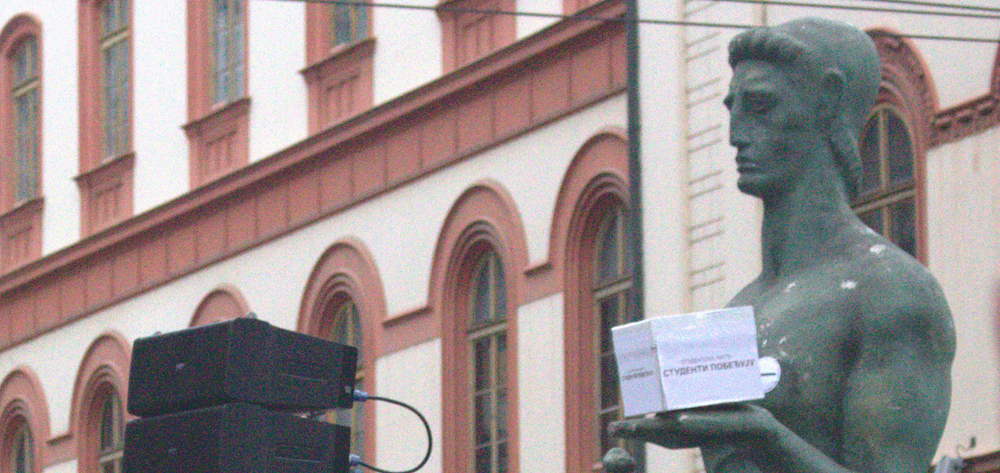
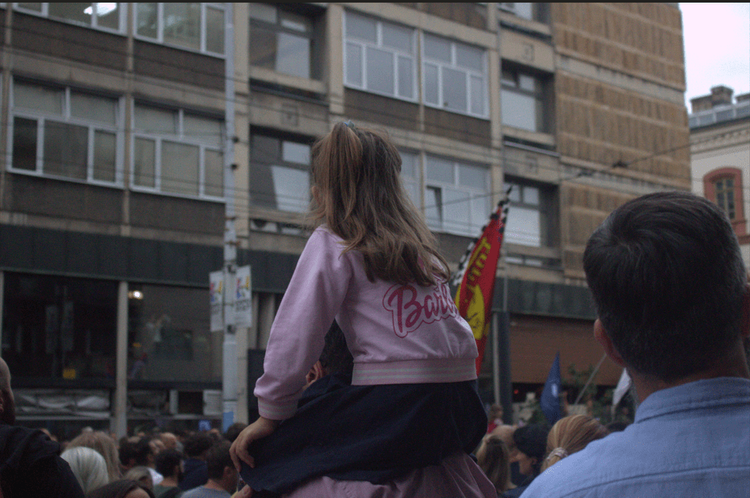
On Students' Square, on 14 September, among faculty flags, bikers, children sitting on their parents’ shoulders and people waiting for the procession to begin, stands Pobednik.
Not the one from Kalemegdan. This one has been brought down from the column, almost to the height of the people around it. In its hand it holds a white box that reads: “Students Win”.
A few hours later, the figure will move through central Belgrade together with students and citizens carrying boxes with signatures for the electoral list. It will travel from the Rectorate through the central city streets to the Republic Electoral Commission at 14 Kralja Milana Street. The students themselves announced the event as a “victors’ walk” and a “path of the victor”. In their invitation to citizens, they wrote: “We will carry the signatures together, because this is a shared struggle, just as the victory will be.”
At the head of the procession was precisely that figure.
It is difficult to view the choice of Pobednik as accidental scenery.
Its name fits almost perfectly with the name of the list, “Student List – Students Win”. But the more interesting part begins when we look at who that man on Kalemegdan actually is, why he was created and how, over the course of a century, what he represents has changed.
Because Pobednik has already once had to change its place, its audience and its political meaning.
The man who was supposed to stand on Terazije
Today’s Pobednik belongs so naturally to Kalemegdan that it is difficult to imagine that it was never originally supposed to be there.
In 1913, after the Balkan Wars, the Belgrade municipality decided to erect a monument to the victory of the Serbian army. The commission was given to Ivan Meštrović. His idea was much larger than the figure we know today: a monumental fountain on Terazije, with lions, a basin and a column, on top of which a nude male Victor would stand.
In one hand he held a sword, in the other a falcon. War and peace.
The First World War interrupted the project. When the idea returned in the 1920s, so did the controversy.
Belgrade seriously quarrelled over one naked man.
Part of the public believed that a nude figure did not belong in the city centre. Others objected that Pobednik did not have a sufficiently clear national marker, that he was not a soldier wearing a šajkača, a uniform or some other easily recognizable Serbian symbol. In the public controversy of 1927, people debated his nudity, artistic value, identity, the place where he should stand and even the direction in which he should look.
In the end, he did not get Terazije.
He was installed in 1928 on a high column in the Upper Town of the Belgrade Fortress, on the tenth anniversary of the breakthrough of the Salonika Front. Over time, he became one of the most recognizable symbols of Belgrade.
That is precisely what is interesting about public symbols.
Their meaning is never completely frozen at the moment they are cast in bronze.
Pobednik was conceived after the Balkan Wars. The First World War changed the context. The Kingdom of Serbs, Croats and Slovenes changed the political framework. Belgrade changed his location. Time transformed him from a controversial naked man into a city symbol that almost no one experiences as a scandal anymore.
Then the students took him into their hands again.
Pobednik no longer looks down on the city
In Avangarda’s photographs, perhaps the most interesting change is one that the organizers probably did not even need to explain.
The original Pobednik stands high above the people.
The student Pobednik stands among them.
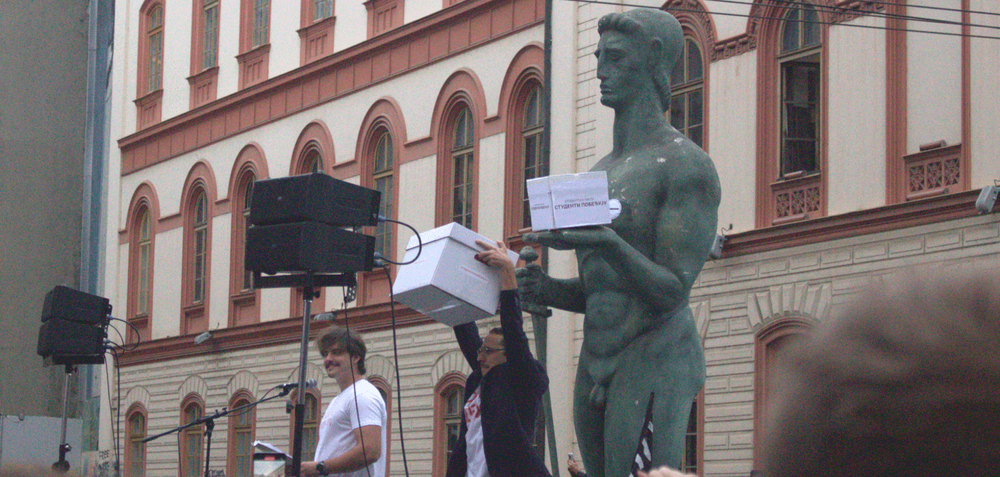
There is no high Doric column. No distance. People walk around him. A child points toward him. Faculty flags stand behind him. In another frame, his silhouette moves through the crowd. In the next, he is no longer the dominant object of the photograph, but part of the procession.
The symbol has come down to the street.
That does not prove what the authors of the performance had in mind. I have not found a publicly available text in which they explain in detail why they chose Pobednik. But what the organizers themselves called “The Path of the Victor”, together with the name of the list “Students Win” and the message that the “shared struggle” would end in victory, provides enough material for interpreting the performance.
In that image, victory is no longer a completed historical event that is being commemorated.
It becomes a political claim made in advance.
The students are only entering the electoral contest, yet their visual language already speaks from the position of the victor.
That is a classic function of political performance. It does not merely describe what exists. It tries to create an image of what its authors want the audience to imagine as possible.
History made a small loop that day
There is a detail that makes the entire event even more interesting to read.
Pobednik was originally supposed to stand on Terazije.
The student procession with his figure started from the Rectorate, passed through Republic Square and by the Albania Palace, then continued through the central city area toward Kralja Milana Street and the headquarters of the Republic Electoral Commission. Reports from the scene recorded that the procession reached Republic Square and the Albania Palace at around 18:15, then continued toward the Presidency and the RIK.
In other words, almost one hundred years after the centre of Belgrade had been denied to him as a permanent location, Pobednik, in his student version, once again found himself precisely in that space.
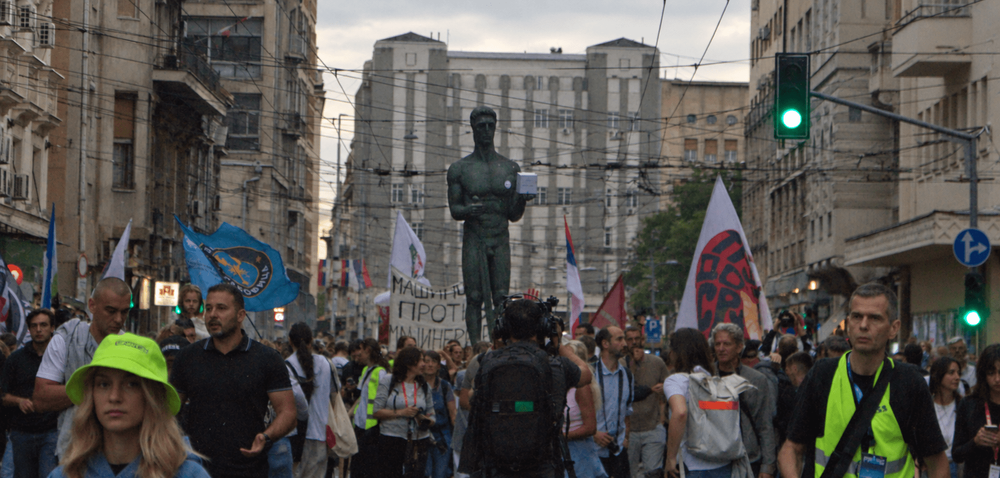
There is no evidence that the route was chosen in order to create this historical reference. It is entirely possible that it was simply the most logical route from the Rectorate to Kralja Milana Street.
But symbols do not always depend on the intentions of their authors.
Sometimes the city itself writes part of the story.
The figure over which Belgrade argued in 1927 about whether it should be allowed to stand on Terazije was watched by Belgrade in 2026 as it passed through the city centre carrying a student electoral box.
It is difficult to imagine a better illustration of the fact that the meaning of a monument is never finished.
Sword, falcon and electoral box
Meštrović’s Pobednik carries a sword and a falcon.
In the symbolic language of the time, war and peace.
On the student figure that appeared in front of the Rectorate that day, the box was pushed into the foreground. The inscription on it directly connects the city symbol with the electoral list.
That substitution may be the clearest part of the entire performance.
Military victory shifts into a civilian political contest.
A symbol of combat shifts into procedure.
And procedure, however less spectacular it may appear, was ultimately the only thing that actually mattered that day.
This can be seen most clearly in the final photographs from the series.
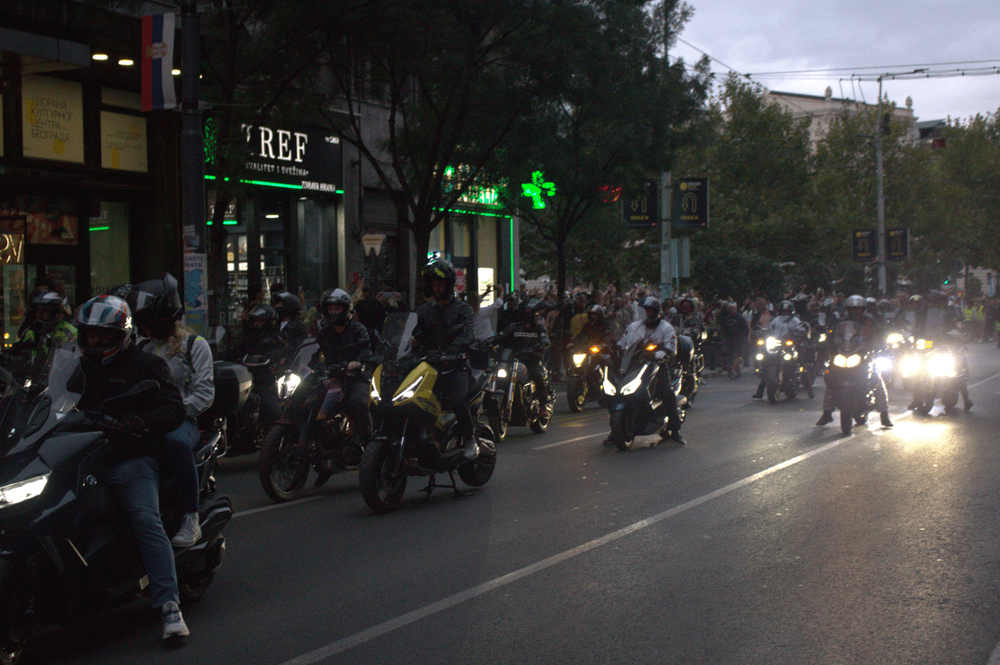
Outside there were flags, motorcycles, music, crowds and Pobednik.
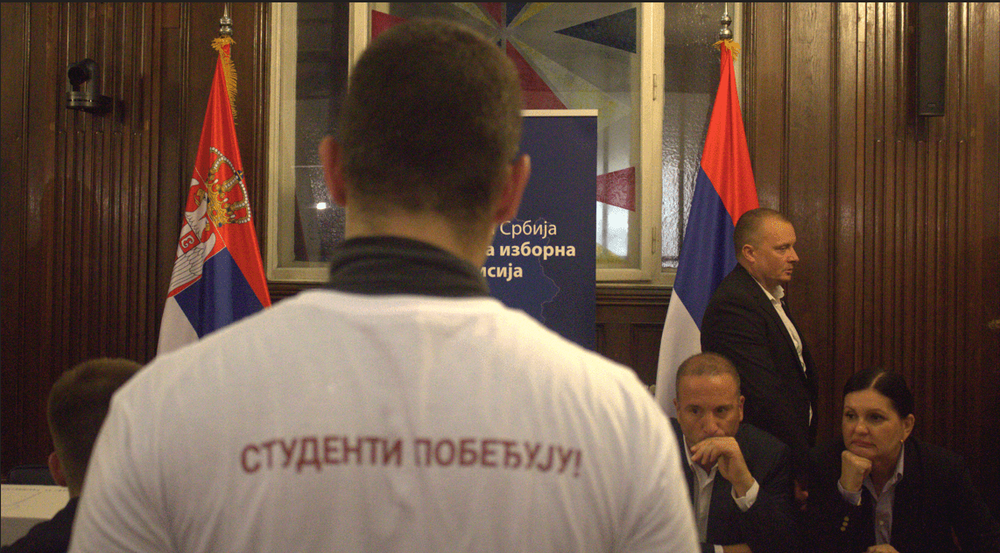
Inside remained fluorescent lights, a long table, members of the Republic Electoral Commission and white boxes containing documentation.
The students carry them in one by one.
In one photograph, the back of a white T-shirt reads “STUDENTS WIN” in large red letters, while a few metres ahead sits a member of the Commission.
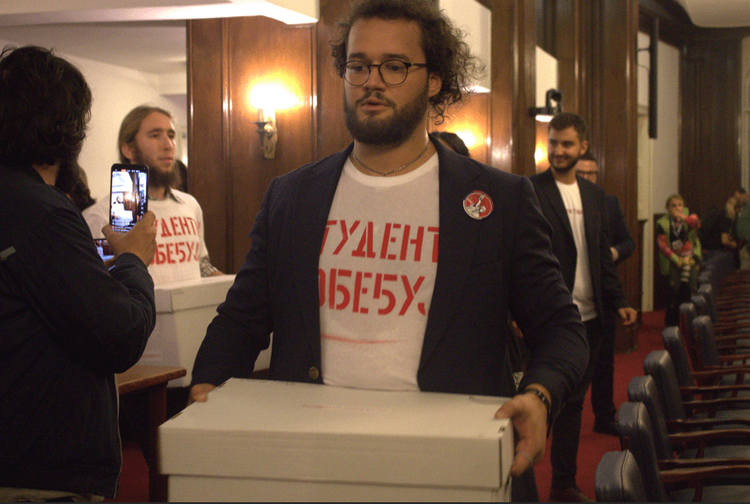
That is the moment when the slogan has to give way to the rulebook.
A day later, on 15 September, the RIK proclaimed the electoral list “Student List – Students Win” for the parliamentary elections scheduled for 25 October 2026.
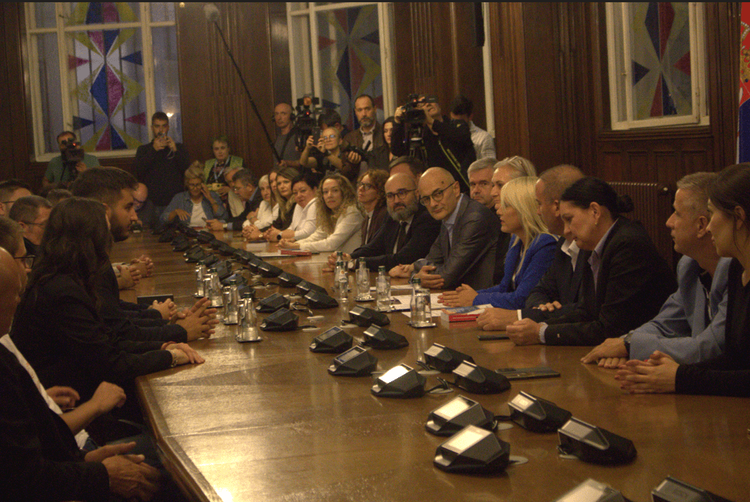
Pobednik could come as far as the door.
From there, the documentation had to take over.
Whose Pobednik is it?
There is also a more serious question behind the entire aesthetic.
Pobednik is not a politically empty symbol.
He emerged from the culture of remembrance surrounding Serbian military victories, and his final installation is connected to the breakthrough of the Salonika Front. The student procession set off to “Marš na Drinu”. War veterans, national flags, faculty flags, bikers and citizens of different generations appeared in the procession. In front of the RIK, brass musicians played and people danced the kolo.
That choice of iconography can be read in several ways.
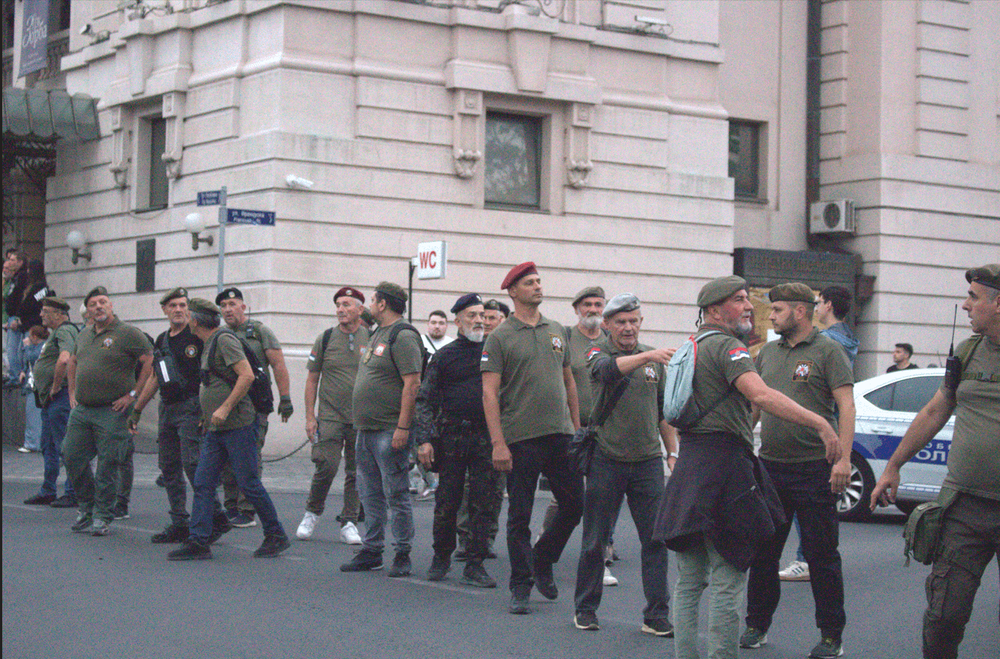
One reading sees an attempt by the student movement to take classical state and national symbols out of party ownership and present them as common symbols. In that interpretation, the flag, Pobednik or “Marš na Drinu” do not belong to the government, the opposition or a single ideological camp.
A second reading can be more critical. The language of victory, military historical symbols and marches carry meanings that go far beyond a single election campaign. For part of the audience, they can generate a sense of togetherness. For another part, they can evoke nationalist or militarized political aesthetics.
Both readings have a basis.
Pobednik is a good symbol precisely because he has never been entirely simple.
Even in 1927, people could not agree on what exactly he represented.
Some wanted a Serbian soldier.
Meštrović created a universalized male figure without the expected national costume.
Some saw scandal in him.
Others saw art.
Some saw victory over the Ottomans.
Later, victory in the First World War.
Today tourists mostly see Belgrade.
And on 14 September, part of the city saw a student electoral message in him.
A monument that can change meaning and remain the same
Belgrade is full of monuments that passers-by barely notice anymore.
Pobednik does not have that problem.
His silhouette works on a refrigerator magnet, a tourist postcard, a protest banner and in political performance.
That is the power of a successful public symbol: recognizable enough to immediately carry meaning, yet open enough for every generation to try to add something of its own.
On 14 September, the students did not alter the original monument.
They created their own version.
They brought him down from Kalemegdan, put a box in his hand and led him toward the electoral commission.
The original remains on his column.
But for several hours, another version of Pobednik walked through Belgrade.
The one on Kalemegdan looks across the Sava and the Danube.
This one looked toward 14 Kralja Milana Street.
One preserves the memory of victories from the previous century.
The other was used as an image of a victory that still has to be tested at the ballot box.
That difference matters.
Because on 25 October, Pobednik will no longer be in the procession.
There will only be the ballot paper.

Comments